

These sure aren’t North American birds!
Mark Roberts and Lara Donovan are the heart and soul of GoWeb1. They not only administer this website, but they also hold my hand, teach, encourage me through all my ideas, and they make all my changes. And keep in mind that technology and I have an uneasy relationship at best, so this has not been the easiest job for them. They are both patient and never lose their sense of humor. Without the two of them, this website would not be, and I am eternally grateful for them because it has allowed me to share birds and gardening with you and in return, I learn from all of you. (Click here for the link: GoWeb1)
Both Mark and Lara took trips this spring and actually looked for birds while travelling – and I don’t think either of them would call themselves birders. Both told me that after working with me all this time, they have become interested in a world they never really noticed before – bird world! They took photos for me – enjoyed it! – and sent them to me and now I want to share them with you. First Mark.
Mark just got back from an African safari with his mother. Visiting the Serengeti to view all the animals had been her lifelong dream, but try as she would, she just never could get a trip organized. And then a good friend of Mark’s became a travel agent and was planning a trip to the Serengeti including her husband and his mother. As Mark told me – the timing was just perfect. Unfortunately, Mark’s wife could not go, but he and his mother went, and I think had a trip of a lifetime. Mark even said his mother’s mobility improved on the trip and she returned home much stronger. Traveling can be just the tonic needed to lift the spirits! Before leaving, Mark upgraded his cell phone in order to take better photos, invested in new binoculars, and said he had a whole new perspective on birds from helping me with this website. I thank Mark and GoWeb1 for these photos!
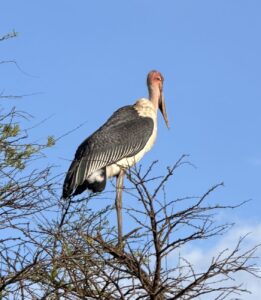
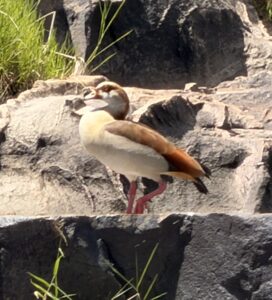
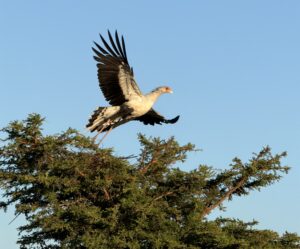
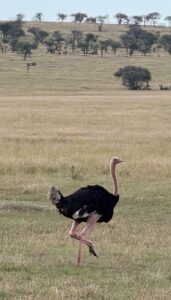
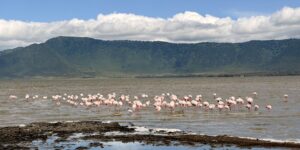
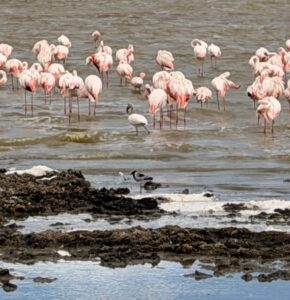
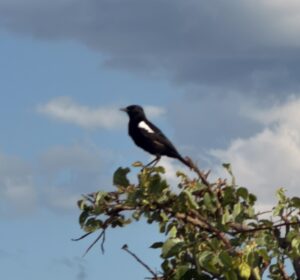
←This bird really surprised me. I checked blackbirds and even starlings and crows – nothing resembled this bird. I looked at its body shape with its beak, how and where it was perched, and wondered…….. I looked down the extensive list of birds in Tanzania that is on Wikipedia and found that chats are not placed with warblers as they are in our U.S. and Canada field guides but are grouped with flycatchers. And there are over a half dozen chats in Tanzania. That is where I found it – this is a Sooty Chat (Myrmecocichia nigra). I NEVER would have thought about chats if it was not for this bird’s posture right on top of the branch – very chat!
I have never been to Africa and what I know about birds in Africa can be put on the head of a pin. I spent some time with the bird list from Wikipedia and looked at additional photos and these are my best guesses as to the identification of each of these birds – although I will stake my reputation as a very good birder that that is an ostrich! I included the Latin names so all of you would be sure what bird I meant. Common names can differ from place to place – these birds are in Africa and I am identifying them from photos here at my desk in central Illinois. The Latin is the same regardless of where you are in the world. If you are better versed on African birds and see that I have made a mistake, please tell me and I will correct it in a future blog. But I will tell you one thing I am absolutely sure of…..
Identifying these birds took me back to my first few days of birding at J.N. “Ding” Darling National Wildlife Refuge on Sanibel Island in Florida*. There I was on Day 2, armed with my binoculars, a note pad and a pencil – sitting on a bench at a good spot of trees, undergrowth, grasses, shrubs. And was totally frustrated. I could not get my binoculars on any of these songbirds, I had no idea where to even begin to look in the field guide, and all the birds were brown! I felt just that way when I tried to ID these photos from Mark.
In our U.S. and Canada field guides, there are many divisions of birds – some are pretty darn funny or just plain odd to my ear**:
Coots Shearwaters Nightjars Trogons Tyrant Flycatchers and Becard
Accentors Longspurs Emberizine Sparrows
The bird list from Tanzania is even more extensive than a field guide list of U.S. and Canada birds. And so much of it was totally foreign to me – I had no frame of reference. I could picture no bird in some of these divisions. And this only added to my helpless confusion. Just like Day 2 of my wanting to be a birder. Here are some of the divisions of birds on the list of birds in Tanzania that do not appear anywhere in a field guide of birds in the U.S. and Canada:
Bustards Turacos Flufftails Thick-knees Pratincoles and Coursers
Shoebill Hamerkop Mousebirds Hoopoes Woodhoopoes and Scimitarbills
Bee-eaters African Barbets Honeyguides Cuckooshrikes Wattle-eyes and Batsies
Wow. Totally foreign groups of birds for me. So, thanks, Mark, I learned a whole lot working with your photos!
Next blog will be Lara – and her trip was very different! Happy birding! Linda
P.S. There is a new essay under Natural Thoughts by Greg Weiter of Oregon. Hope in the High Desert. And I added a shrub native to parts of North America under Landscape and Gardening for Birds and Wildlife. New Jersey Tea.
A good friend of mine is now a birder and she just sent me this quote originally posted by comedian Jesse Case (with a nod of acknowledgement to comedian Gabe Rutledge) on Twitter – now X – in September of 2022:
“As you age, it’s ridiculous how fast bird-watching creeps up on you. You spend your whole life being 100% indifferent to birds, and then one day you’re like ‘damn is that a yellow-rumped warbler?'”
I laughed when I first read it and am still grinning as I share it with you. This is not true for me, but it is definitely true for my husband, Cleon – who came to birding later in life and is now a very good birder. And no one is more surprised about this than him!
*If you want to read more about first 2 days of birding at J.N. “Ding” Darling National Wildlife Refuge, here is the link: About Linda Hendricks Spence.
**These divisions of birds are in U.S and Canada field guides from 2015. The field guide I used was The Sibley Birds, Second Edition by David Allen Sibley.