

Yucca, Adam’s Needle, or Threadleaf Yucca (Yucca filamentosa)
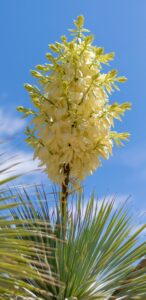
This yucca is native to eastern and southeastern U.S. There are species of yucca that form trunks, this species does not – it is trunkless. At ground level, the spikes/blades of leaves grow up and out from a short stem that is generally not visible. This plant is fan-shaped.
To those of you who are nurserymen, horticulturalists, or plant enthusiasts, you are probably familiar with Michael Dirr. I have his mammoth work Manual of Woody Landscape Plants: Their Identification, Ornamental Characteristics, Culture, Propagation and Uses. My copy is quite worn from use – I love this book. When I was working as a nurseryman and perennial/small shrub garden designer, this book was always in my car or truck. Michael Dirr is just about as knowledgeable about woody landscape plants as anyone could possibly be and not only is this huge book informative about every aspect of a tree or shrub, he also has quite the sense of humor which is apparent every now and then – and it most certainly is with this plant. He writes – and I quote:
There is a certain reluctance on my part to include these sword-like members of the Agavaceae, but their use in landscaping, especially in the southeast and west, is an undeniable and often horrible fact. When I see them in a landscape a feeling of old Mexico or the desert of the southwest arises. …… But too many Yuccas are sufficient reason to cause one to YUK!
Gee whiz, Mr. Dirr. Why not tell us what you really think?
I live in central Illinois and there are yuccas planted in yards here in our small town. In my opinion, the ones that are tended – that are weeded, mulched, any dead or dying leaves removed, and deadheaded as the flowers fade – look good. I wonder if Mr. Dirr would agree? The key to having beautiful yuccas is to take good care of them – if you neglect them, they are messy, untidy, slovenly, and will look half-dead. To quote Mr. Dirr, “YUK!” Have I made my point?
These are big plants so do take up space and sometimes in a garden, that is exactly what is needed – especially if your budget is not large. One yucca could take up as much space as a half dozen smaller plants and at today’s prices, that is a difference of quite a bit of money. I think there is a real place for these in a garden – a BIG garden. Especially one that is hot, sunny, and dry – a difficult landscape for many plants. So, if you think you have a place for one – or more – read on. If you are careful in placement and take care of it/them, I think you will be quite happy. And I have to admit, never did I think I would disagree with Michael Dirr, and I feel quite sheepish about it. That said, read on as to how to place and grow yucca – or Adam’s Needle.
Light: Full/part sun. Plant tags sometimes say this plant will grow in part shade which means less than 6 hours of sun each day. I agree that it will, but it will not be at its best. This plant is a sun-lover. There are better plants for dry, part shade than yucca.
Soil and water: Average garden soil, but it will tolerate poorer soil – especially those soils that are sandy or rocky. The one requirement that has to be met is the soil must be well-drained. This plant will withstand longer periods of drought than many plants, but it will not tolerate soil that remains moist all or most of the time. The soil has to completely dry out between rains.
Hardiness Zone: Zones 4-10.
Size: When it is not in bloom, it is about 3 feet tall and 3-4 feet wide. In bloom, it can be up to about 7 feet tall – this is a big plant.
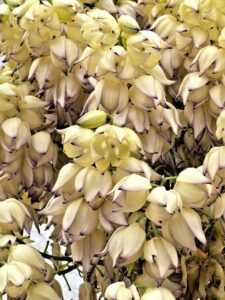
Bloom period and color. Deadheading: Flowers: This is where the plant gets big. The flower panicles and stalks can grow as tall as 7 feet and are almost always at least 5 feet tall. That is a lot of height. And the flowers are many that form a huge panicle and so make quite a statement. Yucca blooms late spring and early summer with flowers that are creamy white and each flower is bell-shaped.
The leaves are most often described as sword-like, green, and all develop distinctive thread-like filaments along the edges – I think this is an attractive feature which is quite distinctive. The leaf blades are a rosette. (Note: A rosette is a circular arrangement of leaves beginning at the base of the plant. The leaves emerge from one central area.)
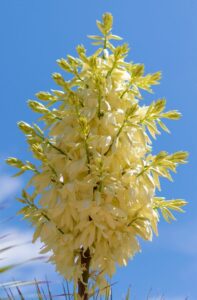
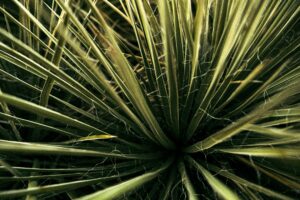
Deadheading and pruning: Check your plants about once every 4-6 weeks and remove any outside leaves that are broken, dying, or dead. Remove them by cutting each leaf blade at its base – right where it begins in the rosette which is at the base of the plant. To deadhead the flower stalk, once the flowers are finished, cut the stalk off down within the rosette of leaves to hide where you cut. Removing dead and dying leaves and cutting the stalk off in that way will keep your yucca looking neat and tidy all growing season.
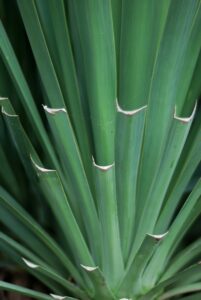
Look at the photo. Notice where these leaf blades have been cut from this plant – you can see every single cut. Always try to hide your cuts and prunings as much as possible. With a yucca – as with this plant – cut each blade as close to the bottom of the rosette – as close to the ground – as you can. And if you are able, pull each leaf blade out from the plant and make your cut on an angle towards the center of the plant. These cuts are all angled away from the plant so as the cut hardens, it becomes obvious. On this plant in the photo, even the cuts that are made closer to the bottom of the plant – towards the bottom of the photo – could all be at least an inch or two farther down – and angled in. These small things will go a long way into making your yucca a real eye-catcher in your garden all season long.
As the growing seasons go by, yucca will slowly spread by its roots spreading out and creating new rosettes which will be fairly close to the original plant. You can allow these to grow, you can cut them out and give them to friends, or you can transplant them.
Butterflies and birds: The flowers attract many different species of pollinators.
Deer, rabbits, and other pests: I have never had deer or rabbits bother yucca but on doing research, if you live in the desert, close to the desert, or your garden is more arid, deer could browse on yucca – most especially in winter. If you live in these types of habitats, I recommend using a repellent year-round – just follow the instructions on the label.
What to plant with yucca: If you have a large, hot, sunny, and dry area in your garden, this would be an excellent place to plant drought tolerant plants. Good companions to yucca would be Rattlesnake Master, the taller sedums, Sea Holly, and Prickly Pear Cactus. Watch your spacing as some of these plants need room. But these plants, plus possibly some added large rocks, would make a beautiful garden.
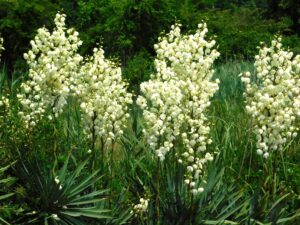
How to use yucca: This is truly a wonderful example of what is referred to as a sculptural plant. And what does that mean?
From Co-Pilot AI: A sculptural plant is a plant whose form, shape, or texture is so distinctive that it creates an architectural or artistic impression in the landscape. Unlike traditional flowering plants that rely mainly on color, sculptural plants are valued for their bold silhouettes, dramatic silhouettes, or unique foliage patterns that add structure, drama, and visual interest to gardens or landscapes.
Yucca would add a sculptural aspect anywhere it was placed .
Yucca can be used on slopes for erosion control, placed in the back of your garden as a backdrop, used as a single plant, or placed in a grouping of 3 or more. The plant will soften or camouflage a stone or stucco retaining wall or the wall of a shed or garage. It can be used as a wide hedge between properties.
Yucca is a very tough plant. It is especially good for sunny, dry spaces in areas of cold winters where most desert plants will not survive. This would be a good plant to consider if you live in North Dakota or Montana. Because it spreads, it can be used as a ground cover – and there are not a lot of perennial groundcovers for hot, dry areas that also get cold in winter. Just remember, this will take time and that it does not just eventually form almost impenetrable rosettes, but will also be tall – most plants used for groundcovers are quite short. Yucca is not the plant that would first come to mind as a ground cover, but it could be used that way. Just give yourself access areas so you can deadhead and remove any unsightly leaf blades. It is not an aggressive or fast spreader, but give a single plant a few years, and it will widen out through new rosettes to more than double the width of the original plant. And it will be a fairly solid, impenetrable mass which is exactly what you want in a ground cover.
I have included perennials on this website which are short-lived: Butterfly Weed is a good example. Yucca is exactly the opposite. With minimal care, lots of sun, and very well-drained soil, this perennial can live many years – even decades. Low maintenance, long-lived, big bloom, attracts pollinators…… what is not to like about Yucca, Mr. Dirr?