

American Goldfinches, raccoons, and a surprise cardinal!
American Goldfinches are an oddity amongst North American songbirds. Even their close cousins – the Lesser Goldfinches – do not share this trait. American Goldfinches only begin nesting at the end of July. Here it is – almost mid-August – and they are in the midst of their first nest of the season.
All the other North American songbirds begin setting up their nesting territories and looking for mates in early spring – some as early as March. In fact, the Horned Lark, a bird of grasslands and prairies, can start nest building as early as late February. Almost all of our songbirds have their first nest constructed and are laying eggs by the beginning of May – and many start in early April. By now, early August, many are finished raising families for the season and are quiet, molting, and preparing for migration or moving to their winter territories. Others are just about finished with their last family which could be their second or third family of this year – or even their fourth if they are House Sparrows.
American Goldfinches do not even think about setting up territories, mating and nesting until about July 1st and most begin nesting at the end of July through August. Because the eggs have a short incubation period and the hatched young are only in the nest about 2 weeks or so, if a pair begins in mid-July, they might even have a second brood. That is pushing it as the fledglings will have to cope with cooler weather – especially through the night – but these goldfinches appear to thrive on this timing. And why is nesting late a good decision for them?
Almost 100% of American Goldfinches’ diet is seeds – and they seem to relish pulling off larger flower petals. By mid-July, all their favorite flowers are either in bloom or are already setting seed. Goldfinches nest in large shrubs or saplings near big gardens or unmown grasslands, prairies, and meadows. Large areas where big plants are blooming and there are seedheads. This makes getting food for themselves and their nestlings so much easier. These photos are of male and female American Goldfinches on some of these plants. Other plants which are not pictured, but on which goldfinches forage, are coneflowers, compass plants, prairie docks, all sunflowers, and all thistles. And female goldfinches often construct their nests using the downy seeds of milkweed and thistle.
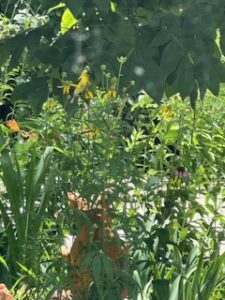
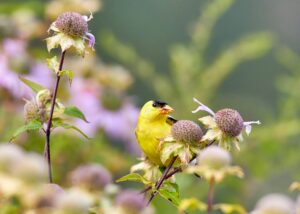
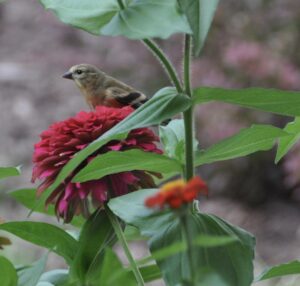
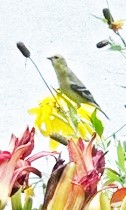
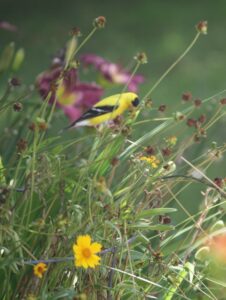
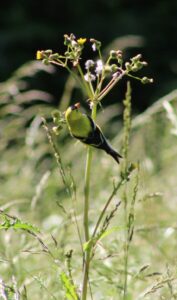
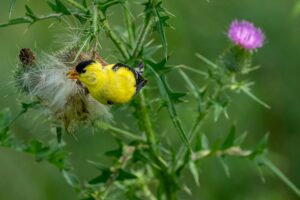
If you have a day of leisure, now is the time to pack some breakfast and binoculars into your car and drive out to rural areas where the wildflowers are in full bloom or setting seed, and look for these goldfinches. Even though the males are brightly arrayed in golden yellow and black, their favorite flowers are also yellow and so they will blend right in and can actually be hard to see. Perfect camouflage! Look for movement of the birds – flitting from flower stalk to flower stalk. Also look for movement of the flower stalks themselves as goldfinches land on them and start pulling out petals or seeds. These flower stalks will wave or bend wildly from the weight of the bird. And remember, you generally will not see one goldfinch, but there will often be several. These birds like company – they often nest fairly close together in a loose colony. Where there is one goldfinch, there should be several or even more.
_________________________________________________________________________________
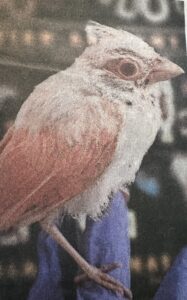
Vonetta from southern Pennsylvania sent a photo to me of a rare albino Northern Cardinal – a fledgling just out of the nest*. It was found under a parked car on July 1st. This area of Pennsylvania had experienced quite high temperatures and heavy downpours for some days. The rescuers saw no parents and felt the bird was either injured or distressed and so contacted the Raven Ridge Wildlife Center who said if it could be captured safely, they would take the bird. The bird was safely caught and brought to the wildlife center in a closed box. (link: Raven Ridge Wildlife Center). I believe the rescuers did everything possible to ensure the bird’s safety – the closed box was essential for that.
It is my opinion that young birds should be left alone and simply watched for some time to see what their conditions actually are. In almost every case, the parents are taking care of all their just-fledged birds – they just might not be visible at the moment. And once a young bird is captured and taken to a center, its life is irrevocably changed. It will no longer be wild. And we human beings have no idea of the level of stress we cause the parents when they return to feed their youngster and it is simply gone. So please, please, please, unless you have monitored a young bird for at least a day, do not capture it. Wait and see what happens. But in this case, I believe the human rescuers made the right choice.
It is a sad fact that we must accept. We human beings are a species in which there are members who see sport in killing something that is different – a trophy – or even a weeding-out of something undesirable. Although this was a small bird, there is no reason to think that someone would not kill it just for fun. In my opinion, this bird should now have a long life at the refuge center where it will be well taken care of and safe. My guess is in nature, the odds are that it would never live long enough to be one year old. And why do I think this way? Here is one of many examples I could cite – this is one I read about when it happened and was heartsick for days and days. From Co-Pilot AI (links are included at the ends of sentences for more information):
Rare Albino Deer Shot and Killed in Pennsylvania
A beloved albino whitetail deer in Perryopolis, Pennsylvania, was shot and killed in November 2022, sparking community outrage and legal action CBS News.
The Animal and Its Significance
The deer, affectionately called “Whitey” or “Midnight” by locals, had been roaming Jefferson Township for eight years. Residents described it as a striking sight — completely white with a rare coat — and said they could spot it from half a mile away. It grew from a young buck to a 14‑point mature deer, becoming a local icon and a frequent visitor to feeders at night CBS News.
T he Incident
According to Perryopolis native Jonathan Keffer, the buck was illegally shot along Cope Road by Laramie Noel Sisco. The wildlife management area where it lived had a week‑long break between archery and rifle deer seasons when hunting was prohibited, and that’s when the killing allegedly took place CBS News.
Community Reaction
The shooting drew attention from people across the region. Residents expressed shock and sadness, noting that there was an unspoken agreement that the deer would live out its natural life. Some said they would have respected a legal harvest, but the act of killing it illegally was seen as unnecessary CBS News.
Legal Consequences
Sisco faces state game violations, with potential fines and the loss of his hunting license. The Pennsylvania Game Commission is investigating the case CBS News.
Aftermath
Keffer said he hopes another albino fawn in the area will live a long life. The incident has left a lasting mark on the community, remembered as both a wildlife rarity and a symbol of local identity.
___________________________________________________________________________________________________________
And now on to something cheerier. We have raccoons. And if you have been following my blog, you know that. But I had no idea what they were doing long after I was in bed. Here is a small glimpse into what is going on in the area of the bird feeder livestream at night. Click on the links to see the videos:
And the squirrels are using the now-completed squirrel tower. Although I think it may be the ‘raccoon tower’ at night???? Cleon took these photos from our living room window:
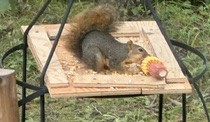
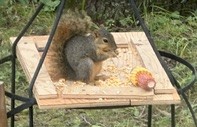
Time will tell if this squirrel tower is a blessing or a curse. Our friend Janelle – who sent the photos and videos of her Red-shouldered Hawk family this past spring which I posted here on the website – also has raccoons. She has even better habitat than we do. She brings her feeders in at night and at first, that was all that was necessary. Her security cameras showed a raccoon family came and ate the spilled seed that was under the feeders, but then they would leave. And then came the evening they did not leave, but the two youngsters climbed up the side of her house and started pawing at her screens on her windows. So, be careful what you wish for? Right now, the raccoons and Cleon and I are living in harmony – or maybe an uneasy truce would be a better description? We welcome wildlife into our yard and hope what we plant and how we treat our gardens provides a haven for plants and animals. But these raccoons cannot shred our screens. We will see how this turns out as time goes on …….
We do have American Crows living in the large riparian woodland across the lake from us and this time of year the juveniles from this year’s nests start moving around in loose groups. If you have your volume turned up on the bird feeder livestream, you may hear them from time to time. They will come to our side of the lake and there have been a few afternoons in the past week where three have perched in our trees for some time. Keep an eye on the squirrel tower – crows love corn! And these cobs are quite accessible for them.
For those of you who are new to my website and blog, here is a video I shared with everyone in 2024. It is 10 minutes long and in the middle 3 minutes, there is not a lot of action, but the last 3 minutes? Will make you grin! If you watch it all, you will get a real feel for how crows think and act – what concentration! American Crows Rearranging Rocks
Happy Birding! Linda
P.S. I just added a plant to the Landscape and Gardening for Birds and Wildlife section which is commonly called Yucca, Threadleaf Yucca, or Adam’s Needle (Yucca filamenotosa). Here is the link: Yucca
*For more information on Frosty, the albino cardinal, here are three links:
Philly Voice
Lancaster Online
USA Today