

New Jersey Tea (Ceanothus americanus)
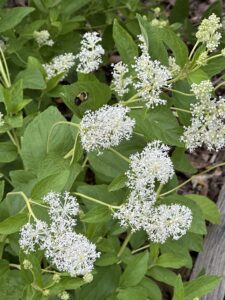
I did not know this shrub until I designed and developed the native plant garden at Rock Springs Nature Center in Decatur, IL. Besides being a formal garden of landscaped beds of only plants native to central Illinois, it was also a demonstration garden to show homeowners and gardeners how native plants could be used. New Jersey Tea is a small shrub which we planted en masse at the main entrance. And what a showing it made! None of the gardeners working in this garden were familiar with this shrub and we all agreed it should be more popular – more used. Read on and if the growing and care requirements suit you and your space, I recommend you give it a try. It is hard to find at garden centers and nurseries, but it can be ordered online. The plant sent to you will be small, but it is a good grower – just be patient.
And yes, this was one of the plants whose leaves our New England colonists harvested for brewing ‘tea’ after the Boston Tea Party. Try it and see what you think. And remember, all colonists were hearty souls!
Light: Full/part sun. Mine are in part sun – morning shade from the house and full afternoon sun.
Soil and water: Medium to dry soil. Drought tolerant. Will grow in rocky soil. Mine are in a heavy clay soil and on a gentle slope.
Hardiness Zone: Zones 4-8. If you are in Zone 3, you can try it – just be sure it is in a more protected site and that the roots are well-mulched for winter.
Size: 3 ft. tall and wide. It can sprawl a bit but is bushy enough that you may never know it has. And as always, the more sun, the less sprawl. This is truly a small shrub.
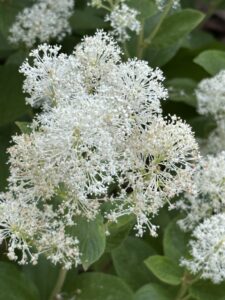
Bloom period and color. Deadheading and pruning. Transplanting: Masses of white flowers – all at the tips of the branches. Some are slightly and pleasantly fragrant – some seem to have no fragrance. Blooms in June and July. Some sources include August, but all of mine are finished by mid-July. You could have a different experience. Just understand on average, they bloom profusely for about 6-8 weeks – not 3 months.
Deadheading and pruning: I do not deadhead this shrub after flowering at all – I let it develop seed heads which have an interesting texture and are brown. I take a good look at each plant in late February-mid March and cut out any dead or broken branches, branches that are touching each other, or are crossed – some need no pruning at all. I step back after making several cuts to make sure the plant retains the shape I would like it to have. I do not like my New Jersey Teas to look as though they were whacked at with an electric or battery powered hedge trimmer. I like a rounded but natural shape. New Jersey Tea easily lends itself to that sort of shape. This plant will also regenerate from the roots so every 2-3 years, in that same time period of late February to mid-March, I cut the entire plant down to about 2-4 inches from the ground.
Transplanting: For a small bush, this plant has an extensive, thick root system – and an especially long taproot. This could be why the plant is drought tolerant. I had a 3-year-old, beautiful New Jersey Tea, but it was in the wrong spot. Even though this was a small shrub, I had placed it too close to a walkway and in summer, it was simply too wide and covered too much of the walk. I was able to transplant it, but it was extremely difficult and took me the better part of a day. I have heavy clay soil, but that tap root was still way down deep. I did finally dislodge the entire root system, but it was a backbreaking job that I would not wish on anyone. So be careful where you place it. I was just lucky I did not kill this plant. It took it over a year to recover, but it is now doing nicely and is in a spot it likes – and that I like.
Butterflies and birds: New Jersey Tea is a host plant for Spring Azure and Summer Azure caterpillars.
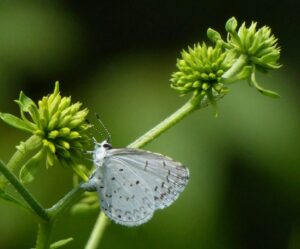

These plants are a food source for hummingbirds, Wild Turkeys, and quail. Native bees are also drawn to the flowers – and that includes the Yellow-banded Bumblebee which is now listed throughout its range as ‘Rare’.
Deer, rabbits, and other pests: Deer, rabbits, destructive insects, and disease have never eaten or disfigured any of the New Jersey Teas I have planted. However, if you have deer and rabbits in your yard, I strongly recommend that you spray these plants with a repellent – most especially in spring.
Because they are low, fairly bushy, and the branches are softer and more pliable than most other shrubs, I have found some animals like to bed down within a group of them. A few years ago, there was a new-born fawn who spent a day totally hidden within ours – a very cozy and safe bed. It stayed there until the female came and led it away. We have had a pair of Mallard ducks try to nest within them – unsuccessfully. We do have raccoons and occasionally they will curl up within them. So, if you plant several together you might be surprised what you might find within.
What to plant with New Jersey Tea: Because they are about the same size as a medium-tall perennial – and they bloom white – they can be planted with just about anything and will look good. Just keep in mind that if you are planting them in poorer soil, then anything planted with it must also do well in poorer soil. Plants that grow well in poorer soil include Sedum – especially Autumn Joy, Echinacea – purple coneflower, Catmint – just make sure it has plenty of room, Black-eyed Susans, and – thinking outside the box – try Tree Mallow – Lavatera – just remember this is a big plant – bigger and taller than New Jersey Tea so will dominate your vision. For a real contrast, try planting New Jersey Tea with Red Hot Poker – Kniphofia.
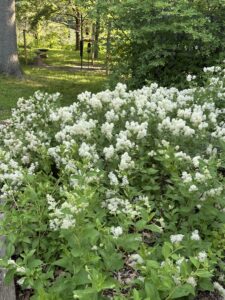
How to use New Jersey Tea: We have 9 planted en masse in a sloping area close to our house and deck. This was an area that was greatly compressed, scraped, and totally abused during construction of this house. I have added compost from our bins, chicken manure from my cousin, and some topsoil I bought, but I will never be able to bring the quality of the soil back to where it should be in my lifetime. New Jersey Tea grows well in disturbed and poor soil – and ours are thriving. If you have a spot in which nothing grows and it is in full to part sun, give this plant a try.
You can also use New Jersey Tea singly in perennial beds – it is a good size and will work well with other perennials. And keep in mind this is a small shrub and so will work well at your entrance way or along a drive or sidewalk where you need something more sturdy and reliable but not very large.