

What has happened in our yard……
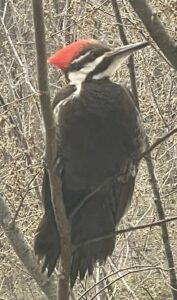
This past February, we had a Pileated Woodpecker visit our backyard for 3 days in a row and then it did not return. These crow-sized woodpeckers live across the lake from us in an over 200-acre riparian woodland*.
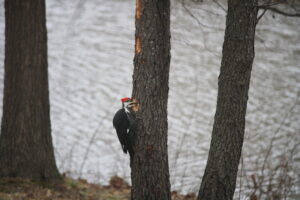
Our Pileated flew straight across the lake from this riparian woodland and landed on the trunk of our dead Wild Black Cherry tree (Prunus serotina). This tree died several years ago, and we have kept it for woodpeckers. It is in our back yard, surrounded by full-grown oaks and a big silver maple. If you did not know it was there you would never see it, so it is not an eyesore for our neighbors. And that can be an issue. All sorts of creatures love dead trees – their trunks are easier to drill into for nesting holes. Beetles and insects can easily lay eggs or tunnel under the bark. But human neighbors often want dead trees removed. And it is true, they can be a hazard. But if you have one, instead of removing it entirely, consider just removing some or most of the branches and leaving it in place – sort of an abstract statue. You can even grow vines up the trunk to soften the appearance. But back to this Pileated Woodpecker.
As soon as this woodpecker landed on the tree trunk, the drilling began. We are not sure of the reason. As it was February, we think it was way too early for a nesting hole and as you can see in the photos, this bird was excavating at my eye level. Way too close to the ground. Normally this bird’s nesting hole would be at least 15 feet above the ground and most often, higher. He could have been excavating a hole to roost, but again, this was awfully close to the ground – the higher, the safer. And he did excavate more than one hole – and all in the same area of the trunk. We think he was going after beetles and anything else that is bite-sized and lives in decaying trees. After 3 days, I guess his tummy was full, he ate everything available, or he found a more convenient source of tidbits, because he never came back. We did hear what was probably him plus at least 1 other Pileated calling from that woodland all spring, but none returned to our yard.
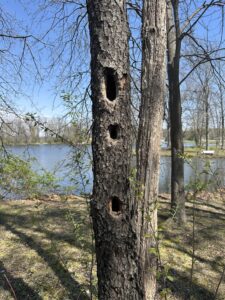
And here is what the tree looks like inside the holes.
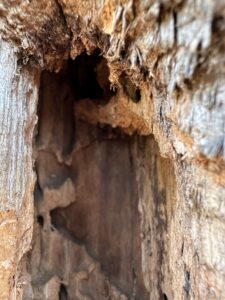
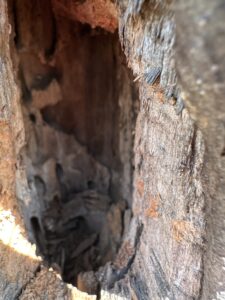
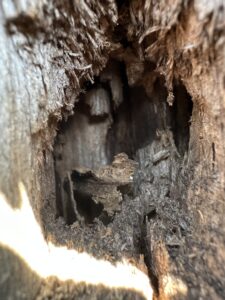
Just beautiful, isn’t it?
Happy birding! Linda
P.S. Our largest Elderberry Bush was in full bloom, I took 2 photos, and added them to the entry for Elderberry under Landscaping and Gardening for Birds and Wildlife. Click here and scroll to the bottom to find these photos, to read how I used this shrub, and what is planted with it. Elderberry Bush
*riparian woodland – a forested or wooded area of land adjacent to a body of water such as a river, stream, pond, lake, marshland, estuary, canal, sink, or reservoir. This definition is from Wikipedia (Wikipedia – riparian woodland).
Our right-across-the-lake, riparian woodland has a tributary to the Sangamon River running through it – this tributary is always fairly slow-moving and in July and August – and last year during our drought – the current can stop completely and the water is at a standstill. In spring, this woodland is almost completely flooded for several weeks when this tributary overflows its banks. This is a beautiful woodland – completely unsuitable for development because of the severe and widespread flooding. And to that I say, “Yeah!” Both this woodland and the adjoining grassland have been owned for many years by a group of hunters. They have made a few alterations – mostly to the grasslands – but nothing too radical or severe. Deer and Wild Turkey live here. These hunters did release some Northern Bobwhites which they either killed, or these birds did not survive their first year because there were no Bobwhites the following year or in any years since. For most of each year – and sometimes the entire year – this land remains untouched and untrod by any human being.