

Elderberry Bush or American Black Elderberry Bush (Sambucus canadensis)
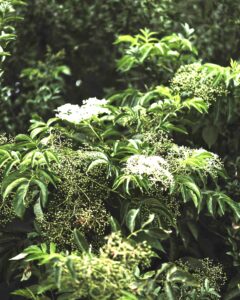
The elderberry is native to most of North America. Our only states where they are not found in the wild are Idaho, Utah, Nevada, California, Arizona, and New Mexico. This bush has been hybridized and often when you buy one, it will be a hybrid which is OK, just be sure it is a hybrid that produces flowers and berries, not just flowers. Read plant tags and when in doubt, ask!
Also be aware, there is a European Elderberry (Sambucus nigra). My advice is to plant our native elderberry – it is a better plant for North America. And do not plant an elderberry that has leaves a different color from green – and no lime green! These elderberries with different colored leaves – generally burgundy or lime green – have been hybridized to produce a lot of flowers and few or no berries. And if they do produce a few berries, these are the last berries the birds will eat – if they eat them at all. To make sure you are buying a good berry-producer and not just an ornamental bush, read the plant tags carefully before buying and if you buy at a nursery or reputable garden center, ask. The native elderberry bushes that produce lots of berries can also be ordered online from most nurseries/growers that sell fruit trees and bushes.
When we lived in West Virginia, Cleon made wine. The best wine he ever made was from the flowers of the elderberry – Elder Flower Wine. Labor intensive but so worth it. If I close my eyes, I can still savor its aroma and taste!
Light: Most references will say full sun to part shade which is true, but in my experience for the most flowers and berries, full sun is best. Also keep in mind, this bush has an open growing habit which I think is really lovely and provides a contrast to other shrubs. It is not solid and compact. But the less sun it gets, the stragglier it will look and for me, that is never good. I have always grown elderberry bushes in full to part sun – at least 7 full hours of sun a day – and have had great success.
Soil and water: Likes a regular garden soil, but more acidic. Elderberries also like to be consistently moist, but well-drained – they do not like to be in standing water or sopping wet soil. A 2-inch layer of mulch will help keep the soil evenly moist.
Have your soil’s ph tested before investing in elderberry bushes. You can have this done professionally or you can buy a soil test kit and do it yourself. If your state university has an extension system, contact your county’s extension – they should be of great help with soil testing.
Soil ph is measured on a scale of 0-14. 0 is the most acidic and 14 is the most alkaline. 7 is neutral. The majority of plants – like most perennials, annuals, and your lawn grass – like a ph around 7. Elderberries like the soil ph to be from 5.5 to 6.5. If your soil tests out to about 7, all you need to do is add an acid fertilizer to the soil around the plants twice a year. Once in spring and once about July 15th. In addition to the acid fertilizer, Cleon also adds coffee grounds to my elderberries. He makes all our coffee and uses a French press. The grounds are all in the bottom of the large glass container. When we have finished all the coffee, he just fills the container with water and goes outside to dump it around an elderberry bush – and he has our elderberry bushes on a rotation with our blueberries and native roses. Each gets coffee grounds about every week to 10 days from mid-April until the 1st of September.
Just to remind you, my website is totally independent – no endorsements. No favors. Just me. So when I recommend something to you it is because I have tried it and it did exactly what it was supposed to do. For all my plants that like a more acid soil, I use Holly Tone – an old fertilizer brand. I probably use this because when I was a little girl, we had a few azaleas as foundation plantings in our front yard and my dad used Holly Tone on them every spring – they were beautiful! So, I have continued with that brand, and I think it does a very good job. Holly Tone has branched out into other fertilizers so just make sure that on the front of the bag it says the one you are buying is an acid fertilizer or look for at least 2 of these plants to be listed: azalea, rhododendron, hydrangea, camellias, bluberries. Just follow the instructions on the bag. This is a granular, slow-release fertilizer which will slowly add acid to the soil.
Another way to gauge the acidity of your soil is to look around you. What is growing? Thriving? Common plants that thrive in more acid soils are azaleas, rhododendrons, hollies, and hydrangeas. Are any of these close-by? Are they growing well? With or without added acid? If without, your soil may be more acidic.
Another good source of acid is oak leaves – we have an abundance of these. Mother Nature mulches these bushes herself each fall. In early spring, I rake the leaves from around the bushes and run our mulching lawn tractor over them to shred them – it does an excellent job. I then put the shredded leaves back around the bushes as mulch for the spring and summer. As these leaves biodegrade over the spring and summer months, they slowly release acid into the soil.
Hardiness Zone: Zones 4-8.
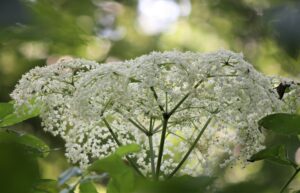
Size: 6-12 feet tall and wide. I have several varieties and all fall within these limits. Check the plant tags for size before buying.
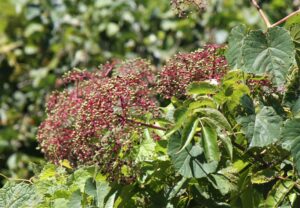
Bloom period and color. Deadheading and pruning: Blooms white. Flowers are small but in huge clusters so immediately noticeable. They are also fragrant. Depending on the variety/hybrid, blooms in June to mid-August.
Deadheading: I have never deadheaded any of my elderberries. The birds eat all the berries quickly – and tend to fight a bit over which bush belongs to who. Luckily with at least 10 bushes scattered around our acre, there are plenty of berries to go around. In fall, I simply leave these bushes alone – no trimming or pruning.
Pruning: In spring, after the bushes start to leaf out, I take a good look at each one and this is the time I do any necessary pruning. First of all, elderberries will sucker – send new shoots out underground from the base of the plant in any and all directions. Each spring, I take a good look at these suckers and decide how wide I want this elderberry to be. If there is room for more spread, I might allow 1-2 of these suckers to continue growing. They will develop with branches which will bloom and fruit. And can be separated from the bush and replanted on their own somewhere else for another bush. My elderberries are growing with other shrubs and so I most often cut our all the new suckers by digging down into the soil an inch or so and cutting the root off at that point.
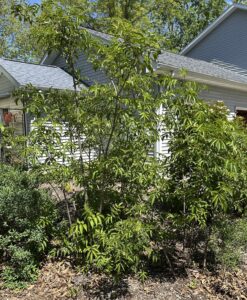
This is also the time of the year I step back and take a good look at the bush – remember, pruning is an art form. A chance for you to ‘sculpt’. Never go at pruning with an electric or battery powered trimmer and just start sawing and hacking away. Make each cut deliberately and take time to step back often and see how the shape is forming. Take your time.
Elderberries have been described as ‘straggly’. Unless they are in too much shade, I would never use that word to describe them. I think of them more as fitting in perfectly with abstract art. They can have any shape and branch in any direction. Each bush is individual – a bush that can be a real free spirit. I generally do not alter its shape in any way, but I do cut out any completely dead trunks/stems at ground level – and the older the bush, the more there will be. In one I planted 20 years ago, I cut out 3 just this past week and the trunks were thick enough that I had to use a pruning saw – they were way past loppers. I also look at each alive trunk and branch and remove any dead twigs – and there are always a good number of these. So, I am not pruning for shape but for tidiness. And when I am finished, with their wild shapes, I just love how they look. And the taller they are, the wilder their shapes will be. The one I was working on this past week is about 11 feet tall – this is just about the maximum height (see the above photo). There are smaller varieties/hybrids – read the plant tags before you buy. Just remember, the larger the bush, the more flowers and berries you will have. We even had a catbird nest in one last year – that is like us setting up a bedroom right at the breakfast table!
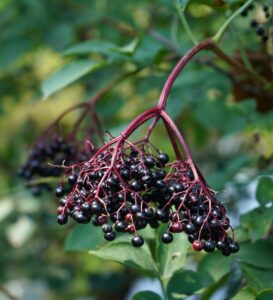
Berries: These bushes are loaded with small berries from mid-July through September. Birds love them. We humans can also use them – cooked. Never raw. There are lots of recipes and tips on the Internet.
Elderberries ripen anywhere from July through August. If you have many berry-eating birds in your neighborhood such as:
American Robins Gray Catbirds Cedar Waxwings
Eastern Bluebirds Northern Mockingbirds Hermit Thrushes
all Orioles Indigo Buntings
and you want to harvest berries for yourself, consider placing a net over each bush from early June until harvest is finished.
Butterflies and birds: Butterflies, moths, beneficial insects, and native bees are drawn to the flowers, and any bird that eats berries will come for these.
Deer, rabbits, and other pests: I have had elderberry bushes here in central Illinois for the 20 years we have lived here – 4 of which I planted and another half dozen or so that were growing along the edge of the lake when we bought this lot. None have ever been bothered by anything – not deer, rabbits, disease, or any insect.
What to plant with elderberries: Elderberries, blueberries, and viburnums will make a lovely shrub collection of lots of berries for birds for many weeks. If you have room, a dogwood can also be added. (Cornus florida – our native flowering dogwood – not any of the dogwoods from Asia like the Kousa dogwood. Native dogwoods are much better berry-producers.) I have my planted elderberries in our long shrub hedge at our property line. The one I just worked on is planted with an American Cranberry Viburnum, a blueberry, a Ninebark, and a hybridized Sumac. St. Johnswort shrubs are planted in front. These bushes go very well together. Lots of color – both leaves and flowers – and texture.
How to use: My elderberries – both in this shrub hedge and along the lake – are used as privacy screens – a hedge. Cleon and I are private people. We are not like Bald Eagles who like a long view. If we need a long view, all we have to do is go upstairs and look out our windows. But when we are sitting on our deck, patio, or the bench outside the garage, we like privacy. Elderberries help provide that.
The shorter varieties can be used in perennial flower beds – several can be placed in a row across the back of the bed, or a single one can be used toward the back or in the center as a focal point. The smaller ones are not as wild in their shape, but still have beautiful leaves, flowers, and berries. Berry-eating birds are also insect-eating birds. So, drawing birds to your garden with berries will also put a good dent in any destructive insect population.
Elderberries can also be used to soften a garage or shed wall – plant along the foundation. If you are really adventurous, you can try the shorter varieties/hybrids as foundation plantings along a side of your house, but measure how far your windows are above the ground. Elderberries could be too big. But using the smaller ones in this way is definitely outside-the-box thinking – which I love and encourage!
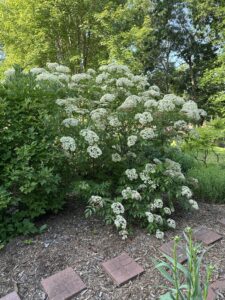
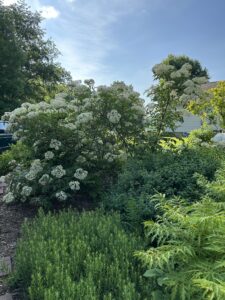
The photos to the left show one of my elderberry bushes in full bloom – it is five years old and is the biggest one I have. Full sun. And I think it also has access to underground water that other beds in my garden do not have. This elderberry is part of a long shrub border and no matter how hot and dry our weather is – even during the drought we had last year (2025) – this bush did not need watered. All the other beds did, but this long, mixed-shrub border did not.
In the photo to the far left, the bush planted next to it is an American Cranberrybush viburnum (3 years old and still growing) – one of my favorite shrubs. In the photo to the near left, in front of the elderberry are native asters I am using as a small ground cover. They will bloom purple in fall. The small shrub to the right front of the elderberry is St Johnswort. The straight species is a native to central Illinois – this shrub is a hybrid, but I love it – as do all the native bees when it is in bloom. Several moths also regularly light on it to feed. Some plant, shrub, and tree hybrids are not as attractive to insects and butterflies as the straight species, but this one is. The lime green shrub in the lower right corner is another hybrid – a sumac. Cutleaf Staghorn Sumac. And no, this is not in any way poison sumac. It does sucker a bit and so I have to monitor it monthly and cut the suckers out at soil level. I wear gloves but do brush up against the leaves from time to time – this is NOT poison sumac. I bought it because I love the branching pattern of sumacs and this is the only lime green-leafed plant I have in all my gardens. Normally I do not like lime green leaves, but I love this one. As you can see, all these plants look good with elderberry. And this elderberry is a focal point in my long border of mixed shrubs which is on our property line. So much better than a fence! Catbirds, Brown Thrashers, and American Robins nest in these shrubs every year. And wait till the berries ripen on that elderberry – catbirds, sparrows, robins, and even Cedar Waxwings will be busy, busy, busy! You could never say that about a fence!