

Lots happening in our yard – and in some of yours, also!
Spring migration followed by nesting season is just the best time in our yard to sit and watch birds. We have a patio and fire pit close to our small lake and as it is on the north side of the house, it is always shaded. Perfect for these late afternoons and evenings. If there has been enough rain, we build a fire – and sit a bit back from it. Lovely colors in the flames, but the heat is now a bit much. And while we relax in our Adirondak chairs, we have our binoculars handy. But we don’t need them to see this lively bird – this nest box is close to where we sit.
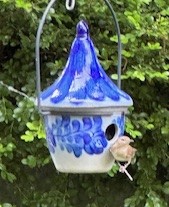
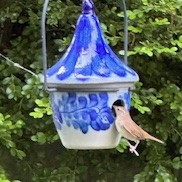
This is a House Wren. For the last several years, House Wrens have arrived late in our yard. Generally, it is early May before we hear the males sing. House Wrens have used this nest box for the last 4 years, and us sitting there or Canada Geese strolling by does not bother them one bit.
This nest box and their arriving late solved the problem we had with them and robins nesting in “the same space”. I described this conflict in the eGuide I wrote entitled The American Robin. Click here to download this free eGuide: The American Robin. Since our good friend Cheryl gave us this pottery nest box, there has been no conflict. Cleon and I both love House Wrens – they are such busy birds! If we had their energy, there would not be a weed anywhere in our garden and our yard would be immaculate. Alas, that is not the case!
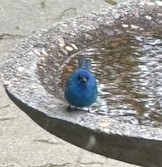
We do not always have Indigo Buntings, but we do this year – at least 2 males. We have not seen a female, but that does not mean she is not here. For us, here in our yard, these birds are secretive and shy. Not everyone has this experience with these birds. In my observation, the more male Indigo Buntings there are – the more exuberant they are. But when there are only 1 or 2 – and they come to feeders and bird baths alone – they are timid. These 2 males often come at dawn or dusk and when the sun is not shining, these birds are not blue but are dark – more black. And they are small and slender so at dawn and dusk, easily overlooked.
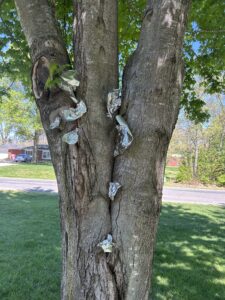
Mary from central Illinois emailed me with a problem she was having with woodpeckers. Red-bellied Woodpeckers were damaging the 2 big ornamental trees in her front yard. Both are Autumn Blaze Maples – 25-30 years old. She did contact a tree expert who diagnosed both trees have canker fungus.
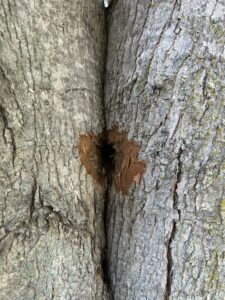
Canker fungus weakens the bark and inner layers of trees making it much easier for woodpeckers to excavate nesting and roosting holes. Insects can also be attracted to trees with this fungus because the fungus will cause sap to ooze out over the bark – many insects relish sap. If you have a tree that woodpeckers will not leave alone – a constant drilling of shallow holes – this could be a sign there is something seriously wrong with the tree and a tree expert needs to be called.
Mary wanted to stop the woodpecker damage – they were returning to the holes they already started where the tree had been weakened by the fungus and were making them larger. I recommended using aluminum foil to deter them and it did work. Mary wants to save these trees and so her tree expert is spraying them with a fungicide to try and halt the fungus. This expert will also do selective pruning to remove the most heavily infested branches. But the woodpeckers were the ones who alerted Mary to the problem.
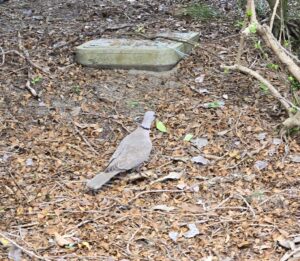
Thank you to Miles who sent this photo from Florida of a Eurasian Collared-Dove. This dove introduced itself to the U.S from the islands in the Caribbean and has moved from Florida, northwest – clear across the country. This bird is especially fond of corn so is exploding in numbers here in the Midwest and on The Great Plains.
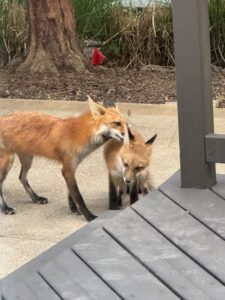
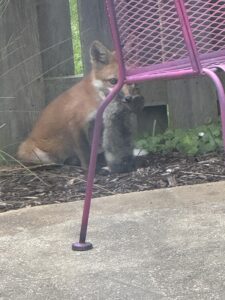
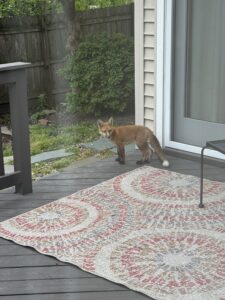
And Jane who lives in northern Illinois in a suburb of Chicago sent photos of this lively family making itself right at home on her deck and in her backyard.
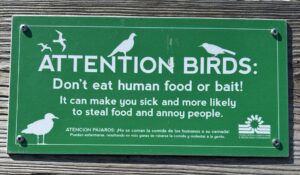
And here is something that made me laugh as soon as I saw it. What a great sign! And thank you to Carol from the coast of North Carolina for sending it – made my day! Happy birding! Linda
P.S. I have included the American Cranberrybush Viburnum ( Viburnum trilobum) in the Landscaping and Gardening for Birds and Wildlife section of the website. Several of you emailed me to tell me that your viburnums can be troubled by red spider mites and the viburnum leaf beetle. I have never had trouble with either on the viburnums I planted in southeastern Pennsylvania, southeastern West Virginia, or here in central Illinois, but after doing some research, I learned these can be a problem. I have added a paragraph under Deer, rabbits, and other pests with ideas on prevention and also what to do if you get an infestation. Click here for the link: American Cranberrybush Viburnum (Viburnum trilobum).