

Buttonbush (Cephalanthus occidentalis)

Light: Part sun to shade. Will grow in full sun if it is watered deeply and regularly. However, I recommend part shade – about 4-6 hours dappled sun each day for the best growth.
Soil and water: Moist, well-drained soil. This shrub does not seem to be too picky about the soil. When I read about this shrub before writing about it, there are Buttonbushes that are planted in quite sandy soils and growing very well. My two are in fairly heavy clay and both are doing well. The key sems to be water. These bushes are native and in their natural habitats, they are wetland edge shrubs. They will withstand flooded conditions. My two are planted in part shade, at the bottom of a small slope, and close to our small lake. There have been some springs when our lake has flooded and both shrubs have been in standing water of several inches for a week or so. Both thrived. My research indicated that once established, this shrub will withstand some drought. Last summer and fall, we were in a severe drought situation here in our part of central Illinois and both shrubs made it through without my watering them. This is one tough shrub!
Hardiness Zone: Zones 5-9. But remember, this is a tough shrub and so this is one you can push the growing zones a bit to 4-10. Just plant in protected spots. In zone 4, adding extra mulch around the roots and planting it near or against a wall to protect it from bitter winter winds will help. In Zone 10, plant it in the shade (4 hours of sun each day) and keep it watered.
Size: Can vary a great deal in size – check the plant tags or the description if you are ordering online. They can be anywhere from about 3 feet to 10 feet tall – and on rare occasions, can grow as tall as 15 ft. One of ours is almost 20 years old and is about 6 ft. tall and wide. The second one is about 8 years old and is only about 4 ft. tall. These shrubs are round and so generally are as wide as they are tall. Give it room.
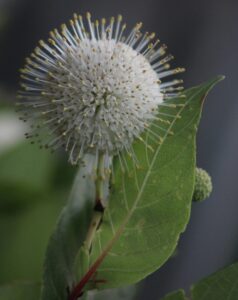
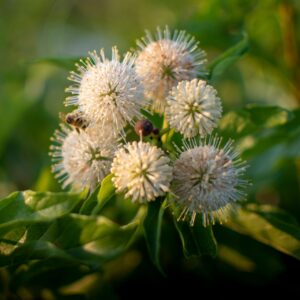
Bloom period and color. Deadheading: Most plant tags and catalogues will say this plant blooms June, July, and August. It actually can bloom during any of these months, but is only in bloom for about 3-4 weeks – not the entire 3 months. Blooms white. The flowers are round balls which I think are attractive and quite interesting. The seedheads are also attractive. I never deadhead – I just leave the seedheads on the shrub and they fall off themselves over winter.
As I explain in Deer, rabbits, and other pests, beavers gnawed both our Buttonbushes to the ground. And both regenerated beautifully. So this is a shrub that if it gets too big or you do not care for its shape, in early spring, cut it to within about 6-8 inches of the ground and it will completely regenerate and within about 3 years be back to its full size.
Butterflies and birds: Butterflies and native bees love this shrub and will come to its flowers. Waterfowl and shorebirds will eat the seedheads.
Deer, rabbits, and other pests: We have deer and rabbits, and they have never bothered either bush. But we did have a whole lot of trouble with beavers who took all the branches of both bushes a few years ago. Amazingly, the older bush – the one which is now 20 years old – was improved! It was always a lovely shrub but after the beavers gnawed every branch to the ground and left those pointy stubs, the shrub regenerated from its roots and its shape was even better. It did bloom the following year and within 2 years, was back to about 6 feet tall. I thought we had lost it for sure! My guess is that since this species is an edge wetland species, it is used to beavers and has developed these recuperating strategies. My second buttonbush also recovered nicely from the beaver annihilation – it was much younger and not full grown.
What to plant with Buttonbush: I have a damp shade garden on the north side of my house. This is where my 2 Buttonbushes are – planted side by side. In this garden are Hostas, Fuchsias (which I winter over in my small greenhouse), a Witch Hazel, a Viburnum, 2 Deciduous Azaleas, a mass planting of Turtlehead, and scattered Lady Ferns and Lady’s Mantle. I have 2 groundcovers. Next to the house with only indirect light is a mass planting of Lily-of-the-Valley. Where there is dappled light is Green and Gold. I love this garden and the 2 Buttonbushes are the anchor.
How to use Buttonbush: The garden I described to you in What to plant with Buttonbush is on the one side of our patio which includes a fire circle. The two Buttonbushes serve as a screen so when we are on the patio, only the kayakers and fishermen on the lake can see us. We are blocked by these two bushes from the neighboring houses and street. We like our privacy!
Buttonbushes can also be planted at the edges of ponds – either ones that nature created or ones that you dig. They are a good addition to rain gardens. In any damp part shade/shade garden, they can be used as the back border, or one can be placed towards the center as a focal point.