

Rogue males
I have only ever heard the term ‘rogue male’ used in terms of raptors – particularly with Bald Eagles, and Ospreys. The definition from the online Collins Dictionary (British) is any solitary male. Other references add to this simple definition: A solitary male who is acting in an unusual way that is different from the other males of its species.
Every time I have heard the term ‘rogue male’ used, it was to describe a male eagle or osprey harassing or attacking a nest of their own species. Sometimes the female – whose nest it is – is right there and she will fight. More often, the mated male will engage the rogue male and chase it off. Sometimes they will lock talons and fight. If the mated male is defeated, the rogue male will often take over the nest – including the female and young. And then there are times when neither parent is there and the rogue male will kill the young. I never thought about – or observed – rogue males disrupting nests of mated pairs in birds other than raptors until yesterday afternoon.
I spent almost the entire afternoon in our kitchen at the table and riveted to the window which looks out at the robin’s nest on the elbow of the drain spout at our garage door. This is the one I told you all about in my last blog. The nest with one robin family after another and with no additions of any material to the nest. This female has been sitting tight – she rarely leaves the nest. When she does, she generally takes a drink, has a bath, and then forages right below the bird bath – all within good sight of this nest. The male is generally nearby – often at the bird bath.
Today, out of nowhere, another robin flew at the nest. I am assuming it was a male. The sitting female raised an alarm and stood up in the nest. Her mate flew towards the nest from the bird bath and chased the rogue male robin away. This was quite a serious chase through our trees and shrubs, but the mated male prevailed, the intruder was gone, and the mated male returned to the bird bath area. The female settled back down on her nest.
Within a few minutes, the rogue male was back, and this time came at the sitting female fast and hard – dislodging her from the nest. He sat on the rim but only for a few moments when the mated male came right at him, they had a brief skirmish with talons, then the mated male chased him off once again. Lots of robin alarm calls! The female returned to the nest and checked everything very carefully. She had her beak down in the nest for more than a minute, making gentle movements – and repeated that gesture several times. I was not sure if the rogue male had damaged the eggs? Or if the eggs have actually hatched? We don’t think so because the parents are not bringing food to the nest. I did not see the rogue male stick his beak into the nest and he was only on the rim for a few seconds before the mated male rousted him.
The female stood on the rim of her nest – most often looking down into the nest – for over an hour. It was another hot day with a heat index of 104°F so the eggs were not going to get too cool. I was worried there was damage. She finally settled down on the nest, and after a few minutes, the rogue male came at her a third time. Again, he dislodged her, but this time the mated male was right behind him and the rogue male never had a chance to land on the nest. These two males started a fight and actually tumbled onto the driveway – talons locked. They did separate and the mated male chased the rogue male off yet again – all through our trees and large shrubs. And once again, the female stood on the rim of the nest, staring down at what was inside for about another hour. She did stick her beak into the nest from time to time – ever so gently. The mated male returned and took up his post near the bird bath. She did finally settle again on the nest, so I am assuming her eggs or just hatched or hatching young were fine. She is still on the nest this morning, so I am assuming all is well. The parents are still not bringing food to the nest so I assuming there are still eggs. Cleon is in the kitchen this morning and says he has not seen the rogue male so maybe it finally moved on? I hope so.
I have never observed this behavior in songbirds. Blue Jays and Crows will raid nests but that is generally for prey. Robins are insect and berry eaters, not baby bird eaters. So, what was actually happening at this nest? It is mid-July, so late for a new nesting attempt. And there was only one rogue robin, not a pair. And whatever was driving the rogue male to exhibit this behavior, it was an overwhelming urge, as the behavior lasted all afternoon – and on a very hot and humid afternoon – despite serious rebuffs by the mated male. So, I will repeat what I said in my last blog – never ignore robins. They live their entire lives right in front of us where we can observe just about everything. And just like us human beings, they can be unpredictable and surprising.
And speaking of posturing, aggression, and fighting for dominance, the Canada Geese who are under our feeders for about an hour most days are going at it. This is a flock of geese who, for whatever reason, did not raise families this year. All of these are adults at least 2 years old. And if you watch them for several minutes, you are sure to see some outstretched necks, chasing, pushing and shoving, and even some flying at each other. What in the world is going on? This is normal behavior in spring when mating occurs and there are fights over territories and nesting sites, but this is the middle of July! No goose is going to nest now. So, what are they fighting over? Why all the pushing and shoving and generally bad behavior towards each other? And yet they remain as a flock. At this time of year, we have never observed this behavior under our feeders – or anywhere on our small lake.
Hope you are being as entertained as we are! Happy birding!
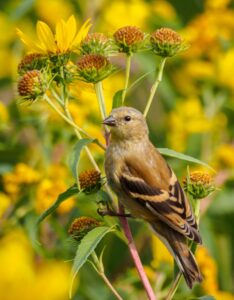
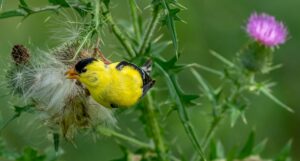
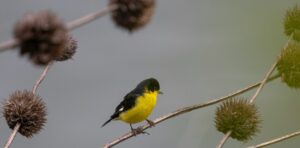
P.S. If you live near unmown meadows, grasslands, or prairies, the flowers that American and Lesser Goldfinches love are in full bloom, and some are even starting to set seed. You will find both species of goldfinch on the flower heads, pulling out petals and eating the newly forming seeds in the centers. Both goldfinches are quite acrobatic and so will be hanging every which way on these plants. This is a good time to find a good spot and either sit in your car, take a lawn chair with you, or just stand and watch the interaction and antics of these birds. Both finches are always feisty and love these fresh seeds!
P.P.S. I added a shrub to Landscaping and Gardening for Birds and Wildlife. And as always, it is one of my favorites – in fact every plant I have placed so far in this section are plants I love and if I ever move and start all over, these would be the first plants I would consider! This is probably why adding this section to the website has been such fun for me. I love talking birds, plants, and books! Here is the link: Buttonbush (Cephalanthus occidentalis)