
Royal Catchfly (Silene regia)
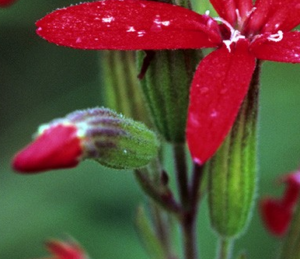
The leaves, stems, and the tubular calyxes just below the flowers of this Royal Catchfly plant are hairy and a bit sticky. Insects can get trapped – hence its common name of catchfly. This plant is not related to the carnivorous plants like the Pitcher Plant we find in bogs and wetlands in North America and whose genus is Sarracenia. The genus for Royal Catchfly is Silene. The stickiness of the plant is thought to be a defense against insects who would be destructive to the leaves and stems. Although insects landing on the leaves or stems will generally be trapped by the stickiness and die, Royal Catchflies do not ingest the insects who land on these sticky parts as carnivorous plants do. Hummingbirds, butterflies, and moths who foraging for nectar and are pollinating the plant either land on the flowers or hover and so would not be affected by the stickiness. Interesting, don’t you think?
Royal Catchfly was once scattered throughout most grasslands and prairies – particularly in Missouri – but now it is quite hard to find in these places. It is on the endangered lists of several states. Growing it in your garden helps to keep this plant from going extinct. Try it – just remember, it is tall! Also, this plant is generally not sold at garden centers. But you can order them online.
Light: Full to part sun. If in part sun, morning to early afternoon sun is bet – particularly if your Julys and Augusts have unrelenting hot days of temperatures over 90°F.
Soil and water: Medium to medium-dry soil. For the first 2 months after planting, water it deeply at least once a week. But after that period of time, it is somewhat drought tolerant. This plant needs to be in soil that drains easily and well – it will thrive on a gentle slope. It also prefers a sandier soil. If you have heavy clay like I do, be sure to dig out a lot of the clay from the spot you have chosen and replace it with compost and topsoil.
If you live in a hot dry area in July and August like I do here in central Illinois, during that time, the lower leaves could yellow. Keeping the plant watered during those periods helps and the yellow leaves can be removed. Remember, this is a tall plant. If you put it in the back of your bed and plant shorter things in front of it, those shorter things will most likely hide any yellowing leaves.
Hardiness Zone: Zones 4-9.
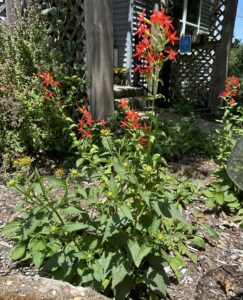
Size: 4 ft. tall x 2 ft. wide. This is a tall, somewhat gangly plant but I have never had to stake mine – and mine are planted in part sun. Here in central Illinois, we get a lot of wind – most every day. These plants sway with the breeze but always end up straight and tall. They have never flopped over. But 4 ft. is tall and if you are concerned or you have had other tall perennials not stand straight/flop, then I would advise you stake or support them.
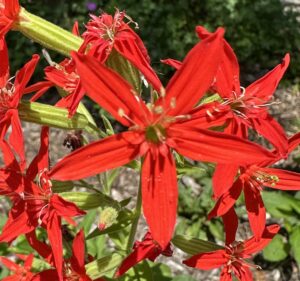
Bloom period and color. Deadheading: Blooms red/orangish red in July and August. I did some research on deadheading, and some sources recommend deadheading faded flowers by making a cut along the stem where there is an intersection of leaves – that this will promote a longer bloom. In my experience, that does not happen. I do not deadhead my plants but allow them to complete their growing cycle and produce seeds. They are NOT prolific self-seeders or invasive in any way so you will not have seedlings popping up everywhere in your garden – just a couple here and there and they can always be transplanted if they are in the wrong place or give them to friends.
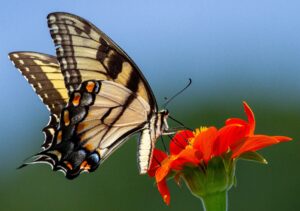
Butterflies and birds: Hummingbirds like this plant as do butterflies – especially the swallowtails.
Deer, rabbits, and other pests: These plants are generally not bothered by pests, however, newly planted seedlings or plants that have just broken ground in spring are vulnerable to rabbits. To be on the safe side, I would recommend spraying with a repellent until about June 1st – just follow the instructions on the label of your repellent.
What to plant with Royal Catchfly: I have mine planted with Black-eyed Susans (Rudbeckia) and Crocosmia and I love this combination. (Note: There are several species commonly called Black-eyed Susans – all Rudbeckia – and all would work with Royal Catchfly. Just be aware of size because some Black-eyed Susans are shorter than others and I would recommend the taller ones.) Shasta daisies would also be a good addition to this grouping. Royal Catchfly will also grow well planted among Yellow Coneflower (Ratibida pinnata) – just keep in mind that Yellow Coneflower is taller and needs to be supported/staked. But the red interspersed with the yellow is striking.
How to use Royal Catchfly: I have some planted where I place my hummingbird and oriole feeders. The hummingbirds will use the flowers and I think these flowers are more of an orangish-red and the Baltimore Orioles in our yard are attracted to the color orange. Royal Catchfly also works very well as a backdrop for medium tall perennials. When in bloom, they are showy, but not overpowering so will work with most plants. Just remember they like to be in well-drained soil – as do the majority of perennial garden plants
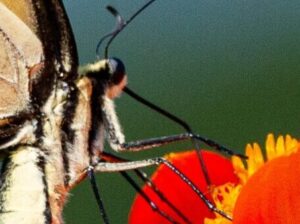
*Proboscis (from Merriam Webster) – the elongated, tubular, sucking organ of a butterfly.