

The Loggerhead Shrike
Over the next few weeks, I am going to talk about birds who were once common within their range and habitat, but whose populations are now in steep decline. Things in the United States are changing. The federal government is no longer protecting wildlife and habitats as they once did. I never think it is a good idea to get our news and facts from sources who are in the business of disseminating a point of view – liberal or conservative. So here is a document straight from the source. I got this from a US government website. It is an executive order from President Trump on this very subject. This is not opinion or rumor, but the actual executive order. It is a fact.
Click here: Administration of Donald J. Trump, 2025 Executive Order 14154—Unleashing American Energy January 20, 2025
(Note: if the document does not come up, wait a few minutes and try again. I have been able to read the document only off and on – the government host website reports it is having an error. It is not your computer or server, the error is on the government’s end. And that leads to a whole lot of questions????)
Here is a second link to try if the first one has an error – same document, different site. This is the site for the White House: Executive Order 14154
Right now, our federal government offers little to no protection for plants, wildlife, or our environment. That is a change. And after listening to the president and vice president speak to reporters, it appears that regulations requiring conservation plans before construction, mining, or drilling will be further lessened or eliminated. So, it is up to us who think these things should be a priority to make them a priority. The first thing is to vote this coming November for candidates that reflect your vision of what you want the US to be. And don’t just listen to the rhetoric or news talk show host opinions but look at what the candidates have done and what they say they plan to do. I think it is important for you to know where I stand in this – I am a former Republican who has been a registered Independent since Ronald Reagan appointed James Watt as Secretary of the Interior. But regardless of whether you are an Independent, a Republican, a Democrat, a Libertarian – however you fit into all this – VOTE!
The second thing is to support groups who have the same priorities as you do – or create your own. Over the next few weeks, I will be highlighting birds who need our help – our intervention. They are all heading towards extinction – some faster than others. And I will suggest a few ways to help for you to consider. It is time for us who care about preserving our vast and incredibly beautiful US for future generations – to step up with time, money, or both.
As I was researching the Loggerhead Shrike, I checked the US government’s websites. At one time, there was information on this bird and its decline. Also, some proposed action. The general information about the bird is still there but the documents that were once included are there in name only – their contents have been removed. (The notice did say “removed or moved” but I could not find them anywhere. It is my belief they have been removed. If you search for these documents and find them on a government website, please let me know and I will post the link.) These were documents assessing the population numbers for this bird and recommending action. Click here for the websites:
This is the website for the general species information that is still there: US Fish and Wildlife Service – Lanius ludovicianus
These are the documents that have been removed from this website with this explanation: “Sorry, the content you are looking for is not found or has moved.”
Keinath, D. A. & C. Schneider. 2005. Species Assessment for Loggerhead Shrike (Lanius ludovicianus) in Wyoming
USDA Forest Service. 2003. Conservation Assessment for Loggerhead Shrike (Lanius ludovicianus)
I think it is important that all of us who are interested in birds understand what is happening and how things have changed.
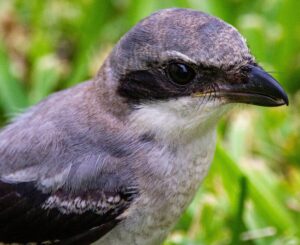
Back to the Loggerhead Shrike.
If you look at the range map in your field guide or on allaboutbirds.org, you will see if you divide the US in half, the Loggerhead Shrike is more of a southern bird – although it does nest in Canada. The habitat in which to look for this bird is open spaces. Short vegetation interspersed with scattered smaller trees, shrubs, thickets, brambles. They gravitate to plants with thorns. Look for them in overgrown agricultural fields and pastures, old orchards, desert scrublands, savannas, prairies, golf courses and cemeteries. Another good place to look is along the sides of rural roads that have fences with barbed wire, and utility poles with wires. They generally nest in thorny small trees, shrubs, and thickets. As you can probably guess, their main food in spring and summer is insects – particularly grasshoppers and beetles. In fall and winter, they switch to small rodents.
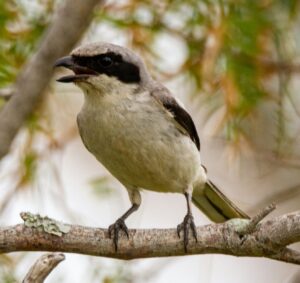
The North American Breeding Survey* data shows that this shrike’s population has declined by 2.5% each year since 1966 which is a total decline of about 75%.
This decline began with the increased use of pesticides on our agricultural fields. Grasshoppers are always a target for agricultural pesticides and this is the Loggerhead’s favorite summer food. Since pesticide spraying began in the 1940’s, these shrikes have been eating grasshoppers and other insects that are often covered with toxic chemicals. To add to that, their prime habitat is overgrown areas of shorter vegetation interspersed with brambles and thickets – and this is generally areas that are earmarked for our development into housing areas, strip malls, schools, and interstates. And one of the biggest habitat destroyers is mining – most especially surface or strip coal mining. Once those things are built or an area is mined, the habitat is completely changed forever. For most plants and animals – and birds like the Loggerhead Shrike – it is utterly destroyed.
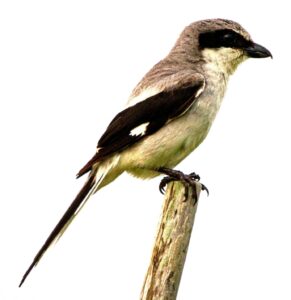
And Loggerhead Shrikes are picky about their nesting sites – which does not help them. They nest in thorny shrubs, brambles, and small trees. If those thorny areas are removed from the field or open area, the nesting site is lost. These shrikes seem unable to adapt to that loss. They will move on to try to find another area of thorns which is often not successful as we are removing those sorts of habitats at a fairly fast rate. No nesting site, no reproduction.
From the executive order from President Trump (and his catch-phrase which always creates roars of approval at his rallies: Drill, baby, drill!!!”), I am assuming the Loggerhead Shrike will not be taken into consideration if a mining company wants to open a new site, but there are other governments who are looking at this bird, its population numbers, and forming conservation plans. These shrikes nest in southern Saskatchewan – click here to read their entire plan: Saskatchewan Prairie Conservation Action Plan – Loggerhead Shrike
Click here for a success story for Loggerhead Shrikes from Indiana: Indiana Audubon. This is a program which you can support. And here is another program you can support if you are interested in assisting the work being done to help this bird recover some of its population. Loggerhead Shrike Working Group
As you are out walking your neighborhood, in your favorite park, or on a trail during these last days of summer, think hard about all this. What are your priorities? And how can you best work towards them? Happy Birding!
__________________________________________________________________________________________________________
P.S. Here is a short video from Cleon taken in our front yard. As I have written several times, we do not have many large butterflies at all. I believe we should have more because I do have flowers they are drawn to throughout my gardens during all the spring, summer, and early fall months. Click here to watch: Red-spotted Purple Butterfly.
It is amazing to me that butterflies spend part of their day fluttering around trees – in our yard, their favorite trees are all big oaks: pin and shingle. I type these blogs for you sitting at my desk at one of our upstairs windows – and looking out, I am just below the center line of one of the big pin oaks. I have watched one Black Swallowtail, one Monarch, one Viceroy, and one Red-spotted Purple (I am assuming the one in the video) all take turns to flutter around this area of the tree for the past about 10 days – most always in the late morning. These butterflies come one at a time – not together. Another reason for planting native-to-your-area trees. You might be surprised at how the butterflies flutter around and perch on big trees. And notice, I am saying one of each of these larger species – I am looking daily – and diligently! – and as far as I can observe, there is only one of each. Normally we have 2-3 of each one. Not this year.
This video begins with the butterfly fluttering at the base of an older pin oak with moss on its trunk, but the butterfly quickly settles on a pile of scat. I am not sure what this scat is – fox????? Maybe?????? I can say with a fair amount of certainty it is not raccoon, deer, rabbit, or possum. Butterflies like scat. No accounting for taste, right?
I have added another plant to the Landscaping and Gardening for Birds and Wildlife section of this website: Wild Ginger (Asarum canadense)
*North American Breeding Bird The North American Breeding Bird Survey