

The Northern Bobwhite
I am continuing this week with once common birds whose populations are in steep decline. Last week it was the Loggerhead Shrike. This week it is the Northern Bobwhite.
Last week, I explained that my recommendation is not to rely on news shows or social media, but to go straight to the federal government to understand its position on regulations governing industry, mining, drilling, and development. When you go straight to these executive orders written and signed by President Trump, you are dealing with facts, not someone’s opinion. I included the link to President Trump’s Executive Order 14154 – Unleashing American Energy. If you missed last week’s blog, here it is again:
Administration of Donald J. Trump, 2025 Executive Order 14154—Unleashing American Energy January 20, 2025
Here is a link to a federal government website for a second executive order from President Trump in March 2025. Click here:
Administration of Donald J. Trump, 3/20/25 Executive Order 14241 – Immediate Measures to Increase American Mineral Production.
On the top of page 3 of this executive order, you will read: To address the national emergency declared pursuant to Executive Order 14156 of January 20, 2025 (Declaring a National Energy Emergency), I hereby waive the requirements of 50 U.S.C. 4533(a)(1) through (a)(6). This is a link to what he is waiving:
50 USC 4533: Text contains those laws in effect on January 3, 2016 From Title 50-WAR AND NATIONAL DEFENSE CHAPTER 55-DEFENSE PRODUCTION SUBCHAPTER II-EXPANSION OF PRODUCTIVE CAPACITY AND SUPPLY
Executive orders 14154 and 14241 focus on relaxing, circumventing, or eliminating years of work of other Presidents and Congresses who spent much time, thought, and effort proposing, passing, and signing laws to protect our environment – for us and for future generations. These were the Presidents and Congresses who continued the work of President Ulysses S. Grant who created our first national park – Yellowstone – and President Theodore Roosevelt who greatly expanded our national park system. Both were Republicans.
I believe mining, drilling, and development are important. We all flip a switch to turn on lights. We all eat food cooked on gas, propane, or electric stoves. Most of us drive cars. We heat and cool our homes. We use products that are dependent on mining and drilling every single day. Many of us live in housing developments. We drive on interstates. We shop in big box stores and strip malls. We park in parking lots. We all use plastic. And so many of us now have cell phones, computers, and even electric cars – all which have batteries made from materials that are mined. The list goes on and on. My guess is none of us would like to give any of this up. But there has to be thoughtful consideration given to the consequences of destroying habitats each time we completely alter a huge area – often destroying forever what was there. Not just live mindlessly by the mantra “Drill, baby drill!”.
Elected officials – and the people they appoint – make decisions involving where there will be mining, drilling, and developing. I believe everything must be taken into consideration – both the pluses and the minuses of a site. They need surveys of what is in the habitat(s) being developed, exploited, destroyed. Is it worth it to push a species towards extinction so we can have another place to shop? Is it worth it to drill at or close to the Arctic National Wildlife Refuge when the extreme temperatures make any spill almost impossible to clean up and those same temperatures make it almost impossible for the habitat to recover? Just so we can drive more cars or fly on a greater number of jets*? (Click here for more information: from USGS – Dept of the Interior – Oil spills and polar bears. Click here for an overview of our federal government’s policy beginning with the first Trump administration: from the Congressional Research Service** – An Overview of the Arctic National Wildlife Refuge.)
We need to take a good hard look at ourselves. Could we be more energy conscious? Could we use less plastic? Recycle? Turn lights off? Do we always need the newest cell phone? Etc. Etc. Etc. If we don’t want plants and animals to go extinct, if we don’t want large tracts of habitat destroyed forever, are we living the best lives we could live to preserve and even enhance all life other than just our own? Do we really need so many possessions of manufactured material? Can’t we renovate abandoned buildings instead of always building new? Can’t we reclaim old building sites for new projects instead of clearcutting a woodland or scraping all the soil from a field to build over it and then pave it? Questions to ponder when you are walking through your favorite park, woodland, field, or wetland with your binoculars slung around your neck, breathing deeply, and watching and listening for birds. Look around – is all you see worth destroying so human beings can have MORE?
And now another bird who was once common in our central and southern states – from The Rocky Mountains to the Atlantic coast. It is also found – in ever declining numbers – in Washington and Oregon. The Northern Bobwhite. Even though this is a good-sized, quite round and chubby bird, it is so well camouflaged that you will rarely ever see one. In fact, if you are walking through a grassland, a bobwhite will not flush until you almost step on it and when it bursts into flight right in front of you, it will explode into a mass of feathers and scare the living daylights out of you! You will never forget the experience! And once your heartbeat is back to normal, you will break out into a big grin! What a great bird!
If you are in or close to grasslands, you may have heard one – more so in the last century. There is almost always more than one and they do call back and forth to each other. However, their calls no longer ring out over grasslands as they once did – so many grasslands are now more silent. A bobwhite’s call is easy to recognize since the bird says its name. Click here: Calls of the Northern Bobwhite.
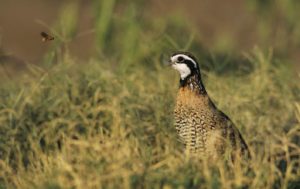
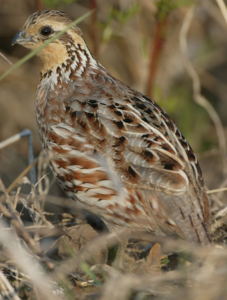
Here is an outstanding PDF published by The US Department of Agriculture in 1999 about the Northern Bobwhite: Northern Bobwhite. 1999 was during the terms of President Bill Clinton.
The North American Breeding Survey*** has reported that between 1966 and 2019, the Northern Bobwhite lost 3% of its population each year. Their population numbers are now down 81%. Why?
When birds start decreasing in number, the number one cause is often either loss of habitat or habitat degradation. And this is one of the main reasons bobwhite population is in steep decline. Their habitat is open grasslands – prairies, fields, meadows with borders of hedgerows/edge areas of overgrown thickets and scattered trees. They especially like large areas of warm season grasses**** and the plants that usually grow with them. Their main foods are seeds, leaves, and insects. As with the Loggerhead Shrike, areas like this are often taken for development. And if the habitat is degraded by overgrazing, invasive plants, constant mowing, or the hedgerows are removed, bobwhites disappear.
Bobwhites who live in hedgerow/edge areas of agricultural fields are badly affected by the use of insecticides and herbicides in those agriculture fields. These chemicals are often applied on breezy days and so the chemicals do not simply fall on the targeted areas but are wind-born to a good portion of the surrounding area – this is called drift. You can demonstrate this for yourself. Stand outside on a breezy day (wind between 8 and 12 mph) and spray water towards the ground. Notice it does not just dampen the area directly under the nozzle, but some of it drifts with the wind. Most agricultural fields are sprayed and most days during the growing season are not devoid of wind – especially here in the Midwest and on the Great Plains.
These chemicals are all timed to be used on the fields for optimum results. For example, some herbicides are pre-emergent which means they must be used before plants break ground. Insecticides target insects at a specific stage of their growth so must be used when that occurs. The window of opportunity for each chemical to be applied is not long. If it is breezy every day during that window, the chemical must be applied anyway or whatever it is targeting may ruin this year’s crop. If you are a farmer with a farm and family to support, these are not easy decisions to make. Our world population continues to increase and the crops from US farmers feed not only us here in the US, but people all over the world.
Here is a situation to think about: A farmer has a 200-acre filed planted in a crop. Surrounding the field is a wide hedgerow/edge of good habitat for bobwhites and Loggerhead Shrikes. All sorts of thickets, brambles, tall warm season grasses, shrubs, several small trees. Both birds are present and probably nesting. The crop is vulnerable to beetles – a favorite food of both birds. The daily temperatures are now optimal, the vegetation is not yet too big to prevent good coverage, and no rain is forecast. But day after day the winds are at about 10-12mph. If you were the farmer, would you spray? (The accepted industry standard for wind speed is about 10mph – over that and there will be drift. My opinion is that is too high – I think drift can occur at lower wind speeds.) If you spray, the beetles will be controlled, and you should get a good harvest. However, the drift will greatly affect the plants and insects in the hedgerow/edge where there are nesting bobwhites and shrikes. If you do not spray, you are taking a big risk that you will either lose your crop, or your harvest will be negligible. However, the nesting shrikes and bobwhites will not be affected – but both birds could lose their nests for other reasons. What would you do?
These are the kinds of decisions that face individual farmers. If one farmer sprays when it is too windy and the bobwhites and shrikes are adversely affected, that is not a threat to the overall population of either bird. If many farmers in a large area spray when it is too windy, that could cause a big drop in population numbers of both birds – plus many other plants, animals, and insects. But if farmers do not spray during their windows of opportunity, a large percentage of the crops will fail, not be available for consumption, the farmers will have no income from the field for that year and as a result, may have to apply to the government for assistance.
Something that Loggerhead Shrikes do not contend with – bobwhites are hunted. You might wonder how it can still be legal to hunt bobwhites when their population numbers everywhere are decreasing at an alarming rate? Quail hunters kill bobwhites BUT they are also an ally for this bird. Ask anyone who hunts bobwhites and they will tell you these birds are becoming more and more scarce – some states have now banned hunting of bobwhites. Hunters have been at the forefront of trying to save habitats and to repopulate bobwhites where they were once prolific – with mixed results. Quail Unlimited is the big, nationwide non-profit group whose main goal is habitat protection for all quail and reintroducing populations to areas where these birds were once prolific, but now either gone or in numbers too low to sustain hunting. But can their efforts continue? Click here for information: South Carolina’s Quail Unlimited and Quail Unlimited in Texas.
Canada has had the Northern Bobwhite on its endangered list since 1994. The bird was re-examined and its place on the list was re-confirmed in 2023. Bobwhites are considered critically imperiled in Arizona, Wyoming, Wisconsin, and West Virginia. They are imperiled in Michigan, Massachusetts, and Tennessee. It appears the bird is extirpated***** in Pennsylvania and New Hampshire. For information from Pennsylvania, here is a site from their state government: Information on bobwhites and their status from the Commonwealth of Pennsylvania.
What can you do to help? Here is a great place to begin: The National Bobwhite and Grassland Initiative at NBGI. There is a pilot program for landowners in several states through the federal government.
If you own habitat that would be suitable for bobwhites, here is another program you might want to check into this to see if you would qualify and if the program would suit you: USDA – Natural Resources Conservation Service
If you would like to send money or volunteer, here is a program that would welcome your help: Theodore Roosevelt Conservation Sponsorship
If you live in Texas, Oklahoma, or Louisiana and would like to know the status of bobwhites, try this site. There are no groups listed that need your help, but it is a wealth of information as to what is happening. You could use this information to begin your own group. Bobwhites in Texas, Oklahoma, and Louisiana
More help is being given to Northern Bobwhites than most birds whose populations are in steep decline. That may be because these birds are also targets for hunters. Hunters do kill animals and birds but they are also largely responsible for working to protect the habitats where their prey lives. An excellent example of good work from hunters is the duck stamp program started by waterfowl hunters over 90 years ago: Duck Stamps.
I will continue with another common bird whose population is in steep decline next week. Until then, Happy Birding! Linda
*Oil that would be taken from drilling into areas of the Arctic National Wildlife Refuge would be crude oil – most of which would be refined into transportation fuel: gasoline, diesel, and jet fuel are examples. Click here for more information on oil and gas in this wildlife refuge: Arctic National Wildlife Refuge: Status of Oil and Gas Program and Coastal Plain of the Arctic National Wildlife Refuge
**Congressional Research Service. What is it? It is a nonpartisan group under the Library of Congress. Click here for more information: Congressional Research Service.
***For more information on the North American Breeding Bird Survey: North American Breeding Survey.
****Warm season grasses are grasses that grow in warmer weather and thrive in temperatures higher than 75°F. Includes grasses such as switchgrass, big bluestem, little bluestem, grama, Indiangrass. If we are planting grasses, we tend to prefer cool season grasses which do not make good habitat for bobwhites. Grasses such as: Kentucky bluegrass, perennial ryegrass, bentgrass, fescue. These grasses prefer cooler temperatures and grow well in spring and fall.
*****Extirpated – a local extinction. The species is present in other areas, but not in the defined area. In this case, the defined area is the entire state of Pennsylvania.