

Golden Alexanders (Zizia aurea)
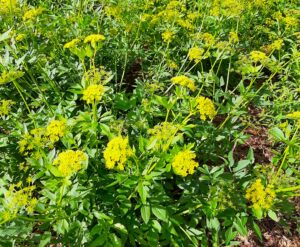
This is an interesting native plant for gardeners in that it allows you to choose just how much of a gardener you want to be – how much attention do you want to pay to it throughout the gardening season. Very little or much attention will not harm this plant, but it will change how it looks. I will explain under Deadheading. Another interesting aspect of this plant is it is a member of the Carrot Family – I never would have guessed that.
Light: Full/part sun. I have several of these plants in my garden – all in part sun. One even self-seeded under a hickory tree and it is growing fairly well. I left it there to see what would happen – it has been there three years and blooms fairly well. Not as well as the others but I can always count on several flower stalks each spring and it does brighten up this area. However, I would recommend if you plant Golden Alexanders, place them where they will get at least 6 hours of sun a day – more is better.
Soil and water: Regular garden soil. Mine are growing in soil that is fairly heavy with clay, and my research tells me this plant will also grow well in a sandier soil. This plant likes a soil ranging from medium wet to medium dry.
Hardiness Zone: Zones 3-8.
Size: The flowers on this plant are on sturdy stems that grow above the plant’s mound of leaves. These stems do not need to be supported. In bloom, this plant is about 3 feet tall. After deadheading, the plant will be about 1-2 feet tall. The plant will be about 1-2 feet wide.
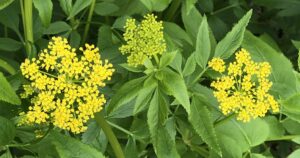 Bloom period and color. Deadheading: This plant blooms yellow. Plant tags and references often list the bloom period as April, May, and June. That is the correct period but your plants will not bloom for 12 weeks. However, this is a longer blooming perennial. The average bloom time for perennials is about 6 weeks. Golden Alexanders will bloom about 8 weeks or a bit more. Here in central Illinois, my plants burst into bloom about mid-April and are finished in the first or second week of June.
Deadheading: Golden Alexanders produce attractive seedheads so it is your choice whether or not to deadhead. But deadheading will make a difference in the appearance of the plant. And remember, after reading through all this, you do not have to do any of it – particularly if your plant is mixed with other good sized plants or is in a pollinator border – someplace where the declining foliage will not be noticed. If planted in a location such as this, you do not have to do anything but cut the entire plant down to the ground early the following spring.
Ask yourself a question before placing Golden Alexanders in your garden and before you decide how – or if – you want to deadhead. Perennials have two roles in your garden. The first is to provide a good bloom for about 6 weeks. The second is to have leaves and stems that look good for the rest of the growing season. One of the reasons native plants are manipulated into hybrids and varieties is to strengthen weak points of a species and one weak point some native plants share is that they look great when blooming, but not so much after they bloom. They decline – especially through the leaves which slowly turn yellow then brown.
Examples of this trait would be the non-native spring-blooming bulbs we all love so much: daffodils, tulips, hyacinths. They look great when they first break ground with their sturdy leaves. They are gorgeous when in bloom. Then the bloom fades and the plant starts to decline towards dormancy and this can take weeks. And as the days go by, the plants look worse and worse until finally the leaves are dead and you can cut them at ground level. Some people choose to cut the entire plant to the ground as soon as it is finished blooming but that is quite detrimental to the plant as those slowly dying leaves produce a whole lot of sugar and nutrients which are stored in the bulb and that is what produces the following year’s blooms. If you do not allow the leaves to do that, next year’s blooms will not be as grand and the plant bulb will not spread.
Golden Alexanders are similar to this. While the leaves will not die back completely, it you allow the plant to set seed heads, then self-seed, the mound will not be as lush – it can even get thin and straggly. If you want the mound of leaves to look good for the remainder of the growing season, cut the stalks of the flowers as they fade at ground level – reach within the mound to do this. Do not allow seed heads to form. And there is a second step to keeping these mounds looking their best.
Every two weeks, check your plants. Look down into the mound and see if there are any new leaves breaking ground. If there are, take your pruners and cut all the old leaf stems off at ground level.
All you will now see are those new leaves emerging. Within a week or two, you will have a fresh new mound which will look great until the first hard frost.
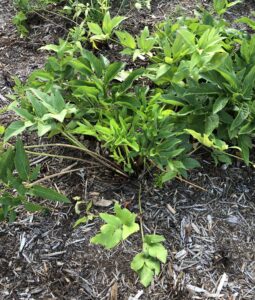
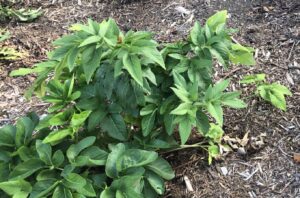
The photo on the left shows an untrimmed mound of leaves after blooming. The tall leaves are just beginning to turn yellow. Notice new green leaves are emerging from the base of the plant. When that starts to happen, cut all the older leaves off at ground level leaving a new mound of fresh green leaves which will form a mound about 1-2 ft. tall and look good for the rest of the season. And when does this happen? It varies from plant to plant and from year to year. Once you cut the faded flower stalks off at ground level, check each plant every two weeks and when you see new leaves starting to emerge from the base of the plant, it is time to remove the leaves that emerged from the ground in spring by cutting those leaf stems at ground level.
If you would like your plants to self-seed: Golden Alexanders will reliably self-seed, but they are not aggressive or invasive. You will find new plants the following spring here and there in your garden. You can leave them where they are, transplant them to where you would like them to be, you can share them with friends, or they can easily be pulled up or hoed out. If you do allow your plants to form seed-heads, I think the seed heads are quite attractive. They provide a good color and texture to surrounding plants that may or may not be in bloom. Just be aware that by allowing them to self-seed, the mounds of leaves may look a bit straggly. Golden Alexander will hold its seed heads upright for most of the entire growing season. It drops the seeds in late summer and fall.
Butterflies and birds: Sparrows and finches seem to like these seeds. These plants attract beneficial insects and are host plants to swallowtail butterflies.
Deer, rabbits, and other pests: A far as I know, deer do not bother this plant, but it has always been a favorite for rabbits in early spring. As soon as the leaves break ground in April, I spray mine with a repellent – just follow the directions on the label.
What to plant with Golden Alexanders: In my front garden, I have several planted with Mexican Hat. Golden Alexanders bloom in spring and Mexican Hat is a summer bloomer. Mexican Hat is a big, dense plant and it will hide the declining foliage on the Golden Alexanders. I allow these Golden Alexanders to set seed. I have a pollinator border on the side of my house at the edge of the lake and there are several volunteer Golden Alexanders from the plants in the front garden. My guess is birds planted them. In my pollinator border, these Golden Alexanders are with Missouri Ironweed, Japanese Iris, Purple Coneflower, Cupflower, and Maximillian Sunflower. I also allow these Golden Alexanders to set seed.
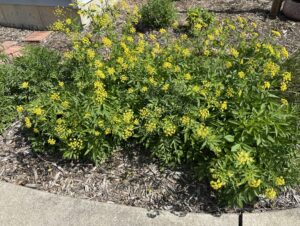
I have two more volunteer Golden Alexanders in a bed with Rattlesnake Master, perennial Geraniums – also called Cranesbill, and Gray-headed Coneflower. In this bed, I want a nice-looking mound of foliage after the bloom so I deadhead these Golden Alexanders as their flowers fade – I do not allow them to form seedheads.
How to use Golden Alexanders: I designed, helped plant, and then was head gardener to a 2100 sq. ft. formal, native plant garden at Rock Springs Nature Center in Decatur, Illinois for a number of years. Golden Alexanders was one of the plants I chose and because this was a formal garden and we did not want volunteer plants of this species, we deadheaded these to the ground as the flowers faded. With these plants, we have Prairie Dock and Compass Plant – 2 very big species of native prairie plants which served as the backdrop. These Golden Alexanders are planted en-masse and make a beautiful showing in April and May. Because they are deadheaded as the flowers fade, the mounds of foliage are a good contrast to the huge, sculptural Prairie Docks and Compass Plant.
They can be used as a mass planting, as a single plant or grouping of three in a perennial garden, or as part of a pollinator border.