

Still more photos from some of you and more from our yard/wildlife refuge
Our good friend Janelle, who lives here in central Illinois, has been updating all of us with videos of her Red-shouldered Hawk nest in which there are 2 youngsters – who look like they are getting bigger and bigger. We have been to her house to watch through our scope, and we must remain at the outer limits of our scope. Both the adult male and female are quick to fly right at us. As long as we stay at scope range, they watch us but seem fine. We never observe for long periods of time so as not to upset them. We are not going to harm them, but they do not know that. Concentrating on us takes their concentration away from things that could harm them or their young. We do not want to divert their attention. Here is one of the latest videos: Red-shouldered Hawk Family.
Miles is our neighbor and good friend. He helps us with things outside we no longer do like lug around big bags of mulch, move heavy rocks, use the chain saw to cut up wood, and climb ladders. He is here most Monday or Tuesday mornings for an hour or two – you might see him from time to time on either livestream. He is the young red-headed man most often pushing a wheelbarrow. He has raccoons at his house and is thrilled! Not everyone would be thrilled to have raccoons, but Miles is. We have a good number of raccoons here in our neighborhood – perfect habitat for them. There is a video or two of raccoons in our yard under the bird feeders at night – even one with a possum. You just never know who is going to show up after dark! Just go to Videos on this website. But here are the photos Miles sent of the 2 youngsters all nestled in a tree stump in his yard.
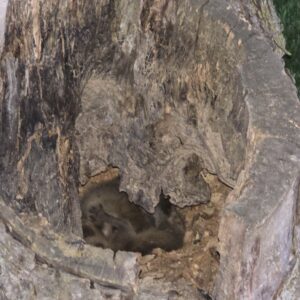
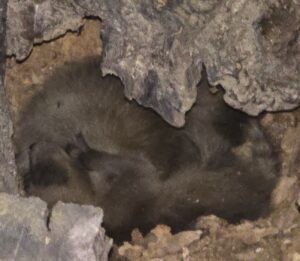
So cozy!!!!!
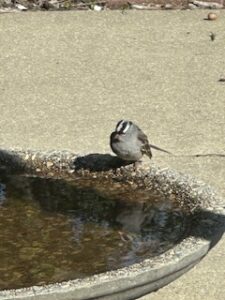
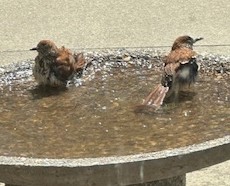
And we have lots going on in our yard:
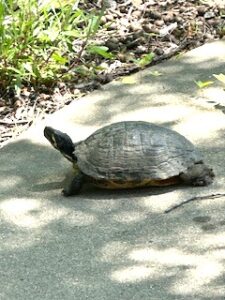
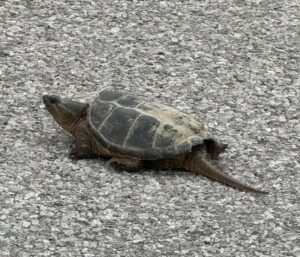
Spring is a great season for turtle watching here on our small lake. It is the start of their nesting season, and the females are up and out of the lake looking for soft, easy soil in which to dig a hole to lay their eggs. I have no idea if either of these turtles is female, but I think they could be. When the female of any species digs a hole in a garden, it can be hard to see where she dug – after laying her eggs, she fills the hole and even tamps the soil down a bit. Some will cover the soil with bits of leaves and plants to hide the fact there is disturbed soil. We did look, but found no trace of a nest. The best time to find a nest is after the eggs have hatched – the babies dig themselves out of the hole and move straight towards the water – and safety. The hole is then exposed.
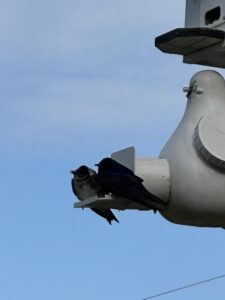
My cousins and I go plant shopping one Friday in May every year. We head towards the Vandalia/Effingham part of Illinois and spend the entire day at Amish and family-owned greenhouses. There were 5 of us this year and 3 large SUV’s were barely enough. We are all gardeners! If you have followed my blog, you know I have posted about this in at least one previous year, but I just love this greenhouse, so I am posting again. It is Amish-owned and operated and the father builds Purple Martin houses and what this man does not know about Purple Martins is not worth knowing. He is ready to talk about these birds – he will answer all your questions, tell you stories, and listen to yours. When you pull into the driveway of their greenhouse/farm, the Purple Martin houses are spaced right along the drive. When you get out of the car, you feel like you are surrounded by these birds – they are calling and flying and interacting. It is just the most wonderful sight. Click here for a video – and turn up your volume so you can hear them chattering: Purple Martins at Zimmerman Greenhouse, Vandalia, IL If any of you are ever in central Illinois in spring and early summer, this greenhouse is worth a visit:
Zimmerman Greenhouse
1386 E. 1050 Ave.
Vandalia, IL 62471
618-846-2874
And remember, they are Amish so are closed on Sundays.
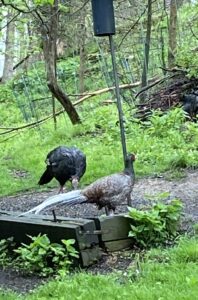
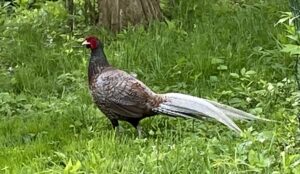
Here is an interesting bird. This photo was sent to me by Paul in Pennsylvania. Although Ring-necked Pheasants can have varying plumage, he does not think this is a Ring-necked Pheasant. And I agree with him. He took his photos to local expert birders, and they all agreed this is a bird that has been bred. Possibly released for hunting. Possibly escaped. No way of knowing. Paul did say this bird is ‘friendly’. He can get close to it before it will move away – that is a behavior trait of birds bred for hunting. Bobwhites, pheasants, and quail are birds that are often raised from the egg and then released for hunting or to repopulate an area where certain species have been extirpated. These birds rarely survive past their first year. Most experts now agree that these birds all share a behavior trait – the female (mother) teaches the young how to survive by example and also discipline if a youngster becomes too unruly or adventurous. If there is no mother, the young do not learn these skills and behaviors.
Cleon and I still laughingly recall that when we lived in West Virginia, we watched 3 female (mother) turkeys strutting along our garden fence through some taller grass with their about 30 youngsters. He and I were quietly sitting on our porch and one of the youngsters broke away from the group to come towards us. We think it was curious. One of the females came right after it, walloped it with her wing, then shooed it back with the others. Tough love. But my guess? Necessary. Those youngsters had a lot to learn about the dangers of the world if they were going to live to see their first birthday. We human beings are predators – and we cannot be trusted. The female was right.
Here are Paul’s photos:
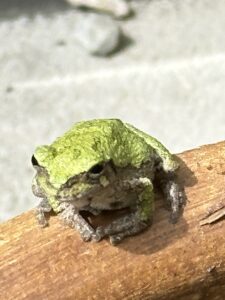
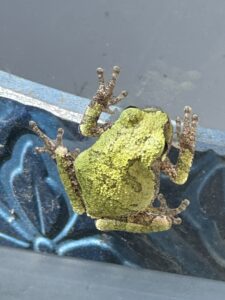
And last, but not least – look what greeted me when I walked into my small greenhouse yesterday! What a great way to start a morning!
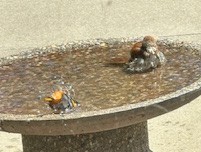
P.S. We have at least 3 House Finch families on both livestreams right now. For the next week or so, the youngsters will be with their parents begging for food. They will also be learning how to take baths. All this can be seen on our cameras. The young will be crouching, tilting their heads upwards, and opening their mouths. The parents will often pop seeds right in. As the days go on, the parents will start ignoring these constant beggings for food – the young have to be forced to start fending for themselves. When the young get hungry enough, they will start their own foraging. As long as the parents are at their beck and call – popping food into their mouths at every begging gesture – the young will never learn. Just like the female Wild Turkey – tough love. Necessary. The world is a tough place for young birds – many never live to see their second year.