

Blueberry Bushes (Vaccinium)
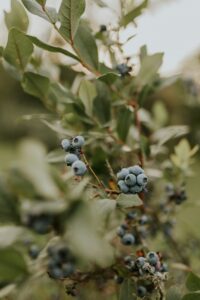
All blueberry plants you buy are hybridized. They will all bloom well, produce good crops of berries, have good fall color, and all have good shapes so require little pruning. Sizes will vary from about 2 ft. tall and wide, to about 7 feet tall and 5 feet wide. Read the plant tags to make sure you purchase the shrub of correct size.
Before planting a blueberry bush, the most important thing to consider and evaluate in your garden is your soil. It must be acidic. In a smaller area (large enough for 3-4 bushes), acidity of soil can be fairly easily and inexpensively changed, then maintained, to meet the needs of a blueberry bush. More information below in Soil and water.
In my experience, blueberry flowers (and swelled buds that are ready to bloom) will take a touch of frost, but they will not survive a freeze. The bush will be fine but no berries for that year. It could matter where you purchase your plants. All blueberries bloom in early to mid-spring and each hybrid will have its own 2-week period of bloom so it is important to know your area’s spring frost date and when your hybrid will bloom*. But these 2 weeks are not just dependent on the variety but also on what is called the chill hours. Blueberry bushes are able to adapt – at least somewhat – to where they are planted and the plant tends to put out flowers when the time is right. But for the plants to adapt to the area in which they are planted – most especially if they were grown in an area much farther south – it takes at least one full year. Blueberries are more flexible than other flowering plants who will bloom at the same time, regardless of temperature and weather in the weeks prior. If you live in our northern states or in mountainous areas where spring can come late, consider buying your blueberry bushes from a local garden center or nursery – where the plants have been for some time and have become more accustomed to the seasonal change. If you live in northern states such as Wisconsin, Vermont, or Idaho, ordering plants on the internet from a nursery in North Carolina could be a problem for the swelled buds and flowers for a year or two until the plants are acclimated.
Light: Full/part sun.
Soil and water: Blueberries thrive in moist soil. A 2-inch layer of mulch will help keep the soil evenly moist. They will grow in sandy soil, a heavier soil, and also a soil that is sometimes saturated. Avoid heavy clay soils. But what is more important than texture and composition is the acidity.
Have your soil’s ph tested before investing in blueberry bushes. You can have this done professionally or you can buy a soil test kit and do it yourself. If your state university has an extension system, contact your county’s extension – they should be of great help with soil testing.
Soil ph is measured on a scale of 0-14. 0 is the most acidic and 14 is the most alkaline. 7 is neutral. The majority of plants – like most perennials, annuals, and your lawn grass – like a ph around 7. Blueberries do not. They like the soil ph to be from 4 to between 5 and 5.5.
If you have had your soil tested, follow the recommendations to make your soil more acid. If you are testing the soil yourself and you need to lower the ph, one of these can be added: sulfur, aluminate sulfate, or iron sulfate. Follow the directions of your test results and also the directions on the bag. I strongly urge you not to add anything to your soil until you test it. Guessing what your soil might need – or might not need – can lead to a big mess. And a lot more costly additives to correct. And you will probably lose a year in your garden while you are fixing your mistakes. Take the time, spend the money. Get your soil tested.
Another way to gauge the acidity of your soil is to look around you. What is growing? Thriving? Common plants that thrive in more acid soils are azaleas, rhododendrons, hollies, and hydrangeas. Are any of these close-by? Are they growing well? With or without added acid? If without, your soil may be more acidic.
If your soil is at the correct acidity level – or close – there are a few things you can add to your soil to maintain that level or to make a small correction. I have always lived in areas of higher acid soils and so have never had to use sulfur, aluminate sulfate, or iron sulfate. However, to maintain the acid level, I do add coffee grounds to my blueberries. Cleon makes all our coffee and uses a French press. The grounds are all in the bottom of the large glass container. When we have finished all the coffee, he just fills the container with water and goes outside to dump it around a blueberry bush – and he has the 4 bushes we have on a rotation. Each gets coffee grounds about once a week from mid-April until the 1st of September. Another good source of acid is oak leaves – we have an abundance of these. Mother Nature mulches these bushes herself each fall. In early spring, I rake the leaves from around the bushes and run our mulching lawn tractor over them to shred them – it does an excellent job. I then put the shredded leaves back around the bushes as mulch for the spring and summer. As these leaves biodegrade over the spring and summer months, they slowly release acid into the soil. My 4 blueberries are thriving. Of course, we only get a handful of berries each year as the robins and catbirds always beat us! And we are fine with that. If you want more berries for yourself, see Berries.
Hardiness Zone: Zone 3-7. Generally, Zone 8 and always Zone 9 are too hot and this bush needs a colder temperature for winter dormancy.
Size: Anywhere from 2’x2′ to 7’x5′. Read the plant tags for each plant. All blueberries you buy are hybrids and each hybrid will be a different size. But all hybrids are generally within this size range.
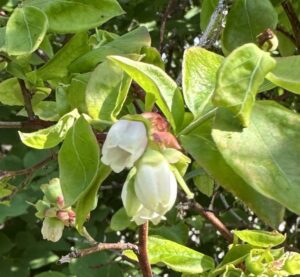
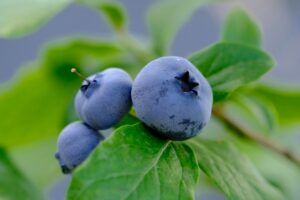
Bloom period and color. Deadheading: Blooms white in spring. Clusters of bell-shaped flowers.
Berries: To produce the most berries, plant at least 2 different hybrids. You will get berries with several bushes all the same hybrid or even just 1 bush, but you will get more with at least 2 hybrids.
Your first big crop of blueberries will come when your bush is about 6 years old. Most often, a nursery or garden center will be able to tell you how old the plant is you are buying – typically they are 1-3 years old. You will get some blooms and some berries the first few years, but it is at year 6 of the plant that it really comes into its own. Every year after that, the bush will bloom well and produce a lot of berries for the rest of its life. You just have to give it time. So, keep that in mind. If you buy a smaller, less expensive 1 year old plant, you will have about 5 years to wait for that first big crop.
Depending on the hybrid, blueberries ripen anywhere from the beginning of July through August. If you have many berry-eating birds in your neighborhood such as:
American Robins Gray Catbirds Cedar Waxwings
Eastern Bluebirds Northern Mockingbirds Hermit Thrushes
all Orioles Indigo Buntings
consider placing a net over each bush from early June until harvest is finished – there are birds that will devour green, unripe berries. And a word of caution – I would not have believed this if I had not seen it with my own eyes. When we first planted our bushes, we netted them. Cleon and I love blueberries and wanted the berries all for ourselves. It was mid-July, our bushes were all securely netted, and yet we were seeing the number of blueberries go down each day – and it was not us. What is the world was happening? I’ll tell you what was happening. A very enterprising and brilliant robin, dug through the mulch using its talons and beak until it could slither under the netting. Hopped up on the branches, gorged itself on berries, then returned to the exact same spot and slithered back out. Each day, it dug itself a new entrance. Although we had considerably less blueberries for our cereal bowls, we had to admire that robin. What chutzpah! So, it is not enough to secure the netting with a few bricks, rocks, or pins and tucking the edges under the mulch. To keep that bird out, we had to place the bricks end to end encircling the entire bush.
After that, we decided to let the birds have the majority of the berries. We still got quite a few, but it really is fun watching the robins and catbirds – with all sorts of aerobics – relish feasting on those berries. I now have a hybridized blueberry that is recommended for container-growing which I keep in my greenhouse all year round. No birds allowed! Those are our berries!
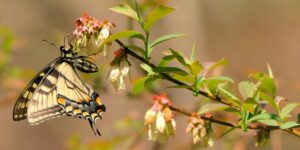
Butterflies and birds: Butterflies and moths can use the flowers for nectar. Berry-loving birds will eat the berries – and sometimes even before they are ripe!
Deer, rabbits, and other pests: Deer can browse on blueberry plants – especially as they are leafing out in early spring. To prevent this, use a repellent and follow the directions on the package or bottle.
If the leaves begin to turn yellow, that is an indication your soil ph is too high – your soil is too alkaline. Before adding things like sulfur, aluminate sulfate, or iron sulfate, do a soil test and follow the suggestions from the results. I try 3 things when this happens and all work well.
1. If I have not been adding coffee grounds, I start adding coffee grounds. I also use coffee grounds on my hollies and roses. If those plants are in good shape, I will stop adding the coffee grounds to those plants and put all of the coffee grounds on the blueberries for about 6 weeks.
2. Just to remind you, my website is totally independent – no endorsements. No favors. Just me. So when I recommend something to you it is because I have tried it and it did exactly what it was supposed to do. I use Holly Tone – an old fertilizer brand. I probably use this because when I was a little girl, we had a few azaleas as foundation plantings in our front yard and my dad used Holly Tone on them every spring – they were beautiful! So, I have continued with that brand and I think it does a very good job. Holly Tone has branched out into other fertilizers so just make sure that on the front of the bag it says the one you are buying is an acid fertilizer or look for at least 2 of these plants to be listed: azalea, rhododendron, hydrangea, camellias. Just follow the instructions on the bag. This is a granular, slow-release fertilizer which will slowly add acid to the soil. This will help stop the yellowing of leaves. However, sometimes, that is not enough. Along with Holly Tone, and especially if the yellowing is severe ……
3. If your case of yellowing leaves is more severe, I use a Miracle Gro product called Miracid. This is a powder that is mixed with water in your watering can. If you choose a different brand, just be sure the label says it is for acid loving plants and then lists the same plants as in #2. Follow the directions as to how much to put in your watering can, but because you are using this as a remedy and not as a fertilizer, use an entire watering can on each bush and be sure to thoroughly soak the leaves – blueberries absorb much through their leaves. And do this once a week for 4 weeks. Your leaves should be decidedly greener at the end of a month. If you have had to use this product, then I would recommend adding the Holly Tone granular fertilizer to the soil around your bushes twice a year for as long as you have your bushes – once in early April and once again at the end of June. Never add fertilizer after July 15th regardless of where you live. You do not want to push out new growth that does not have a chance to harden off before fall frosts. And even if you live in our southern states, the weather has been so wacky over the past 20 years, you just never know if or when you could get a totally unexpected cold snap.
What to plant with blueberries: If you are growing berry bushes for birds, good companions are elderberry, any of the viburnums (read the tags for sizes as some viburnums get big), and serviceberry (which is a large shrub or small tree). Blueberries bloom well and at about the same time as forsythia and lilac. These 3 will provide a nice grouping of shrubs with spring bloom.
How to use blueberry bushes: Blueberries can be planted next to each other and used as a hedge. With some pruning, they can be planted under windows and used as foundation plantings. The shorter hybrids can be used as focal points in flower beds. White flowers, blue berries, red fall color. Will look good with all the rest of your flowers!
*Some of the newest Growing Zone maps have changed the Growing Zones and frost dates in both spring an fall. For example, here in central Illinois, our frost date is now listed as April 23rd. My gardening friends here and I are not sure we totally agree with that??? We are more comfortable with between May 1st and May 15th. It is easiest for me to remember it is around Mother’s Day. Especially for tomatoes and peppers who not only do not tolerate one iota of frost, but they like a warm soil. But I digress – back to blueberries. Our 4 blueberry bushes all bloom in April. This year 3 were touched with just a bit of frost right before they bloomed and all are doing well – a good bloom on all 3. The 4th is the earliest to bloom – early April – and the ready-to-open buds got zapped by 2 nights in a row of temperatures in the low 20’s. Many of the buds were damaged. It is blooming, but the blooms are sparse. Our blueberry bushes always bloom before the April 23rd frost date. Most years that makes no difference. This year, to one of the bushes, it did.
If you live in a colder growing zone – Zone 5a to Zone 3 – plant your bushes in more protected spots. Also covering them with frost cloths or a double layer of burlap the afternoon before a cold night in late March and April will go a long way in protecting the buds. The problem occurs when there are warm days at the end of February or through March which trick the bush into thinking only warmer days are ahead. It is when the buds start to swell prior to bloom that they are at their most vulnerable. And that is what happened to our earliest blooming blueberry this year. We had about a week of very warm days in March – all over 70 with nights in the high 40’s. And then in the first week of April, those 2 nights in the low 20’s. After those 2 nights, most of the swollen, ready-to-bloom buds were far too damaged to bloom. The bush itself is just fine and if all goes well, will bloom profusely next year. But very few berries this year. Who is going to explain this to all the robins and catbirds who stuff themselves with these berries?