

Vireos – so easy to overlook!
When I was a beginning birder – and actually way past those first years – I tended to ignore Vireos. These are not obvious birds at all. They are all small, most often not brightly colored, and their songs can be easily overlooked. And in those first years of birding, I was overwhelmed by warblers so could not even imagine starting on vireos. Like vireos, warblers are small, not often brightly colored (except in tiny patches), many of them also live at the treetops, but there are many more warblers in the continental U.S. than there are vireos. It was always my thought to be more familiar and comfortable with identifying warblers before venturing into vireos. And the years passed by.
It was only about 20 years ago when I moved here to central Illinois that I got serious about vireos and that is when I came face to face with one that is “Uncommon” and is listed in some field guides and references as in serious decline. Bell’s Vireo.
Bell’s Vireo is a bit different from most other vireos as it not at the treetops. This is a bird of thicker understory and often at our eye level. The first one I saw was in exactly that sort of habitat – and close to water. I heard something sort of flittering around, stood still, and just watched. Eventually it came to the edge of the thicket and looked right at me. I was pretty sure I had a vireo, but was surprised where it was. My first reaction was – that bird is wearing glasses – so was I! If you look closely at photos of this bird here and in your field guide, you will see that it does look like it is wearing white ‘spectacles’. The bird I saw was in shadow and the white stood out. I checked my field guide – range and habitat – and knew immediately it was a Bell’s Vireo. Wow.
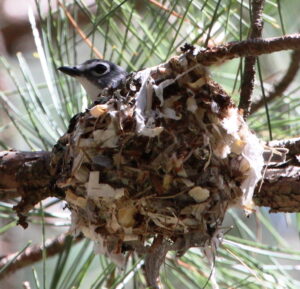
All vireos can be hard to actually see. Many spend much of their lives at the treetops amongst leaves that tend to be bigger than they are. I have IDed most of the vireos on my life list by song plus habitat. allaboutbirds.org is a good place to listen to these birds sing (click here for a link to this website’s home page: All About Birds website home page)
In this blog, I want to talk about two vireos that many of you could hear – and if you are lucky, also see: The Warbling Vireo and the Red-eyed Vireo. Both are common in most of the lower 48 states – check the range maps in your field guide to see if they are in your state and when. Both vireos are found in big trees – generally from mid-level to the top. Both of these vireos are found in woodlands – the Warbling will be in more open woodlands and so will be in tree-filled neighborhoods. The Red-eyed likes large tracts of woodlands that are not as open – more like forests. These vireos could be in tree-filled neighborhoods, but will not be as common as the Warbling. Both vireos can be found in tree-filled parks.
I will begin with the Warbling Vireo – which has had a division.
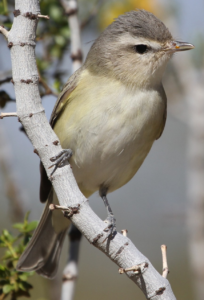
In 2025, the American Ornithological Society made the decision to split the species Warbling Vireo (Vireo gilvus) into two species: Eastern Warbling Vireo (Vireo gilvus ) and Western Warbling Vireo (Vireo swainsoni) – notice the Eastern Warbling Vireo retained the name of the former species and the Western Warbling Vireo received a new species name. (Click here for more information on this group: (American Ornithological Society )
If you look at pictures of both these birds here and in your field guide, you will see they look very much alike. The best way to separate one from the other is geographically. Where are you? The Rocky Mountains seems to be the dividing line. There will be overlap where these two species will live side-by-side. A common example of this sort of overlap would be Black-capped and Carolina Chickadees – these two birds look very much alike. Even with binoculars, I cannot tell one from another by appearance and where their ranges overlap, they sing each other’s song – not helpful! I know which chickadee I am seeing when I get away from the overlap area which is along the border shared by both species. The Eastern and Western Warbling Vireos will be the same – although as far as I know, they are not singing each other’s songs. Thank goodness! However, their songs are quite similar and for me, hard to tell apart. You may find it easier than I do. Here is a quote from allaboutbirds.org about the Western Warbling Vireo: “This gray-and-white denizen of cottonwoods and poplars looks very similar to its eastern counterpart, the Eastern Warbling Vireo. Western Warbling Vireo typically has a slightly smaller bill and a more extensive white line above the eye, but song is the best way to separate these two lookalike species.” (click here for the link: All About Birds website – Western Warbling Vireo and All About Birds website – Eastern Warbling Vireo)
Right now, we have Eastern Warbling Vireos singing every morning and evening in our big trees all through our neighborhood. I have learned their song and Merlin confirms it. I estimate we have about 6-7 singing males – I have actually seen 1. If you are within the range of either Warbling Vireo, listen to their song online and then go outside early morning or late in the afternoon, sit and just listen. You might hear them. Use Merlin to confirm.
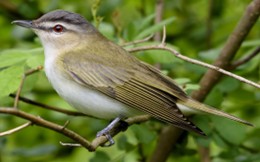
The Red-eyed Vireo. This is one of my favorite birds to hear when I am walking in a huge woodland or forest. They are high up in trees and quite the singers – not in variety or beauty of song but in their sheer persistence. Generally, 3 distinct or slurred notes form their short songs that are repeated over and over. And over and over. And over and over. Field guides sometime state it sounds like questions and answers – I would agree with that. You do have to hear them sing this repeated 3 note song over and over to finally catch the rhythm – at first, the 3 notes can seem jumbled and messy. But have patience. Listen. You should be able to discern the 3-note pattern and the inflection. They can be written in field guides as:
Where am I?
Way up here!
Where are you?
Here I am!
Hel-lo there!
I see you!
I think this is a joyful sound – especially when one vireo sings and several answer. Because the songs are only 3 notes at a time, the song can be easily overlooked – especially if there are other singing birds like Wood Thrushes and Northern Cardinals. But once you learn it and can separate it out from all the other bird songs, it truly is uplifting to hear it. And Red-eyed Vireos are persistent singers. In spring, they sing those 3 notes – at different pitches and inflections – over and over and over and over.
Don’t be like me and wait years to take a good look at The Vireo Family. These birds are fascinating and very much worth your time trying to locate and identify. Learn their songs. Try to watch their behavior if you can. And here is a Fun Fact*! Vireos are often affectionately referred to as ‘preacher birds’. In spring, they are persistent and long singers in both early morning and evening. But also in spring and throughout the summer – they will sing off-and-on – all day long. Offering comments on the day. They are ‘preaching’!
*Fun Fact – for those of you who are fans of Sheldon Cooper, I have borrowed this phrase from him. In both Young Sheldon and The Big Bang Theory, he was full of ‘Fun Facts’ just like this one. I just hope I am not the only one fascinated by this ‘Fun Fact’ about vireos. And yes, Cleon and I have been watching reruns of Young Sheldon and loving every one!