

Sage, Common Sage (Salvia officinalis)
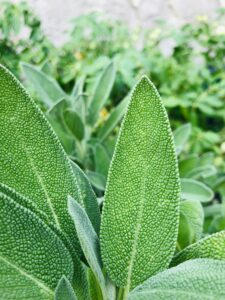
I love perennial sage plants. They are versatile and inexpensive. For example, sage makes a lovely small shrub. At any garden center or online, for a similar sized shrub, you would pay anywhere from $20 on up. A sage plant is almost always under $10. And who doesn’t like that? Sage is a plant for a sunny area so can be added to any flower bed or herb garden. It also grows well in a container. Versatile!
There are three other sages that can be grown in the same way as Common Sage – all are generally smaller than Common Sage:
‘Tricolor’ – Variegated leaves of green, white, and purple/pink. The leaves are striking and will brighten up any garden. This is a lovely sage but, in my experience, not a strong grower. I generally have one or two in my flower garden, but they do not often overwinter successfully. I treat them as annuals. However, your experience could be different.
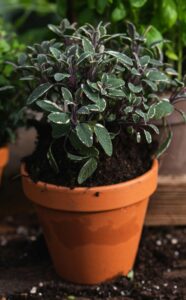
‘Purpurascens’ – The young leaves are more purple and as they grow, will become more burgundy. This is also a lovely plant that will look good anywhere in your perennial garden or as part of a shrub border – just place it in front. Once again, in my opinion, this plant does not live as long as Common Sage but if planted in a spot it likes, you should have it 4-5 years.
‘Aurea’ – this sage is also smaller than Common Sage and has yellow leaves. In my experience, it will last about 4-5 years.
All of these sages are grown in the same way and can be used in herb gardens – although in my opinion Common Sage has the strongest and best flavor. All can be used in perennial gardens, and also as part of shrub borders as long as you plant them in front as they are the size of the smallest shrubs.
Light: Full sun.
Soil and water: Average to sandier garden soil. Must be well-drained. If planting in sage in a container, during the summer check it every day for water. For the rest of the year, check it twice a week.
Hardiness Zone: Zones 4-10.
Size: 2-2.5 feet tall and wide.
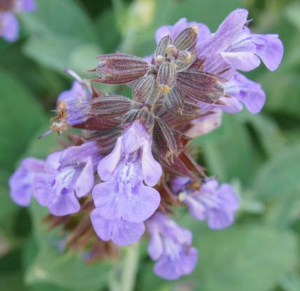
Bloom period and color. Deadheading. Pruning: Blooms bluish-pink to bluish-purple from late June-early August. As the flowers fade, cut back the flower stems to where they intersect with a branch. If you do not want your sage plant to bloom, remove the stems of the flower buds in the same way – cut them off where they intersect a branch.
Sage should be cut back rather hard each spring – late March-early April is the best time. Remove about 1/3 of the plant. The first thing to do is remove any branches you do not want, that are broken, or crossing another branch. If you have not removed any branches, then cut the plant back about 1/3 – being careful not to cut below the lowest set of leaf buds on a branch. If you cut below those buds, that branch will die back. If you have removed some unwanted branches, then cut the rest of the plant back by about 1/4. Sage is what is called a woody perennial – actually it is easier for me to think of it as a small shrub. As the years go by, it wants its stems and branches to become more and more woody which means less and less leaves and flowers. By trimming the plant back 1/3 each early spring, you are preventing the plant from becoming more woody and it will continue to produce lots of leaves and flowers.
Butterflies and birds: If you allow your sage to bloom, it is a magnet for bees, butterflies, and beneficial insects.
Deer, rabbits, and other pests: As with most plants that are herbs – deer, rabbits, and other pests do not bother them. The leaves and stems are strongly aromatic and have a strong taste – most often not to any creature’s liking but ours. Sage is not affected by disease unless it is planted in soil that is too wet or does not drain well.
What to plant with Sage: First, I will tell you the only thing Sage could adversely affect – cucumbers. Don’t plant these next to each other because the Sage can affect the flavor of the cucumbers.
Other than that precaution, Common Sage will look good with just about everything planted with it because its leaves are such a neutral and soothing shade of grayish-green. If you are using one of the sages that have colored or variegated leaves, keep those colors in mind when you place them so they will look good with their neighbors. Common Sage will generally not get more than about 2.5 feet tall and the other sages are shorter. Except for small annuals, they will often be on the shorter side of your garden. Plant them in the middle/towards the front.
How to use Sage:
Sage can be used as an accent plant, planted in small groups for more of a mass planting, or even used as a border for your garden. Small varieties of boxwoods and smaller-than-boxwoods Germander are often used as borders of herb gardens. They are kept trimmed as hedges – flat tops and sides. If you keep Common Sage trimmed back from the day you plant it, it will become bushy and remain fairly small and can be used in the same way – as a border. It can also be used as a shorter hedge or a group of them can be planted about 2 feet apart as a foundation planting around a shed, garage, or even as a shorter foundation planting at your house.
In a container: Sage well develop a good root system so give your plant a bigger container. If you find in fall, winter, and spring, you are having to water it every other day or so, the container is too small. During those cooler months, your Sage should only need to be watered once or twice a week. Repot it each year to give it fresh soil. I generally do not fertilize mine but if you do, follow the directions on the package but only fertilize in the summer months and stop around August 1st.