

Semipalmated Sandpiper
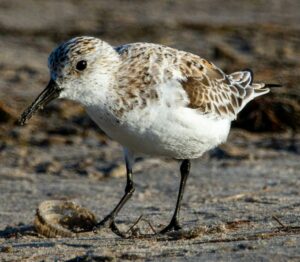
I am continuing my series of once common birds whose populations are in steep decline, what the causes are, possible solutions, how you can help, and the role of the federal government and President Donald Trump.
I have reposted the Executive Orders from President Trump that I previously posted – they are at the bottom of this blog entry. I think it is important that we read exactly what the President has written, decreed, ordered, and mandated in these Executive Orders. Not read or listen to someone’s opinion as to what the President wrote such as a moderator or guest on a news show, an “influencer”, or a person who posts on social media.
In this series, the first bird I wrote about was the Loggerhead Shrike. The second was the Northern Bobwhite. This week it is the Semipalmated Sandpiper.
Almost all of us living in the US only see the Semipalmated Sandpiper in migration – they do not nest or winter in the lower 48 states, but they do migrate through many of these states. To prepare for their long migrations, these sandpipers gather in flocks to forage in mud or in water about an inch deep. Among their favorite foods are tiny invertebrates, mollusks, and marine worms.
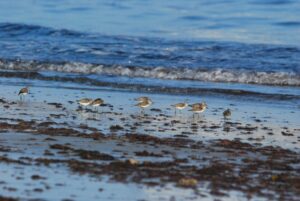
From the Rocky Mountains to the Atlantic coast, look for these small birds in migration when they stop to rest and forage. They will be on mudflats and beaches – both inland and coastal. Also look for them around the mouths of rivers; on the shorelines and sandbars of bays, lakes, and ponds; on beaches; and in the mud and shallow water of marshes. They are often found in flocks in ephemeral ponds* in fields. Here is a PDF from Audubon on the Semipalmated Sandpiper which includes a map – not only of its migration routes but also shows the shaded area of places the bird can be found as it stops and rests. Click here for the link: Semipalmated Sandpiper Fact Sheet.
The 2025 State of the Birds** report has this bird listed with an Orange Alert warning which means this bird is getting close to what could be its tipping point. What does ‘tipping point’ mean in terms of a species? Here is an explanation from biologyinsights.com: In ecology, a tipping point for a species is a critical threshold of environmental conditions or stressors beyond which the species’ population undergoes a sudden, often irreversible, shift in its state. This can mean a rapid decline in numbers, a change in distribution, or a collapse of the species’ ecological role, even if the underlying pressures are only gradually increasing. For a species, a tipping point occurs when the balance between its ability to recover from disturbances and the intensity of those disturbances is breached. Before this threshold, the species may persist through fluctuations, but once the threshold is crossed, positive feedback loops or cascading effects can accelerate the change, making recovery difficult or impossible.
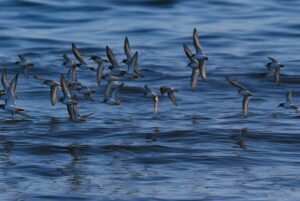
The Semipalmated Sandpiper has lost over 50% of its population in the last 50 years which is alarming, but what places this bird on Orange Alert is that in the past 10 years, the decline has accelerated. The species is approaching its tipping point.
How did this happen? Once again, habitat alteration or destruction is a factor – especially in migration. The mudflats this small bird relies on for rest and food are often taken by us as part of drainage projects for development. In spring, there were once many ephemeral ponds* in fields, prairies, and big agricultural tracts throughout the Midwest and Great Plains, but now, many farmers are tiling their fields which means they are laying a large underground pipe system to drain snow melt and rainfall accumulation from the surface of these fields into ditches that often run alongside rural roads. More and more slightly lower areas of large agricultural tracts that would collect and temporarily hold shallow water from melting snow and spring rain are gone.
Once again, farmers are faced with tough decisions. These ephemeral ponds can be large and as long as they contain water – it can be mid-June before some of them dry up and disappear for the year – the soil in and close to them cannot be worked. No seed planted. And if a farmer waits until the low area of water – the ephemeral pond – dries up and disappears, it may be impossible to get a tractor into the area to plant seed and even if that was successful, the late seed would not be ready for harvest the same time as the rest of the field.
Does a farmer simply not plant what could be several good-sized areas in his fields to support migrating shorebirds? Almost all of them have decreasing populations. Does he lose money – probably year after year? Money needed to support the farm and family? Or does the farmer tile the field, eliminate the ephemeral ponds, and hope the birds find someplace else to rest and eat? There are no simple answers.
To give you an idea of what these ephemeral ponds look like in spring – and so you can see the habitat they temporarily create – here are two videos I shot of an ephemeral pond not too far from us: Sandhill Crane and Killdeer. In the second video, the Kildeer are running through the water so you can see how shallow these ponds generally are. Perfect for shorebirds – especially the Semipalmated Sandpiper who likes water no more than an inch deep. (Killdeer length: 8-11 in. – about the same as the American Robin. Semipalmated Sandpipers are smaller: length – 6-7in.)
Another problem this sandpiper is facing is the private hunting clubs in northeastern South America whose members hunt shorebirds in their fall and winter habitats. There are enough of these private clubs that these hunters are responsible for part of the decrease in this bird’s population. It is very difficult to obtain information from these groups as to their practices. There are nonprofit groups working with these countries’ governments and local environmental groups for some regulation (I have included two below).
If you look at the PDF from Audubon (here it is again: Semipalmated Sandpiper Fact Sheet), you will see part of this sandpiper’s nesting grounds are the northern tundra and coastline of Alaska – continuing throughout the entire northern tundra and coastline of Canada. Canada is closely monitoring birds and the entire environment in this fragile tundra and Arctic Ocean coastline. From my point of view, we should be working hand in hand with the Canadian government in order to protect, but also use this area. To strike a balance as to what our needs for oil and gas truly are and what that habitat can withstand. And this takes much research from experts – in fields of biology and economics, not politicians and billionaires.
The mantra “Drill, baby, drill” does not work here. Acting fast will only cause destruction that can never be fixed. A long-term energy and consumption policy by our federal government – understood by all of us – is what is needed, not a knee-jerk reaction to a global crisis. The old adage holds true: Act in haste, repent in leisure. Click here to learn what Canada is doing: The State of Canada’s Birds. Its State of Birds report that you can access is an official government report developed by Environment and Climate Change Canada (a federal department of the Government of Canada) in partnership with Birds Canada. An example of government and environmentalists working together for the good of all.
Our federal government and the state of Alaska – but ultimately the federal government – control much of Alaska’s tundra and shoreline which is prime nesting territory for many birds including the Semipalmated Sandpiper. Last week, I included information from the Department of the Interior and from the Congressional Research Service*** about this. I have included links to both of these documents once again – they are at the end of this post. And here is the Presidential Action from President Trump – taken directly from the White House website concerning the northern coastline of Alaska. He begins by writing: By the authority vested in me as President by the Constitution and the laws of the United States of America, it is hereby ordered….. :Unleashing Alaska’s Extraordinary Resource Potential – The White House. Once again, this is not opinion or distortion, but exactly what President Donald Trump wrote.
And what do Alaskans think about this? My guess is that feeling are mixed. Those who need jobs might welcome new drilling. Those who value the pristine environment throughout most of the state might not. And there would be many positions in-between. Here is an article from The Alaskan Beacon. And what is the Alaskan Beacon? From their website: Alaska Beacon is an independent, nonpartisan news organization focused on connecting Alaskans to their state government. Alaska, like many states, has seen a decline in the coverage of state news. We aim to reverse that. Here is the link to the article they published: New Trump administration proposal aims to accelerate drilling amid Alaska oil industry’s revival | Alaska Beacon
And here is an article that states many Alaskans want complete control over their state – including all the oil and minerals. They want the federal government out. And these people want to tap into all the resources – they want the money to have better lives. And as I sit in my nice home on a small lake in central Illinois, who am I to say they are wrong to want a different life? As with everything, these questions are not easy at all. Here is the link: Oil drilling in Alaska.
And last – this is a most interesting link to an article published in the Journal of Petroleum Technology. From their website: The Journal of Petroleum Technology, the Society of Petroleum Engineers’ flagship magazine, presents authoritative briefs and features on technology advancements in exploration and production, oil and gas industry issues, and news about SPE and its members. Here is the link to the article published in this journal about drilling in Alaska: Alaska Oil Drilling. This article includes the link to the study on which its conclusions are based.
After reading and trying to digest all this information, remember that through his Presidential Action, President Trump is directing the northern coastline and surrounding tundra areas in Alaska be open to drilling and mining, and he wants that to begin now. This Presidential Action eliminates the studies that were required before mining or drilling could take place. He has declared a national emergency. If you are still uncertain of his position, reread his Action here: Unleashing Alaska’s Extraordinary Resource Potential – The White House – he is quite clear.
How can we help the Semipalmated Sandpiper – which will help all shorebirds? And all shorebirds are struggling. Here are suggestions for you to consider – and there are others online:
Home | Conserve Wildlife Foundation of New Jersey. This organization works to assist all shorebirds migrating down the Atlantic Coast flyway. Click on Our Projects and scroll to the last one which is: Shorebird Project. This is described as the spring migration of shorebirds through Delaware Bay is one of the world’s most magnificent wildlife spectacles – and one of the most imperiled. This project would include the Semipalmated Sandpiper. If you live in the area, you can volunteer. And you can always send money earmarked for this project.
Homepage | The Wilderness Society. Click on Take Action and you will see there are a number of programs that need your help. There is one specifically for drilling above the Arctic Circle and if you click on it, a sample email will pop up that you can either send as is or write your own. You can also sign up for further updates. The Wilderness Society is a nonprofit organization so welcomes donations. Opening up the tundra and shoreline of the Arctic Ocean to drilling without taking care and consideration as to what will be destroyed is what is being proposed right now. Our federal government is in a rush and all regulations and precautions that can be set aside have been set aside. This is a huge nesting area for all shorebirds – including the Semipalmated Sandpiper. If this small sandpiper loses a large portion of its nesting area or if a seasons’ nests are destroyed, that could be the tipping point for this bird.
An organization that is suing the federal government over drilling in Alaska:
Earth Justice. This group represents conservation groups and an Alaskan Native American organization.
Here are two groups working with partners in South America to regulate hunting and to protect the habitats of wintering birds:
A collaboration between Manomet and its partners to study the decline of Semipalmated Sandpipers
Audubon
I will continue this series of once common birds whose populations are now in steep decline with another bird next Sunday – what the problems are and how you can help. But remember, one of the easiest things you can do is to give all this much thought. Do your own research from credible websites and sources which in this case are scientists – most particularly biologists who have studied the areas and birds. And most important – vote! Choose the people that best match what your vision for our country is. Most especially its environment. We can invent so much – especially with AI. We are a talented species – creative, innovative, intelligent. But one thing we cannot recreate is our planet earth. When a species is extinct, it is gone forever.
If we drill in the Arctic National Wildlife Refuge, or anywhere along the Alaskan coastline and its tundra, and there is even a small spill, that part of the habitat – prime nesting habitat – is destroyed. Possibly for a very long time or even forever. If we keep draining wet areas for developing, keep eliminating ephemeral ponds throughout the Midwest and Great Plains, and if private hunt clubs keep allowing unrestricted shooting of shorebirds in their winter habitats, the populations of all shorebirds will continue to decrease with the Semipalmated Sandpiper as one of those leading the way to extinction. Think hard about all this. The Semipalmated Sandpiper is getting near its a tipping point. Do we want this species to survive or don’t we? And what are we willing to do to? To change? Possibly even give up?
So much to consider……. And remember, you can make a difference with the choices you make as you live your life. Happy birding! Linda
P.S. Here is the government’s website for the Arctic National Wildlife Refuge (Department of the Interior/U.S. Fish & Wildlife): Arctic National Wildlife Refuge. This is a wonderful website. Look through it to learn about the species living on the refuge and the ongoing projects. What I did not see was a place where you could register to spend time volunteering at the refuge. Nor is there any way to send money to help with their projects. However, there is a page that describes paying jobs – if you have the credentials for application. Visitors are welcome.
One more thing – not related to Semipalmated Sandpipers! – you might have noticed that as of earlier this week, there are rocks in the small bird bath on the birdfeeder livestream. These are for the American Crows that are in our treetops this time of year. Right now, we count 4. In years past, they have come to this birdbath and moved the rocks around – dropping some to the ground, placing some in the adjacent bird bath, and rearranging what is there. Crow Zen gardening? Hopefully they will come down out of the treetops to this birdbath so you can watch. I have been surprised they have not come for the corn in the squirrel tower but as far as I know, it is still squirrels by day and raccoons by night. And the corn is being regularly munched! Lots of cobs in our compost bin!
____________________________________________________________________
Here are the links to the executive orders from President Trump I included in the last two blogs:
Administration of Donald J. Trump, 2025 Executive Order 14154—Unleashing American Energy January 20, 2025
Administration of Donald J. Trump, 3/20/25 Executive Order 14241 – Immediate Measures to Increase American Mineral Production.
On the top of page 3 of this executive order, you will read: To address the national emergency declared pursuant to Executive Order 14156 of January 20, 2025 (Declaring a National Energy Emergency), I hereby waive the requirements of 50 U.S.C. 4533(a)(1) through (a)(6). This is a link to what he is waiving:
50 USC 4533: Text contains those laws in effect on January 3, 2016 From Title 50-WAR AND NATIONAL DEFENSE CHAPTER 55-DEFENSE PRODUCTION SUBCHAPTER II-EXPANSION OF PRODUCTIVE CAPACITY AND SUPPLY
And these were also included in last week’s blog:
From USGS – Dept of the Interior – Oil spills and polar bears.
From the Congressional Research Service** – An Overview of the Arctic National Wildlife Refuge.
*ephemeral ponds (from AI) – A temporary, seasonal water body that fills with water for a short period and then dries up, providing critical habitat for specialized plants and animals.
In simple terms, these are like incredibly large, giant mud puddles – like the ones we all played in as children and probably much to our mothers’ dismay. But unlike mud puddles, these areas of water will be present for weeks in spring.
**State of the Birds – What is the State of the Birds?
***Congressional Research Service. What is it? It is a nonpartisan group under the Library of Congress. Click here for more information: Congressional Research Service.