

Witch-hazel, Common Witch-hazel (Hamamelis virginiana)
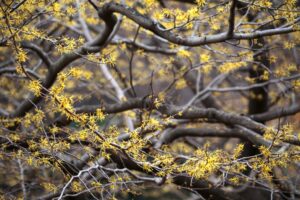
The only problem with this small tree is – how in the world do you spell it? You will see it as witch-hazel, witchhazel, and witch hazel. Two “h’s” side-by-side in the middle of a word? That just seems plain wrong. And yet to completely separate these two words? Witch. Hazel. Too much of a pause if I am saying them. I like the hyphenated spelling. Eliminates the heebie jeebies of two “h’s” side-by-side, but also encourages the two words to be spoken as one word. So, on this website, I will choose to spell it as witch-hazel. And honestly? This may be the hardest thing about this plant – how you spell its name.
I have two witch-hazels in our gardens and both have been easy to grow from the first day they were in the ground and are lovely in all four seasons. If you are looking for a small tree – or a very large shrub – please consider witch-hazel. They can be difficult to find at garden centers, but you can order them online. Even though you will get a smaller plant, witch-hazel is a good and fairly fast grower. Within about eight-ten years your witch-hazel will be close to full size.
Light: Full sun to shade. When you come upon witch-hazel in nature in its natural habitat, you will almost always find it as an understory tree in a woodland and generally more towards an edge – the edge of the woodland or an edge of a glade within a woodland. My two witch-hazels are planted on the north side of our house so are shaded by the house and also by several large trees: hickories and pecan. Both get indirect light all day – no direct sunlight.
Soil and water: Average soil, but witch-hazel likes like a moist soil. Avoid planting in dry sites. Keep in mind this is an understory or edge woodland tree so you need to mimic those conditions as best you can. Dappled sunlight and mulch!
Hardiness Zone: Zone 3-8.
Size: The height and width of a full-grown witch-hazel will be about 15-20 feet. My two are over 15 years old and are not quite that large. However, you have to take into consideration both were cut down by beavers about 10 years ago – see Deer, rabbit and other pests. Both are now about 10 feet tall. One of the witch-hazels is about 8 feet wide and the second witch-hazel is about 5 feet wide.
Witch-hazels grow in a vase-shape. Their branches tend to angle upwards – not out or down. This is a lovely shape.
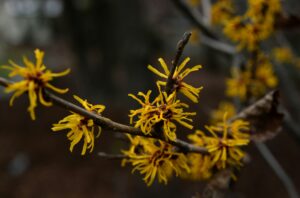
Bloom period and color. Deadheading: Blooms golden yellow in November and December. And yes, that is right – not a typo! That is the bloom period in all the zones including the coldest ones. I live in central Illinois where early winter temperatures are below freezing and we often have sleet or snow. It is always windy out here – and in late fall through winter, the wind can be absolutely bitter. Yet these witch-hazels bloom every late November and are sometimes in bloom at Christmas. What a gift from nature! I have them at either side of our patio so I can easily walk to them and take a close look at their spidery petals and even get a whiff of their soft, light fragrance. IN EARLY DECEMBER!!!!!! IN CENTRAL ILLINOIS!!!!!! This fact alone, makes witch-hazel well worth planting!
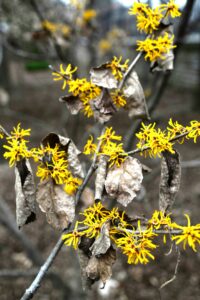
A note of warning, sometimes these flowers are partially hidden/hidden by the leaves which by this time are dead – witch-hazel tends to hang on to its leaves through most of winter. So, although your tree could be covered with these small flowers, they may be hard to see unless you walk right up to it and push the leaf aside. One of my witch-hazels shows this trait and the other does not – the flowers are much more visible. This is individual to the tree. However, even if the witch-hazel you plant hides it flowers with its dead leaves, you will know they are there and can go look at them any time you want – and show your friends who will probably think you are some sort of gardening wizard!
These flowers do not need to be deadheaded – they will fall from the branches during mid-winter and be completely gone from under the tree by March. The leaves turn yellow in fall and can be simply beautiful. So good fall color followed by yellow flowers! What a way to bring your gardening year to a close!
Witch-hazel never needs to be pruned – unless you have a broken branch or a branch that crosses another branch. Pruning will destroy its wonderful shape. Plant it where it can grow to its maximum height and width without pruning. Don’t put it right next to your house. Don’t put it under the eaves of any building. Don’t put it under overhead utility wires. Remember, this tree needs no pruning – that is a blessing! Don’t make work for yourself planting where it has to be forced to fit!
Butterflies and birds: After the flowers fade and fall off, the tree produces brown seed capsules in early spring – a time when there are very few fresh seeds. Songbirds that are wintering in your garden will eat these. If you live in an area of pheasants, grouse, or quail, all three relish these seeds.
Because witch-hazel tends to hang onto its dead leaves through the winter, it provides sheltered roosts for songbirds at night during the winter. It also has a strong branching pattern, so provides for many nesting spots.
Deer, rabbits, and other pests: Generally, deer will not bother witch-hazel. Its leaves are coarse and bitter. However, if you live with deer and there has been a drought or another reason there is a shortage of plants for deer to browse, they will browse on witch-hazel. If you experience conditions like that, spray your tree with a repellent – at least up as far as a deer could reach standing on its hind legs. But normally, deer will not bother this tree.
We had a family of beavers on our small lake – they ravaged my garden and the gardens of my neighbors. The beavers were relocated to the wetland at the large lake several miles from us. We probably all would have been OK with them if during one night, they had not cut down over half a dozen planted nursery trees from our neighbors’ yards – this got expensive. In my garden the beavers cut down my two witch-hazels, my buttonbush, my serviceberry, and my big pussy willow. And all of these species – all native here and plants that can be found close to wetlands – regenerated from the roots. All recovered beautifully and I think actually have better shapes than what they had originally had. My neighbors all lost hybrids or non-native trees that were expensive and that they paid to have planted and none regenerated. All that was left of any of them were the stumps gnawed to points – those points are always the dead giveaway that there are beavers.
Other than the beavers, there have been no problems with either of my witch-hazels. I did do some research, and it is advised to not plant them close to birch trees as they share a gall with them, but other than that, nothing seems to bother these small trees.
What to plant with witch-hazel: One of mine is planted at the retaining wall at our patio which is close to our small lake. Above that retaining wall, I planted a grouping of boxwoods in memory of Cleon’s grandfather who just loved boxwoods. And just as he grew his, we do not trim or shape ours in any way, so it is a solid mass of boxwood in all its natural shape and glory – and a safe and cozy place for our wintering juncos and White-crowned, White-throated, and Fox Sparrows. All four species sleep in them. And they use the big witch-hazel which is planted below the wall as sort of a steppingstone to the mulched gardens on either side of the patio where they all forage. The patio is constructed of pavers with moss growing between them so also a good foraging place. With this witch-hazel to soften the appearance of the retaining wall are Joe Pye Weeds – big perennials that get close to 6 feet tall and bloom pink in August. These 3 plants: boxwood, Joe Pye Weed, and the witch-hazel make a lovely combination of color, texture, and interesting opportunities for birds. I cut the Joe Pye weeds to the ground in early April so they stand straight and tall all winter.
The other witch-hazel is planted with several shrubs on a slope that runs from the front yard down to the other side of the patio. It is planted in a grouping with deciduous azaleas, New Jersey Tea, Clethra – often called Hummingbird Shrub, American Cranberry Viburnum, Button Bush, and the groundcover on the outside edge of this grouping is Green and Gold.
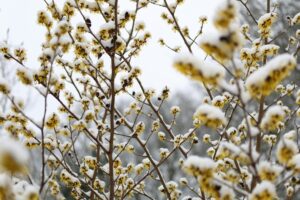
How to use witch-hazel: This is a beautiful small tree. Solid and structural. The branching pattern – vase-like – is beautiful. The leaves turn a lovely yellow in the fall, and it blooms golden yellow in November and December. This small tree could be used as a focal point in your back or side yard instead of the usual birch, dogwood, weeping whatever hybrid, or an invasive Norway Maple. It would be a unique and distinctive touch – not a tree you would see everywhere you look in your neighborhood. You would be thinking outside the box!
I have mine with other shrubs and a large species of perennial and it works very well in groupings such as this. As with all trees – read the plant tag information or information provided online carefully before deciding where to plant it. Even though this is not huge like an oak or hickory tree, it does have some size.