

A Carolina Wren, response on the juvenile albino cardinal from last week’s blog, and me going waaaaay off topic……
First – the Carolina Wren. This is one of my favorite birds. OK – you caught me! – I probably say that about most of the birds I write about. And it is true – there are no birds I do not like. And there are no birds I do not think beautiful.
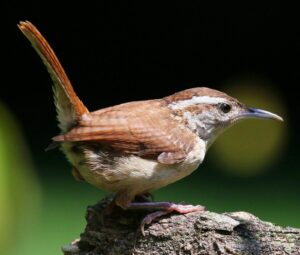
There is so much that is intriguing about Carolina Wrens. First, as a wren, it does go around most of the time with its tail cocked – a wren trait. And then those eyebrow stripes! So white. So bold. So obvious.
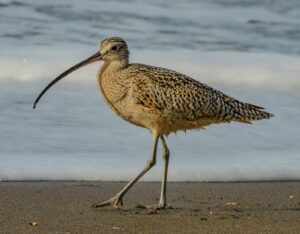
Many birds who have pointed beaks also have decurved beaks*. In songbirds with pointed beaks, if there is a decurve, it is almost impossible to see without a scope. But get a good look at the Carolina Wren with just your eyes and if you get a good look at the beak, you will see it is decurved.
We almost always have Carolina Wrens in our yard – they may be difficult to see as they love to be within a good mess of tangled plants – but they have BIG voices. Their song is often compared to a bugle call and I would not dispute that. If they are in your yard or neighborhood, you will hear them. Click on this link to allaboutbirds.org to listen: Carolina Wren songs and call notes
Carolina Wrens sometimes come to feeders – most especially in winter when food is scarce. They like suet. In spring and summer, they will use sometimes bird baths.
This past week, we had one come to the big bird bath – which is one of our livestreams. Cleon was sitting at the kitchen table, watching the garden as he was working on his sudoku and spotted it. He took a video – click on the link at the end of this paragraph to watch. Notice how flitty the Carolina Wren is – typical wren behavior. Notice there is an utterly soaked juvenile male House Sparrow in the bath – now this is a bird that has learned how to take a bath quite well! And at the end, this House Sparrow turns into a Gray Catbird! Bird baths are magic……… Carolina Wren
__________________________________________________
Last week’s juvenile albino Northern Cardinal. Here is an excerpt from my blog:
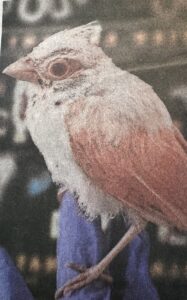
Vonetta from southern Pennsylvania sent a photo to me of a rare albino Northern Cardinal – a fledgling just out of the nest. It was found under a parked car on July 1st. This area of Pennsylvania had experienced quite high temperatures and heavy downpours for some days. The rescuers saw no parents and felt the bird was either injured or distressed and so contacted the Raven Ridge Wildlife Center who said if it could be captured safely, they would take the bird. The bird was safely caught and brought to the wildlife center in a closed box. (link: Raven Ridge Wildlife Center). I believe the rescuers did everything possible to ensure the bird’s safety – the closed box was essential for that.
Claude from Kansas was the first to email me and ask if this bird is actually an albino. He pointed out in the photo the eyes look brown – not pink. And one of the traits of an albino is the eyes are pink. Claude is correct about that. But the color of the eyes of this juvenile cardinal? Honestly? I am not sure. I took this photo from the photo that Vonetta sent me which was the photo from the newspaper so the photo I included in the blog is not of the best quality. The rim around the eye certainly looks pink, but the eye looks dark. It is obvious the feathers are not the normal colors of a juvenile cardinal – so much of this bird is white. There is another genetic condition called leucism which shares some traits with albinism. So, what does this bird have? Albinism or leucism? The rescuer said the bird was an albino and the rescuer actually had the bird in hand – the journalists did not dispute that. Not seeing the bird and just looking at the photo? I would have to go with leucism, but I am very unsure. Regardless of which condition this bird displays, it is obvious its feathers do not have the rich reds of a cardinal or the contrasting gray. This bird is decidedly different. Here is an article I wrote and placed on this website about a year ago: Albinism and Leucism. When is a bird an albino? When is it leucistic? What do you think?
__________________________________________________
And now I am going way off the topic of birds – or even plants and gardens. But it is science – and I am simply fascinated!
I just finished reading the book The Midnight Library by Matt Haig – and I recommend it. It is fiction about the space between life and death. The main character – a woman in her thirties – enters this area and for her, it is a library. And on the endless shelves are books. Each book contains the story of a life she did not choose. And she is given the opportunity to sample these lives to see if one of them would be one she would want to live through in its entirety. And she gets to view her Book of Regrets from the life she has just left to see if any can be undone. The author does a wonderful job with all this, and the book raises so many questions about our own existence. Or is it existences?
And that is the science part. Parallel universes. There are theoretical physicists today who are contemplating this idea and pursuing it through theory backed up with math so complicated it would probably make most of us feel like our heads were going to explode. But this is an interesting theory – that we are not living in one universe but that there are an infinite number of universes and each of us has a life in each one. And each life would be different because the decisions we make would be different. Below are three links to videos that discuss parallel universes.
The first one was the easiest for me to understand. The second one I had to listen to several times before I grasped what was being said – well sort of grasped. But it is the third one – by far the longest – which pulled this together for me and I found utterly fascinating. However, listening to the first two prepared me for the third. The third is a free-flowing discussion of parallel universes/multi-universes between Drs. Neil deGrasse Tyson, an astrophysicist, and Brian Greene, a theoretical physicist. Dr. Tyson has a podcast called StarTalk and this is an offshoot of that. On his podcast, he has a co-host – someone outside the world of science who is intelligent, but who keeps him from getting too…… intellectual? Too theoretical? Talking way above all of our heads? And on a level that most of us cannot even begin to follow? In this recording, the co-host is comedian Chuck Nice who does a great job with questions when these two physicists really get going. The first five minutes is chitchat and a few jokes but then they do get rolling, and I promise you a wild ride as these two highly intelligent physicists start theorizing about parallel universes. I promise you, this will be a great exercise for those little grey cells that Agatha Christie’s Hercule Poirot was always so fond of talking about!
The Most Convincing Parallel Universe Story
Why parallel universes are probably real
Drs. Tyson and Greene discuss parallel universes
And back on topic – regardless of which universe you are in, have a wonderful week of birding! Linda
P.S. We are now seeing two large butterflies here and there – one Black Swallowtail and one Monarch. But only two.
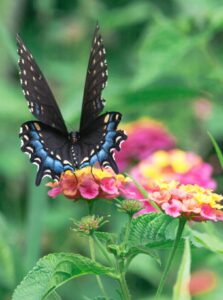
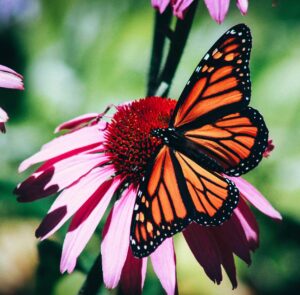
We do not have as many butterflies as I think we should have and this year – so far – we have even less than we normally do in August. I have checked with other friends in the area who look for the larger butterflies, and they told me they are also experiencing noticeably fewer. We are not sure why. Is this just a normal occurrence – a cycle? Or is this an indication that the things that are killing butterflies in all their stages of life are getting even worse – more widespread and prevalent?
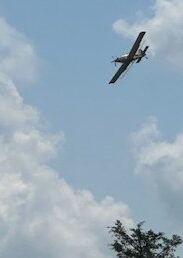
One thing my friends here, and I, can tell you is that we always have aerial spraying for insects over our enormous agricultural fields in late July and August – normally for about 2 weeks. This year it was 4 weeks. Cleon and I live on a small lake, and we don’t have a buffer between all of us living here and the thousands and thousands of acres of agricultural fields surrounding us. These planes spray when there are light winds so there is drift. The clouds of chemicals they release do not just land on the fields – they float through our yards and gardens. Is that what has happened? Two extra weeks of aerial spraying? Killed most of the targeted insects plus all the other insects living in the surrounding areas? Including the butterflies and moths? Email me with your thoughts by going back to the Blog homepage and clicking on the button “Share Your Thoughts”.
And I just Witch-hazel the Landscaping and Gardening for birds and Wildlife section of this website. Click here to read: Witch-hazel
*Decurved beak or bill – a downward curving beak that helps birds probe sand, mud, or bark – and with the Carolina Wren, it is bark. These wrens are able to stick or jab their beaks into bark crevices for beetles and larvae. The decurved shape and pointed end are perfect for his type of foraging.
** When is it called a beak? And when is it called a bill? Beak or Bill? Is there a Difference?