

A Gull in Norway and some odds and ends from our yard – and from some of you……
In my last blog, I told you how this website would be nowhere without the work from Mark Roberts and Lara Donovan of GoWeb1. And I shared Mark’s photos with you that he took when he was on safari in Tanzania. Today, the first thing I want to share with you is a photo Lara took of a Common Gull (Larus canus) when she, her husband, and two children spent 14 days in Norway, Iceland, Germany, and England.
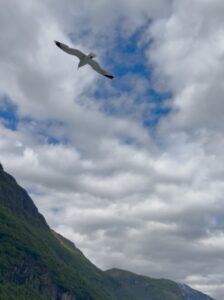
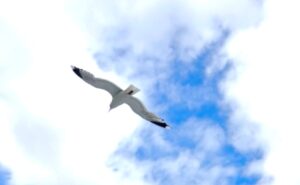
In the U.S. and Canada, if you are familiar with the Herring Gull and the Ring-billed Gull, this Common Gull is noticeably smaller than the Herring and slightly smaller than the Ring-billed, so it is the smallest of the three. I included the photo she sent of the Common Gull and then the same photo, cropped. If you look closely at the cropped photo, you will see small bright white patches at the tips of both out-stretched wings. I think this is one of the best identifying marks to help make the determination the gull you are seeing is a Common Gull. Common Gulls can be rare winter visitors to the coast of eastern Canada where they would be thought of as scarce*. And they can be what is called a vagrant** in New England.
Common Gulls closely resemble one of the gulls commonly found along the Pacific coast of the U.S., Canada, and southern Alaska. This gull is the Short-billed Gull (Larus brachyrhynchus) and it was formerly called the Mew Gull. Common Gull and Short-billed Gull were at one time a single species, but they were divided into two species in 2021 by the American Ornithological Union***.
If you are interested, here are links to both gulls – click on them to compare:
Common Gull (Larus canus): eBird from Cornell Lab
Short-billed Gull (Larus brachyrhynchus): All About Birds from Cornell Lab
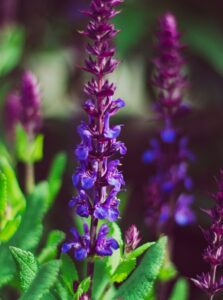
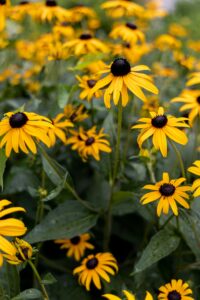
Some of you have emailed me to ask what the flowers are that can be seen in bloom right now on the bird bath livestream. From closest to the bird bath to the back of the photo which is across the sidewalk (photos follow these descriptions):
Salvia – This perennial has been blooming since the end of May and is still putting out buds/flowers. Keep this plant deadheaded and it will bloom and bloom. There are 3 at this bird bath, but you can only see part of one of them. It is the tall spike of many small bluish-purple flowers on the left edge of your viewing area. This Salvia is the variety ‘May Night’ which is my favorite variety – and there are many varieties of Salvia. This plant is a butterfly magnet. Unfortunately, here in our yard in central Illinois, we do not see many butterflies and moths until mid-July through mid-October. I like this plant because once is it established, it is one tough plant and blooms well for about 3 months – which is very long for a perennial.
Black-eyed Susans – Black-eyed Susans have yellow daisy-like flowers with dark centers. There are several species of plants that have the common name of Black-eyed Susan – the botanical name for the one you see on the livestream is Rudbeckia hirta. Right now, they are blooming and are just to the right of the spike of Salvia. Black-eyed Susans are not long-lived perennials, but I recommend them because they are also butterfly magnets – and they do self-seed. If kept deadheaded, these plants also bloom longer than most perennials and so will still have flowers here in our garden in late July and August when butterflies should start appearing in our yard.
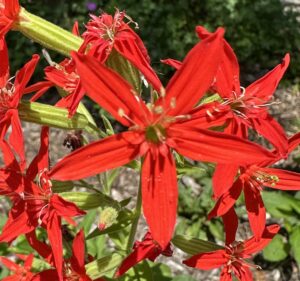
Royal Catchfly – This is another plant whose common name is shared by a few other plants. The ones that you see on the bird bath livestream are Silene regia. I planted these to draw hummingbirds to the feeder. We have only ever had 2-4 Ruby-throated Hummingbirds in our yard in the 20 springs and summers we have lived here – this year it appears we have a male and a female and we do not know if they nested. If we had to guess, we would say they did not – or the nest was unsuccessful – because we have not seen any juveniles. We have not seen them use these flowers – which are the tubular shape they like – but both do come to the feeder off and on each day. Click here for more information from me on growing this perennial in your garden – and I highly recommend it! Royal Catchfly (Silene regia)
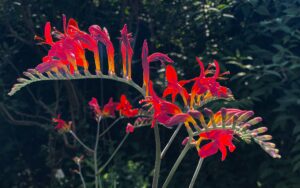
Crocosmia – I have three areas of these plants in this large garden in the front of our house. One of the areas is just across the sidewalk and in the back area of this photo. When the sun is hitting that area of the livestream, you will see tall spiky red flowers. These are Crocosmias which for us, have always been hummingbird magnets. Unfortunately, they only bloom for about 6 weeks – which is average for a perennial – but the blooms are profuse and I think spectacular. Here is more growing information from me: Crocosmia
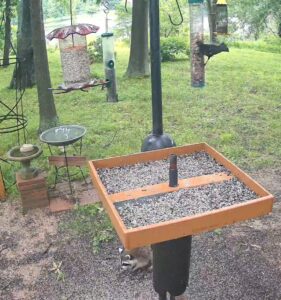
Our good friend Miles, who helps us from time to time with the heavy work in our gardens, took this photo of our backyard feeders These are the feeders you see on our bird feeder livestream.
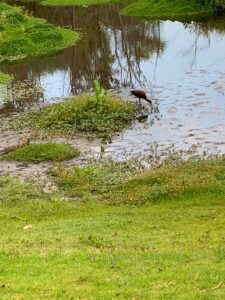
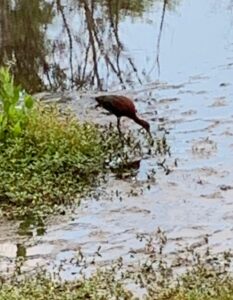
And Florence from California sent this photo of a juvenile White-faced Ibis forging in a wetland close to where she lives. Florence has told me she does not consider herself to be a birder, but she finds she is getting more and more enjoyment from noticing birds and she credits this website with encouraging her. I was so happy to hear this! We may turn her into a birder yet!
And to end this blog, here is a quote. Carol from Pennsylvania sent it to me. She got it from an article written by Julian Hough of New Haven, CT and published in the May 2026 American Birding Association Magazine titled “The Art of Seeing – Technology and Connection in the Digital Age”:
“One of birding’s most cerebral benefits—often appreciated but not always consciously recognized—is its effect on mental health. It’s only later in life that I’ve fully acknowledged the restorative power of nature for me. As a lifelong artist, I’ve noticed that when I’m drawing, my mind narrows its focus and everything else falls away. My partner, a trained meditation teacher, would label this as ‘being in the moment’—not drifting into the past or future, just being present—fully engaged with what’s in front of you. Birding does the same thing for me. I slip into a flow state where attention sharpens, the noise quiets, and the moment becomes enough. It’s a rare and welcome escape from an overactive brain—and one I suspect many birders experience, whether they have a name for it or not.”
Well said! I totally agree – and wish all of you this experience. Happy birding! Linda
*Scarce. What does this term mean when used by birders?
Copilot Search defines it as not common or abundant – low population numbers. Only a few individuals of a species in a given area or time. That a species may be described as ‘scarce’ if it is rarely seen or observed in a particular region.
**Vagrant. What does this term mean when used by birders?
Copilot Search defines it as a bird that appears well outside its normal breeding or wintering range. These birds are considered rare or noteworthy sightings because the birds are not expected in that location. Another word for ‘vagrant’ would be ‘accidental’.
***American Ornithological Society (AOS) – here is a link for more information: American Ornithological Society .