

What is happening in Delaware and New Jersey….. And here at our house and in our yard ………
April is almost here – and in my opinion, this is one of the best times to look for and observe birds. They are migrating, setting up their nesting territories, mating, and even beginning to start nests. And all of this is done right out in the open where we can watch. Even birds who typically nest in tall grass – like Red-winged Blackbirds and Eastern and Western Meadowlarks – are visible right now.
All of us have such jammed-packed schedules these days – even most of us who are retired wonder how in the world we ever fit full-time jobs into our busy lives. But try to set aside time on a soft, sunny spring day, sling your binoculars around your neck, and treat yourself to a walk in the woods, sit at your favorite park’s pond or garden, sit outside on your own deck or balcony, walk around your yard or neighborhood, and just look and listen. Breathe in the aromas of spring.
In Delaware and New Jersey:
These photos were sent to me from expert birder, lifelong environmentalist, and conservationist Rick Radis*. Going birding with Rick is a real treat as he is just so at home off the beaten trail and also recognizes just about every bird song and call note he hears. And the stories he tells! Rick also has the most amazing luck in spotting rare species. My guess is much of it is actually not luck at all, but that he is just so observant, he sees things that most of the rest of us miss. He always seems to be at the right place at the right time. Plus, he lives in New Jersey which is one of the premier bird-watching states. Right along the Atlantic flyway with Cape May as a stopping point for songbirds, raptors and water/shore birds. Here are 3 birds he saw this past winter – the first 2 I have never seen.
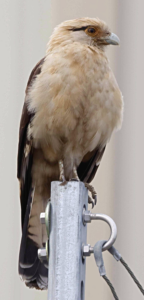
←This is a Yellow-headed Caracara spotted close to Delaware Bay at Wilmington, DE. The first sighting of this bird was in November of 2025 – here is a link to an article published in Forbes (forbes.com): Yellow-headed Caracara in Wilmington, DE. Rick took this photo at Delaware Bay. Here is another link to a page on ebird** that has some recordings of their calls, but more importantly, a range map: ebird – Yellow-headed Caracara. As you can see, this bird’s range is a long, long way from Delaware Bay at Wilmington, DE.
How did it get there? The vast majority of birds stay within their range and range maps are generally quite accurate. But sometimes a bird is simply a wanderer. Sometimes a bird gets caught in a storm or a strong wind current and then has to go wherever the wind takes it – almost like us getting caught in a riptide. Some experts think this bird may have arrived in Delaware Bay on a ship from South America. My guess is no one can definitively say why this bird ended up on the coast of Delaware, but it did. With the exception of a few birds in Florida, this bird is not a North American bird and is not included in most field guides of North American birds. And what I found especially interesting when I did some research on this bird is that most references include the observation this bird is sedentary which means this is a bird that does move around very much. Well, not this caracara. It is a long way from home.
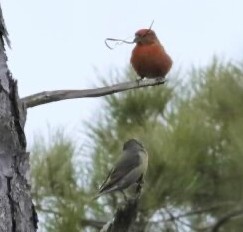
The Red Crossbill→ is a bird I have always wanted to see but never have. Here in central Illinois, it would have to be an irruption year before they would get this far south. If you look in your field guide at the range map for this crossbill, you will see that New Jersey is most often shown as just south of its winter range. It nests in upstate New York, New England, and Canada. However, Red Crossbills – like Purple Finches, Red-breasted Nuthatches, Pine Siskins, and Snowy Owls – have irruption years where their winter ranges will extend much farther south. When that happens in New Jersey, a few of the Crossbills will stay behind – not migrate back north – and nest in New Jersey’s pine barrens. Rick took this photo in the pine barrens of a male Red Crossbill with nesting material in its beak. Like the Yellow-headed Caracara, this Red Crossbill is out of its field guide range. It just would be so much easier for us birders if birds looked at their range maps in field guides and stayed put!
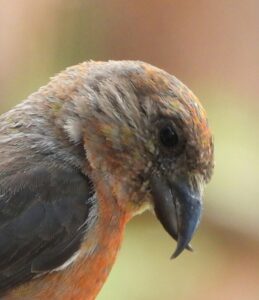
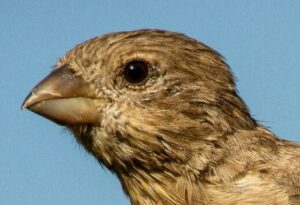
What has always fascinated me about the Red Crossbill is its beak. This bird is a member of the Finch Family which includes the much more common House Finch and both the American and Lesser Goldfinches. All 3 of these birds have regular cone-shaped beaks.
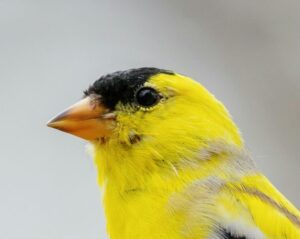
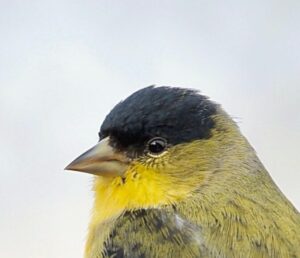
And what do crossbills eat where this beak would be an advantage? Their main food is seeds of conifers – seeds in pinecones. Pine, spruce, hemlock, Douglas Fir and larch. These birds have specialized. Other members of the Finch Family eat all sorts of seeds from many different plants and so their plain, but sturdy, cone-shaped beaks are all that’s needed. But the shape of the crossbill’s beak turns out to be perfect to wrestle out seeds from the cones.
And how did this develop? For the crossbill, I do not know, but for how the shape of beaks in the Finch Family have developed and changed over a 30-year period, I highly recommend the Pulitzer Prize winning book The Beak of the Finch by Jonathon Weiner. This book describes the work of biologists Peter and Rosemary Grant and their work with finches on the Galapagos Islands. I have read this book 3 times and loved it each time. Their work – their observations – are simply fascinating. They documented with painstaking hands-on observations how the beaks of finches changed through periods of drought and heavy rain. Through periods of abundant food and scarcity. This is a fascinating scientific journey. Upon reading this, you will better understand the beak of the Red Crossbill.
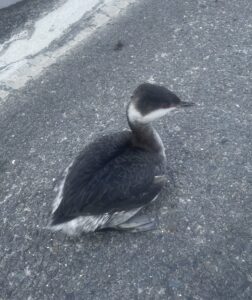
And the last photo Rick sent me was a Horned Grebe. I love grebes! In fact as I am typing this, I am looking out my window and watching a Pied-billed Grebe diving in our small inlet which is full of blue-gill and croppie. Breakfast! We have a few Pied-billed Grebes on our lake every year about this time – they are in migration and stopping for a rest and food. None stay more than a few days, and they are generally alone or in a group of 2-3.
At our house:
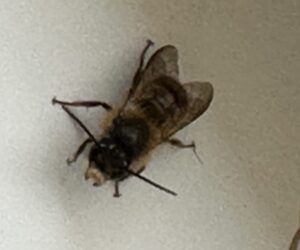
We had a hatching! On a warm day in early March, we got ambitious and washed our upstairs windows. We have the kind that you can pull towards you so both the upper and lower panes on both sides can be washed from inside the house. We also took time to wash the tracks of the windows – spiders love living there and we do tend to always look like we are decorated for Halloween since I do not like to disturb the webs. But the webs were long past being used, so we eliminated them and got all the windows – with their tracks – spic and span. Not a job we relish, and I cannot remember the last time we washed these windows.
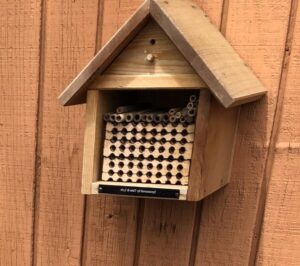
Two weeks later, there were 10 fully adult small bees on the inside glass of the windows. They were crawling all around. I opened the window from the top and using a 3×5 index card, I carefully moved 9 of them up the glass and they all flew out. The 10th was very sluggish and just would not move. I later found it dead on the floor. In 2 days, there were another 7 bees on the same window, and I successfully got them all moved to the outside. Did they survive? I just don’t know. Our weather has certainly been cold and quite warm with some whopper storms – typical March weather for Illinois.
I am guessing these bees hatched from eggs deposited in those window frames. And here Cleon and I thought we were being so thorough in our cleaning! And thank goodness we were not – we did not dislodge these eggs – we never even saw them.
Luckily, I have 2 good friends who know a whole lot about bees. Susan, who is a beekeeper, and Sonia, who has worked with native bees for about 10 years – most particularly mason bees. And she is the one who identified this bee and Susan agreed. This is a mason bee – one of our native bees. At first glance, you can see it resembles more of a house fly than an actual bee, and it is small – about the size of my thumbnail. Compared to a honeybee, its stinger is short and squat. And mason bees do not live in hives. Each bee makes its own nest out of mud or ‘gunk’ and I am embarrassed to admit there was a lot of both in the frames of our windows – washing windows is never a priority with Cleon and me. But now I can stop feeling guilty about the state of our windows – I am providing mason bee nesting sites!
In our yard:
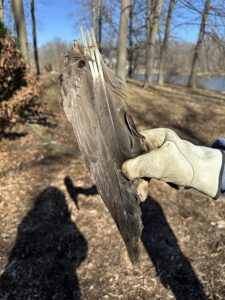
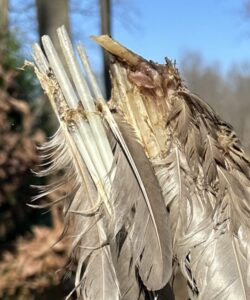
Just so you know I have not been exaggerating about the seriousness of the goose fights in our backyard. And these fights continue. Not every day, but on sunny, warmer days, you will definitely hear them, and you might see some chasing and physical contact between geese behind the feeders on the livestream. A week ago, Cleon found these feathers right at the prime nesting spot on our point. This was obviously one serious skirmish. And a mated pair will work together to dislodge a lone goose they deem a threat – and they are relentless. The fights can get quite physical.
These geese will chase each other from our yard into the lake and will try to drown each other. So far, no fatalities we know of, but they will hold each other under water. Luckily geese have a nice layer of fat and are good floaters, so it is hard to keep them underwater for a long time, but still?
If you send me what is going on in your area – or from a trip you have taken – I would be happy to post your observations. Just return to the main blog page and click on “Share Your Thoughts”.
*Rick Radis is a writer, editor, and environmental consultant who has worked on land and water preservation and as an endangered species specialist since the late 70s. He is a former editor of NJ Birds, NJ Audubon Magazine, and other conservation publications, and his writings and editorials have appeared in other national publications including the New York Times.
**ebird. What is it? Click on this link: ebird