

Clematis – our native one – Virgin’s Bower, Woodbine, or Old Man’s Darning Needles (Clematis virginiana)
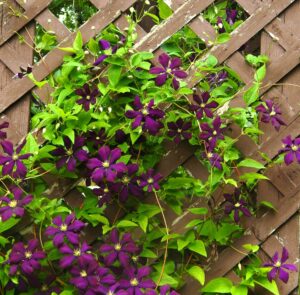
The clematis vines we see everywhere are hybrids and cultivars that have been created by botanists and plant hybridizers. For example, a common clematis we can see in so many yards on trellises and twining around mailboxes is Clematis ‘Jackmani’ which is a cross between Clematis lanuginosa and Clematis viticella – neither of these parent plants are native to North America.
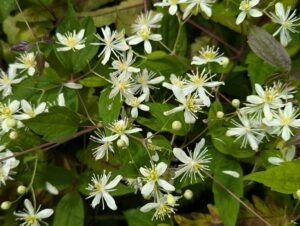
Virgin’s Bower (Clematis virginiana) is most often found east of the Rockies and is native to our eastern states. Its flowers are small and white. There are several varieties of clematis that produce quite large white flowers but again, these are hybrids or cultivars, and the parent plants are not our native clematis.
Virgin’s Bower can be confused with Sweet Autumn Clematis (Clematis terniflora or Clematis paniculata) – this is an aggressive vine from Asia which can be invasive. What is really unfortunate is that the invasive Sweet Autumn Clematis has the most wonderful fragrance while Virgin’s Bower has no fragrance*. In my opinion, even though the Sweet Autumn Clematis fragrance is heavenly, don’t plant it. Its aggressive, invasive nature is too hard to control. Use the lovely Virgin’s Bower in its place – a much better-behaved vine.
And remember the old adage concerning vines in your garden – and it definitely fits Virgin’s Bower!
First year it sleeps
Second year it creeps
Third year it leaps!
Most vines come into their own in year 3 – this one definitely does.
Light: Full to part sun. Mine gets full morning sun until early afternoon, then is shaded by the house. The vine is a good size and blooms well.
Soil and water: Rich, moist, but well-drained soil.
Hardiness Zone: Zones 3-9.
Size and growing habit: Will grow up to about 10 feet tall and wide, but with annual pruning, it can easily be kept to about 8 ft. x 6ft. This plant is a vine which needs some sort of trellis for support. It clings by twining itself around and through the slatted openings or wrapping itself around the support pieces.
Bloom period and color. Pruning: Blooms with small white flowers from mid-July to early September.
Pruning: This vine can be left unpruned, but it flowers on new growth. That means the more pruning you do, the more the vine will put out new growth, and that will create more flowers. It can be pruned to within 6-12 inches of the ground in late fall or early spring, but I prune mine back to about 3′ from the ground. I always prune mine in early to mid-March. If you prune yours to within a foot of the ground, make sure there are buds below your cuts. One reason to cut it back each year is that as the years go by, an unpruned vine will get heavier and heavier and could cause the trellis or fence to bend or collapse.
Check the vine about once a month to make sure there are no parts of the vine growing where you do not want them and that all parts of the vine are twining through the holes or around the pieces of the support. You can do light pruning at any time to remove any parts that are broken, growing the wrong way, or the vine is getting too tall or wide. And if parts of the vine have not attached themselves to the trellis, you can use twist ties to tie them to the support – check every few weeks to make sure those parts begin to twine around the support. Once those parts are holding themselves in place, you can remove the twist ties.
Butterflies and birds: The vine tends to be bushy so provides cover and concealment for nesting birds. Native bees will forage among the flowers.
Deer, rabbits, and other pests: Deer and rabbits avoid this clematis vine.
What to plant with Virgin’s Bower: Because it blooms white, any perennial or annual will look good with this vine. Once the vine is established, you can plant small shrubs of any kind in front of it. If you do choose to do this, make sure the shrubs do not grow over about 3 feet tall and if you prune the vine, do not prune it to a height lower than the shrubs.
How to use Virgin’s Bower: This is a great vine to camouflage or soften chain link fences. It will also grow well on a trellis of any material. If you would like it to grow up a solid wall or post, you can attach chicken wire to the wall which is fairly unobtrusive. The vine will readily cling to it as it grows, and it will not take long for the chicken wire to be obscured.
*An interesting note. Although I have grown every plant I have listed in this section of the website, I always research each one before posting. If you look at different websites for this clematis – Virgin’s Bower – you will find size varies quite a bit. From a maximum height of 9 ft. to over 20 ft. That is a big difference. Especially if you want a vine for a more confined space. It is hard to keep a vine that wants to be 20 ft. tall to be only 8 feet tall. In my experience with this vine, in cultivation, 10 ft. is about its maximum height. Another big difference from website to website is fragrance. In my experience Virgin’s Bower NEVER has a fragrance. Sweet Autumn Clematis ALWAYS has a fragrance. However, I found at least a dozen sites that stated Virgin’s Bower – Clematis virginiana – has a lovely fragrance. Keep this in mind if you plan to purchase this plant. I honestly believe I am correct in the information I am giving you. This vine will top out at about 10 ft in cultivation, and it has no fragrance.
This is a plant you may want to call by its botanical name when purchasing – Clematis virginiana. Common names can vary from region to region, but the botanical names are always the same. In this way, you will be sure of what you are purchasing. Besides height and fragrance, the biggest difference between Virgin’s Bower (Clematis virginiana) and Sweet Autumn Clematis is that Sweet Autumn Clematis is much more aggressive and can be invasive. You do not want to purchase this vine by mistake. One way to tell them apart is that Virgin’s Bower has leaves that have jagged edges while Sweet Autumn Clematis has leaves that have smooth, rounded edges.