

Trumpet Vine (Campsis radicans)

A hummingbird magnet! Native to parts of the U.S. – generally our southern states. It has also been declared a noxious weed in some areas so consult your state’s website that deals with plants. If you are going to grow a Trumpet Vine, then you must take care of it by regularly pruning it and keeping its growth/spreading firmly in check. If you can make the commitment to do this, this plant is not invasive and will be a beautiful addition to your garden. if you cannot make this commitment – each and every year – then do not plant it.
Light: Full sun.
Soil and water: Average to less than average garden soil. The richer the soil, the more leaves and the less flowers. Water it well when planted and then water deeply once a week for about a month. After that, it should be established and unless there is a prolonged drought, it should not need to be watered. This vine is drought tolerant. Cover the roots with 2 inches of mulch.
Support: This plant is a very heavy vine which must be on a strong support. It clings with its aerial roots. The only time a branch needs to be tied is if you want the branch to grow in a certain direction and the tie needs to remain only until the branch has gripped the support with its roots. Supports can be a sturdy wooden trellis, a wooden fence, a stucco or brick wall.
This plant is aggressive in its growth. Wherever you plant it, although you can control it with regular pruning, it still must have room. Give it space!
Hardiness Zone: Zones 5-9.
Size: If you let this vine grow without pruning back its height and width it at all, you can expect it to be 20-40 feet tall and 10-20 feet wide. With regular pruning and attention, you can keep this vine to about 12-15 feet tall and 6-8 feet wide. But you must make a commitment to do this. Trumpet Vine can grow almost out of control in one spring and summer season. But what a gorgeous vine when it is controlled! And the regular pruning will encourage it to bloom profusely.
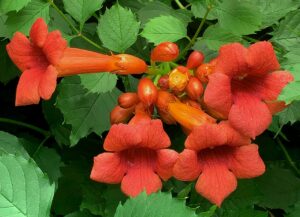
Bloom period and color. Deadheading: Depending on variety – red, orange, or yellow. Blooms in July to late August/early September.
Deadheading: To prevent this vine from spreading by forming new plants, you must deadhead it as the flowers fade. Do not allow it to set seed. Keep in mind that this could require a ladder to reach the flowers at the top of the vine. You do not need to be careful when deadheading – just cut off the fading flowers anyplace. This vine is a robust grower and will recover quickly.
Pruning: This vine can be completely cut down in late fall after all the leaves are withered or fallen. Cut to within about 6 inches of the ground.
Keep this vine to one main stem/trunk – if other stems break ground at the base, cut them off at or just below ground level. Also look on the ground all around the plant – it has an extensive root system and the roots will spread wide. Look for any other stems that have broken ground and cut them out either at or just below ground level. Check for these extra stems at least once a month during the growing season. If you decide not to cut this vine to the ground each fall, then you must still do your hardest pruning in fall after the vine is completely finished blooming. Cut back to the main stem/trunk any unwanted branches. Trim its height back 3-4 feet from your optimum height. Cut off any smaller branches from the main branches that are growing in the wrong direction and cut back or remove any growth that is too thick.
Do not prune or do not do much pruning in spring or you will be removing the summer’s blossoms. However, in regard to the health of the vine, pruning can be done at any time – just keep in mind it starts to form its buds in spring and early summer so pruning at those times could significantly limit its number of flowers for that year.
Deer, rabbits, and other pests: This vine is generally pest free. Deer and rabbits avoid it.
Transplanting and propagating: Choose your site carefully as this plant is hard to transplant because of its size and the root spread.
Propagating: Take stem cuttings in spring.
What to plant with Trumpet Vine: Anything you plant with this vine should be planted at least 3-4 feet away from its trunk. The plant needs room, it has an extensive root system, and you must be able to access the plant easily for regular pruning. When it is in bloom, it can be a focal point in any garden. And when not blooming, it can serve as a backdrop for any plant. This is a heavy vigorous vine so in my opinion, plants that are closest to it should also have a substantial presence. They do not have to be tall but their leaves and foliage should be easily seen. The larger Shasta Daisies, summer phlox, and daylilies, would be good choices as would the larger zinnias, white geraniums, and spider plants (Cleome). This vine can also be planted behind smaller shrubs like St Johnswort and the smaller spireas.
How to use Trumpet Vine: This is an outstanding vine to soften or camouflage a fence. It can also be grown on very sturdy and large trellises. You can grow it right on a stucco or brick wall but if you ever remove the vine, there will be marks from the aerial roots – just like there is with ivy. It is my recommendation to not grow it on walls of buildings like a shed, garage, or your house. The roots are extensive and as the years pass by, they could damage the foundation.
This is also a vine that can be grown on a dead tree – it will use the tree as its natural support. Once established, as it grows, I would recommend completely removing the lower branches (those within 3-4 feet of the ground). Always check the area around the base of the stem/trunk and cut out any other stems that emerge from the ground. Other pruning will not be necessary as the vine will confirm to the branching pattern of the tree. The downside of this is you may not be able to deadhead – the vine could get too big and tall and it would not be safe. Just know you may have volunteer Trumpet Vines in your yard and garden each spring that you will want to remove. Also keep in mind the dead tree must be in full sun for the best bloom.
Trumpet Vine can be used as a ground cover – it is especially effective on dry slopes. But keep in mind that once it is established, you will not be able to easily access the ground of the slope the vine covers – as time goes on, this becomes a thick-branched vine with branches twisting every which way when used like this. But it will hold a slope in place and does not need watered. I would recommend some thought about this before using it this way but know that it can and with success.
One of the most interesting ways to grow this vine is to espalier it – especially with a wall or fence as its background. This takes commitment and pruning skill. But Trumpet Vine is a forgiving plant and grows fast enough that if you make a pruning error – cut something you regret – the plant will repair itself quickly.
Always remember this is an aggressive plant that borders being invasive. You need to commit to its care! And I repeat, if your state has declared this plant to be a noxious weed, do not plant it anywhere in your garden or yard.
Miscellaneous: This plant thrives on neglect, but your maintenance of it must be regular, vigilant, and meticulous. Do not let this plant get away from you and you will have a thing of real beauty! If you do not commit to regular checking and pruning, you will have a mess.