

Santolina or Lavender Cotton (Santolina chamaecyparissus)
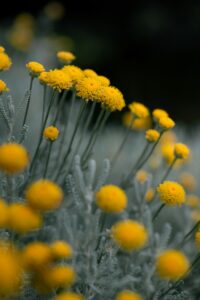
Santolina is an herb that makes a wonderful perennial or small shrub,
Santolina is not a common plant east of the Rockies – in part because it likes hotter, drier sites. West of the Rockies, it is a lovely addition to many gardens. Its requirements for water are quite low, it loves hot sun, and will thrive in a more desert-like soil. Those of you living west of the Rockies are probably familiar with Santolina, but for those of us living east of the Rockies, this is a more unusual plant not found in many gardens. In fact, from our middle states → north, it can be hard to find at garden centers. But this is a plant well worth taking the time to find. It is a great container plant and looks good 11 months of the year – only when you prune it back hard in March will it look a bit rough, but it quickly recovers.
Light: Full sun
Soil and water: Likes a hot, dry site. Average garden soil – but will grow in almost any soil. Santolina will grow – even thrive – in more infertile sites, and even in heavier clay soils. The one necessary requirement is the site must be well-drained.
If your plant is in a container, it also likes to be on the drier side but remember, roots get hotter in containers than they do when planted in the garden so your plant will have to be watered regularly. However, do not overwater. Stick your finger into the potting soil down to about the knuckle. If your finger remains dry, water the plant. If it is at all moist – or wet – do not water.
Hardiness Zone: Zones 6-9. This is what most plant tags and information on Santolina will tell you. But in my experience, planting in an unprotected site in Zone 6 can be iffy – I have planted Santolina in Zone 6 in both southeastern PA and southern WV and my plants did not winter well at all. However, every garden is different as is every gardener, so my experience may not be yours. Just keep that in the back of your mind.
If you are in Zone 6 and your garden is unprotected and prone to wind – especially cold blasts in winter, consider using Santolina as a container plant. I am now in Zone 5 – actually 5b. And it appears on the most current maps, I am now bordering on 6. I have not moved, but the winter temperatures are very slowly changing overall and looking at temperature trends in your area over the last 10 years, my guess is you will see they have warmed a degree or so. I would love to be in Zone 6 – more perennials and shrubs to choose from than in Zone 5, but this all has to be viewed with caution. I like to experiment and push the envelope, and I encourage you to do that also. Just be aware that a Zone 6 plant may not survive if you are on the border between Zone 5 and 6. Plants are expensive. But that said, experimenting can bring so much enjoyment and also that is the way we increase our gardening knowledge and skill. Don’t just read what others are doing on the internet or on social media – get your hands dirty! However, all that said, I am not planting my Santolina in the ground – it will always remain in a large container. And it looks great!

Size: About 2 ft. tall and wide. A dense, mounded shape.
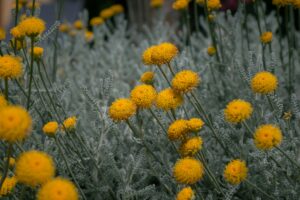
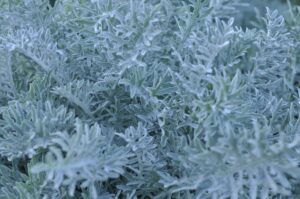
Bloom period and color. Deadheading. Blooms bright yellow. This plant is evergreen – has slivery green leaves which are small and resemble needles on conifers. Gently rub the leaves between your fingers and breathe in – I love their fragrance. Piney, but with a bit more of a resin aroma to it.
Deadheading. To deadhead as the flowers fade, cut the flowers off at the bases of their stems. If you are allowing the plant to set seed, remove the seedheads and stems after you have collected the seed or have allowed it to disperse on its own.
Cutting back in late winter. To keep this plant looking fresh and lovely, in late winter/early spring (if your plant is outside, this is probably March – inside and it can be in late February), take a good look at your plant. You should see new growth coming from the center. Cut back all the previous year’s growth. This breaks the rule of never remove more than a third of a plant when pruning. All this older growth needs to be cut away so the new growth has room to grow – and it will grow fairly fast. Within 4-6 weeks of this hard pruning, your plant should have recovered most of its dense mound shape and be growing well. It will regain its full size within 8-12 weeks. And then bloom profusely.
If your plant is in a container, this is a good time to repot it with fresh potting soil.
Butterflies and birds: Butterflies, moths, and native bees are very much attracted to the flowers.
Deer, rabbit and other pests: Deer and rabbits avoid this plant. I have always had at least one Santolina and have never been troubled with aphids, scale, spider mites, or any plant disease.
Transplanting and propagating: Santolina is not hard to transplant. If in the ground, dig your plant out carefully and then dig a hole as deep and twice as wide. Place the plant in the hole and push the soil back around the roots and stem. Firm the soil, mulch, and water deeply. Water deeply once a week for about 4 weeks and the plant should be established and should not need watered unless there is a prolonged drought.
If the plant is in a container, the best time to repot it is in late winter after you prune it back hard (see above: Cutting back in late winter). If you are putting it back into the same container or one of equal size, because you have cut back so much of the top growth, you can cut the roots back by about 1/3 to give the plant room to grow. Place the plant in its pot and firm potting soil around its roots. Water deeply. Santolina should be watered about once a week. If in all day sun and the temperatures are 90°F and above, check the plant every other day. Stick your finger into the potting soil up to your knuckle. If the soil feels dry, water it. if it feels wet or damp, do not water it and check the following day. A good rule for all plants in containers – regardless if they are in the sun or shade – if the temperatures are above 90°F, check the containers every day and water as necessary.
Propagating. The seeds can be collected and sown in pots, flats, or in cold frames in fall or spring. Cuttings can be rooted in fall. Lower branches of a mature plant can be covered with soil and roots will develop. Propagation by all 3 methods is fairly easy – I have had the most luck with cuttings. This is a more short-lived plant. 5 years is its average life. I like to have several or more of these plants, so I take cuttings from them when they are about 3 years old. Because these plants are fairly versatile and behave themselves in a garden – plus have lovely cheery flowers and fragrant leaves – these make good gifts for friends!
What to plant with Santolina: Santolina is an herb and so will go well with most: rosemary, thyme, oregano, sage, and lavender – and remember, if you live at Zone 6 or colder, rosemary (unless you have the variety ARP) also needs to be brought inside for the late fall and winter as it will not tolerate cold temperatures.
Santolina’s growing habit goes well with any of the Artemisias and their silvery color offsets Santolina’s grayish green – a lovely color combination.
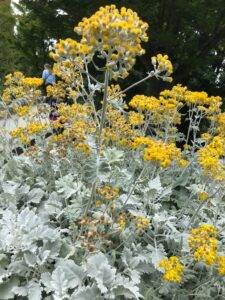
How to use Santolina: As I mentioned above, I live in Zone 5 – actually 5b. And our winters are just too old for Santolina to stay outdoors. I have my 7-year-old Santolina in a large pottery pot which I place outdoors each May and bring in in late October [It is elderly, but still looks wonderful, and I attribute that to the hard pruning it gets every late February/early March (see above: Cutting back in late winter).]. It winters in my small greenhouse where the temperature never goes below 40, and it looks great almost all year round.
If you are able to leave Santolina in the ground for the entire year, this plant makes a lovely small hedge. It can be trimmed to keep it more rounded, or it can be left to grow. It is dense, fragrant, and a bit sticky and prickly so will deter some pests like rabbits. Not a 100% barrier, but rabbits and squirrels do not like Santolina and tend to avoid it. So used with other deterrents, Santolina will help discourage mammal pests.
Santolina is a perfect addition to any herb garden, but it also does very well as a single plant or a grouping of 3 in a perennial garden, or massed with other shrubs. It is smaller, but dense, and so will hold its own if placed at or near the front of a grouping of shrubs. And in a container, it will look lovely on any sunny porch or deck or patio. This is truly a versatile plant.