

Horsemint, Spotted Bee Balm, or Spotted Horsemint (Monarda punctata)
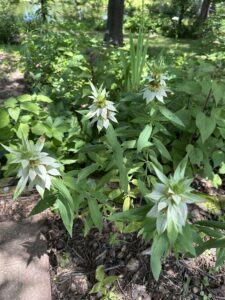
In my opinion, this is an under-used plant. Even many people who are avid gardeners are unaware of it. I love it and have always had it in all my gardens since I stumbled upon it back in the 70’s. It is related to bee balm, but does not spread as quickly – and if you have ever grown bee balm, you know it can be a nice ground cover, but it does not grow as fast as the more invasive myrtle/periwinkle or ajuga/bugleweed. It is the ‘flowers’ that continue to draw me to horsemint – they are just so unusual! And they provide a bright spot in a more shaded area.
I always knew this plant as horsemint – I did not hear it called spotted bee balm until recently, so I will refer to it as horsemint. It is in the mint family – the flower stalks have square stems – always a sign a plant is a mint. However, it is not invasive as the mints we grow for mint tea. This is a well-behaved member of the mint group of plants, but if several – or more – are planted close together, they can still be used as a ground cover – see How to Use Horsemint.
Horsemint is native to our eastern and central states.
Light: Full sun to part shade. However, in my experience, this plant grows best in part shade. Dappled sunlight. Morning sun/afternoon shade. I have always grown my horsemint near trees which shaded it from afternoon sun. I have one growing under a hickory sapling which in summer, provides dappled afternoon shade, and the plant is thriving – it has been in this spot for three years. It is the one in the photo above.
Soil and water: Thrives in a good, moist, garden soil and will grow in sandier soils. My two plants are in clay soils and are doing well. Horsemint does not like a wet soil and any place you plant it should be well-drained – dry out between rains or watering. And it will tolerate some drought – it is much better coping with drought than its bee balm cousin.
Horsemint is considered to be a short-lived perennial. I have not had that experience – mine all lived to be 5-7 years old. But your experience could be different. Horsemint can be divided in spring or fall when it is 3-4 years old. Dividing will rejuvenate the plant each clump will live at least 3-5 years.
Hardiness Zone: Zones 4-9.
Size: In bloom, it is 2-3 feet tall. After deadheading, it is 4-10 inches tall. Horsemint grows into a clump, and each clump will eventually be about 2-4 feet wide – this takes 2-3 years.
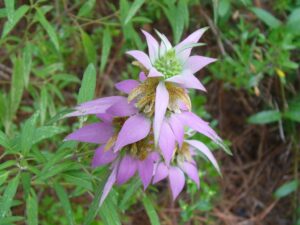
Bloom period and color. Deadheading: The big color is actually not a flower but is from bracts*. The bracts can be white/ivory, pink, or purple – most often, a soft blend of all three colors. And an interesting characteristic is that the ‘flowers’ – the bracts – can stack – one on top of another on the same stem. Not many other plants do this. This is one of the features I love about this plant – the bracts and actual flowers are fascinating – and beautiful!
Horsemint shows all this wonderful color from its bracts for weeks – much longer than most other blooming perennials. Horsemint starts showing the color in July and will continue through September and well into October.
Deadheading: Deadhead fading ‘flowers’ by cutting their stems at ground level. This often prolongs blooming by about 2 weeks. If you allow the last flowers to set seed, this plant will self-seed. It is not invasive, but you will get volunteers in your garden which you can transplant to where you want them, dig them up and give to friends – horsemint is not an easy plant to find in garden centers, or hoe them out and put them in your compost bin.
Butterflies and birds: Hummingbirds are drawn to horsemint as are butterflies and moths. Pollinating insects love Horsemint!
Deer, rabbits, and other pests: As far as I know – and in my experience – deer and rabbits avoid this plant.
Powdery mildew** can be a problem. I have powdery mildew in my garden and it has never struck either of my horsemints. In my opinion, horsemint is only moderately susceptible. Plants like zinnias, phlox, and bee balm or more prone to the disease. Keeping your horsemint in well-drained soil and making sure it has good air circulation around it will go a long way in keeping your plant healthy.
What to plant with Horsemint: Lavender, rosemary (watch the growing zone!), and thyme are good companion plants – especially if you are planting for fragrance of leaves. Horsemint will look good planted in front of coneflowers and Shasta daisies. I also like it with any of the alliums.
How to use Horsemint: It is often described as too straggly for the front of a garden, but I do not agree. It can become straggly if you do not take care of it – this is a plant that needs tending – you need to be a gardener. Not someone who puts plants into the ground in spring and never gives them another thought until the following spring.
About once a month, take a good look at your horsemint and cut away any part of the plant that looks like it is ‘straggling’. Neaten it up. If you do that, your plants will look just fine for the entire growing season.
I have mine planted both as a ground cover on a smaller area and as a single plant within my perennial garden – both look good.
To use as a groundcover: If you have powdery mildew** in your garden, I advise you not to use horsemint as a ground cover for a large area. You can certainly plant individual plants in your garden, but do not plant them close together as you would for use as a ground cover. However, if you do not have powdery mildew, then horsemint will make an interesting ground cover – and one you will not see in everybody else’s yard. (I am experimenting with it in my own garden where I have powdery mildew but am still using horsemint as a groundcover – but for a small area. So far, so good, but it has only been two years – not enough time. If powdery mildew is going to develop on these plants, I look for it in years 3-5.)
Place the plants about 16-18 inches apart and they will slowly fill in. You should have a good coverage during the second year. Until then you will have to keep the area weeded. You can step on horsemint – just be careful and try to do it as little as possible. Although when you do, that lovely leaf fragrance should envelop you – a nice perk! Horsemint may not fill in as solidly as other groundcovers, but it will do a good job – you will just have to watch out more for weeds and pull them as you see them in order to keep the bed looking its best. But when a mass of horsemint shows all that color? And for such a long time? It is so worth the effort to keep it tidy!
Unlike many other groundcovers, Horsemint can be mowed – just set your mower blades to 3.5 inches or higher.
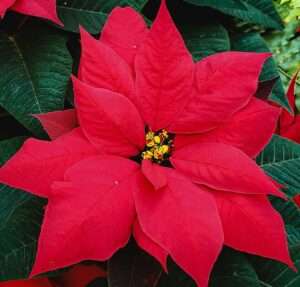
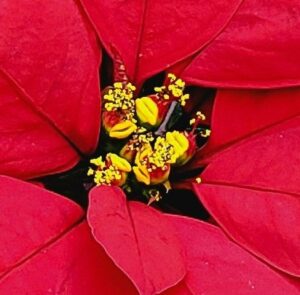
*Bracts (from Merriam Webster) – These are leaves (most often NOT green) from which a flower arises. A good example of bracts that are mistaken for a flower are the ones found on a poinsettia. Those red ‘flower petals’ are not flower petals – they are bracts. The actual flower is at the center of the bracts. Horsemint is the same. The color is not from flower petals but from bracts. The actual flower is quite small and at the center of the bracts. If you use a magnifying lens on Horsemint or Poinsettia, you will see more clearly how this all fits together.
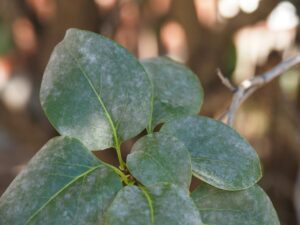
**Powdery mildew is a widespread disease in many gardens – I have had it in most of my gardens throughout my life and I have it here in my garden now. It will look like your leaves have a white powder sprinkled over them. To slow down the spread of it in your garden, do not overcrowd your plants – make sure each has good air circulation. When you use any tool around a plant that has powdery mildew, dip it or rub it with alcohol before using the tool on or around any other plant. Remove any leaves that show the powdery mildew and place them in a plastic bag for your trash collection. Do not burn them or add them to your compost bin.
Powdery mildew can be spread by overhead watering. If you have powdery mildew, always water your plants at the soil level – do not get the leaves wet.