

Green and Gold (Chrysogonum virginianum)
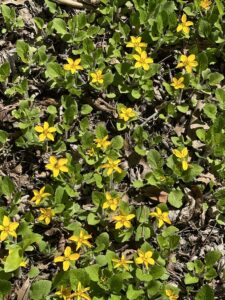
Green and Gold is one of my favorite groundcovers and it is a groundcover most people have never heard of. One of its best features is that it is not invasive like so many groundcovers are. It is native in North America and its range extends from Pennsylvania south to Florida, then throughout the south to Louisiana. I live in central Illinois (it is not native here), use it as a groundcover, and it is growing very well. You can walk on Green and Gold – sparingly – and it hugs the ground in a low-growing mat. The cheery yellow flowers blanket the entire area covered by this groundcover in spring. It does a very good job choking out weeds and holding the soil in place – exactly what a groundcover should do.
If you need a groundcover for a more shaded area and are automatically thinking of ajuga/bugleweed (native to Europe, Africa, and Asia) or periwinkle/myrtle (native to Europe and Asia) – STOP! Both of these are faster growing than Green and Gold but both are invasive and are now in many woodlands choking out small native plants. Green and Gold is not a prolific self-seeder and it is slower growing. I am unaware that it is anywhere where it should not be. Always choose Green and Gold over these other 2 groundcovers that are overused and invasive.
Unfortunately, Green and Gold is not easy to find in garden centers but it can be ordered online.
Light: Some plant tags say this plant will grow in full sun. In my experience, that is only true if you live at the edge of a wetland or are planning to water it deeply every day in June, July, and August. In my opinion, this is a part shade plant – 4-5 hours of sun a day at the most – and preferably, morning sun – no afternoon sun. It grows well close to trees where it will get dappled sun.
Soil and water: Rich, loamy, and moist soil. It will withstand some flooding, but it will not grow in a consistently water-logged soil. And to show you how tough this little groundcover is, it will also tolerate a short period of drought. If you grow it close to trees, just be sure to check it once a week to see if it needs watered. Trees can be thirsty plants! I have my Green and Gold growing within about 20 feet of large trees and even closer to good sized deciduous azaleas, a viburnum, a witch-hazel, and a buttonbush. These big trees and larger shrubs are on a gentle slope and the Green and Gold is at the bottom of the slope so gets all that good rainwater flowing downhill. Even though these other plants are big and soak up a lot of water, I only have to water the Green and Gold if there is a prolonged drought of more than 4 weeks.
Hardiness Zone: Zones 4-8.
Size: Each plant is 1-2 inches tall and will spread about 18 inches. If you are using it as a groundcover, place the plants about 12 inches apart. They are not incredibly fast growers like more invasive groundcovers, but they will fill an area in within a few months time – just be patient.
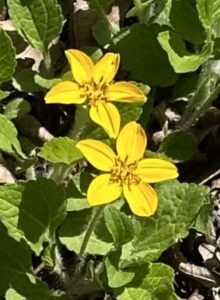
Bloom period and color. Deadheading. Transplanting: Blooms bright yellow. For an inch tall plant, these very short-stemmed flowers are obvious and showy – and there will be a lot of them. Some sources say this plant blooms April to October. I have never found that to be the case. I always get a big bloom in April which lasts about 3 weeks – sadly, most spring-blooming plants just do not have a long enough bloom for me. They are so gorgeous, I wish they would bloom all summer, but they do not. Plants like irises, lilacs, tulips, redbud, bluebells. Like all of them, Green and Gold also has a shorter bloom, but when it is flowering, it is just lovely! Occasionally in fall – generally in September – these plants might produce a few flowers, but most years, mine do not so do not count on this. I have never seen this plant bloom during the summer months. However, you could have a different experience than mine. Just keep in mind, a likely scenario will be a big April bloom and that will be it for the year. Just remember, even when not blooming, this is a pretty plant whose mat always looks neat and tidy.
I have never deadheaded this plant and like all groundcovers, it transplants easily. When I researched this plant, several sources said it will self-seed – not profusely so it is not at all invasive, but you could get some volunteer plants in other areas of your garden. I have had Green and Gold in all my gardens everywhere I lived and it never self-seeded. Just keep in mind it could in your garden, but don’t count on it.
Butterflies and birds: Pollinating insects of all sorts seem drawn to these flowers, butterflies will also use the flowers, but this is really not a plant that birds use. But we all need groundcovers in our gardens from time to time and this is a good one because it is not invasive and will not spread to woodlands or wetland edges to choke out plants birds do use.
Deer, rabbits, and other pests: I have never had deer or rabbits bother any of these plants. However, if you have an abundance of either animal, I recommend spraying newly emerging plants in spring with a repellent until they are up and growing well. Just follow the directions on the label.
I have never had any of these plants bothered by any insect or plant disease, but my research did say that mildew can be a problem. Again, I have had Green and Gold in all my gardens, I have always had mildew issues – most especially on Bee Balm (Monarda) and summer phloxes – but never on this groundcover. Just keep in mind it could happen.
What to plant with Green and Gold: I have mine around deciduous azaleas, a witch-hazel, a buttonbush, and a viburnum. Also in that garden are Lady’s Mantle and Lady Ferns. I think this is a lovely combination for a shaded garden.
How to use Green and Gold: I have always used it as a groundcover. And it can be used in smaller or larger areas. Because it is not an incredibly fast grower, it can be used to edge the front of your garden because you only have to check it once every 4-6 weeks and then chop away any that is growing outside where you want it to be. You could also use it as a single plant in the front of your garden – just be sure it has about 24 inches in which to spread out in all directions.