

Fuchsia – a hummingbird magnet!
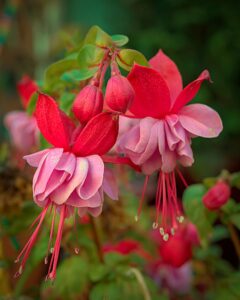
Fuchsia Fuchsias can be trailing – these are the ones used in hanging baskets and pots. But there are also Fuchsias that are upright. These can also be used in containers or planted right into the ground. If you are buying single plants, check the plant tags for growth habit.
Light: This can be tricky and my advice is to place your plant in what you think would be the optimum place and then look at it each day for 2 weeks to see how it is faring. Bright, indirect light is best. Some direct early morning sun is OK. Part shade to filtered sun is the best description. They absolutely will not tolerate hot sun. I grow mine in containers on our deck which is shaded all day by big trees. Mine get dappled light – or filtered sun – and shade all day/every day. My plants do very well. My opinion is if you are going to make an error, make it an error towards shade.
Soil and water: If you are planting them right into the ground, they grow best in a rich, moist soil that is well-drained. Mulch them to keep the soil moist. They are also good container plants – use good quality potting soil and the container must have drainage holes.
If planting Fuchsias into the ground, water deeply twice a week for about a month until they are established. After that, as long as they are not in direct sun, they should be fine. If there is a dry period, check them – they may need watered.
In containers. Check Fuchsias every day – especially when the temperatures are above 85°F. If the potting soil feels dry, water them.
Over-wintering: If you want to over-winter your Fuchsias, when the temperature outdoors matches the temperature in your unheated garage or basement, bring your Fuchsias into your garage or basement. (If you have planted them into the ground, dig them up and place them in containers with potting soil. Water them thoroughly when you pot them.) Allow them to go dormant by slowly withdrawing water over a period of about 2 weeks and keeping them in a dark place where it is about 45°F. About April 1st, cut back all the dead growth from the previous year. Repot with fresh potting soil and slowly begin to water – increase the amount over about 2 weeks until you are watering the plant about every 3-5 days. Once new growth appears, place the plant in more light – keep in mind it will not tolerate temperatures colder than 40, but where you place it can be warmer. Once all danger of frost is past, place your plant outdoors.
Size: There are many varieties of Fuchsia and a wide range of sizes – be sure to read the plant tags. But the average size range is about 12-36 inches tall or trailing and about 12-24 inches wide.
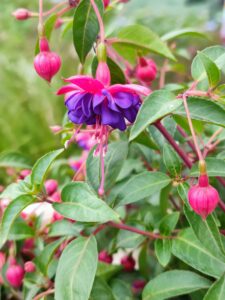
Bloom period and color. Fertilizing, deadheading, and pruning: Color greatly varies. If the plant you are buying is not in bloom, check the tag. All Fuchsias will bloom until either you bring them inside to over-winter or they are hit with frost.
Fertilizing: If your plants are in the ground, they should not need to be fertilized. If they are in containers, they need to be fertilized at least once a month beginning about June 15th. A fertilizer of 10-30-10 is good – follow the directions on the package.
Deadheading: Fuchsias do not have to be deadheaded, but they will produce noticeably more flowers if you do. Check your plants once a week for fading flowers. To deadhead, just snip off the faded flower where the flower stem meets the plant stem.
Pruning: To make your plant bushier with more flowers, pinch off the tips of the stems. If your Fuchsia is trailing from a container or basket and gets too long, pinch back the tips of the stems.
Deer, rabbits, and other pests: If the plants are within reach, both deer and rabbits will browse on fuchsias. Use a repellent and follow the directions on the label.
Transplanting and propagating: Fuchsias are easy to transplant and those planted in your garden can be transplanted into containers to over-winter in your unheated garage or basement. See above: Over-wintering.
Propagating: Fuchsias are propagated from soft cuttings which can be taken any time from spring to late summer. Place in potting soil and keep moist. They like a warmer place with indirect light. The cuttings should produce roots in about 4 weeks.
What to plant with Fuchsias: In the ground: Blue Lobelias, Ferns, and Hosta. They can also be planted with any annual that likes shade – any of the ones that go well with them in containers will go well with them in the garden.
In containers: Impatiens, Begonias, Coleus, Ferns
How to use Fuchsias: These are versatile plants that can be in your garden or in containers. They can be planted singly or in groups of 3. They can be used as accents in your garden or more than 3 can be planted in the ground for a mass planting. Just follow the tags for directions on spacing. Pay attention to their light requirements and once those are met, use them anywhere and with just about any other plant.