

Crocosmia
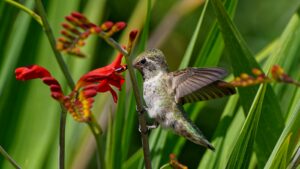
Crocosmia is both the botanical and common name for this plant. I find it interesting there seems to be no two-part Latin species name for the ones you buy here in the United States. On plant tags, you will find them called Crocosmia with the variety/cultivar listed next: Crocosmia ‘Fire King’, Crocosmia ‘Citronella”, and Crocosmia ‘Emberglow’ would be examples. Crocosmias are related to Irises, and they are native to South Africa and Madagascar.
Light: Full to part sun. The more sun, the more stalks of blooms there will be.
Soil and water: Average garden soil, but it must be well drained. Crocosmia likes a moist soil but not a constantly wet soil. Although it blooms best in full sun, it does not tolerate a hot, dry site. For example, if planted in full sun, do not plant it close to a wall, sidewalk, or driveway – reflected heat will make the site too hot. If the site is in full sun, be sure to cover the roots with about 2 inches of mulch and water during dry periods. This plant also does better in sites that are protected from hot drying winds. Surrounding them with plants close to their size – or taller – will help.
Hardiness Zone: 6-9. Some sources say 5-9, but I think this is dicey – it is also a change from about 30 years or more ago. For example, here in central Illinois, gardeners (and farmers!) are all aware it is not as cold here as it was 30 years or more ago and now changing some of the ratings of Crocosmia from Zone 6 to Zone 5 may be a reflection of that. Just be aware, that up until about 30 years ago, all Crocosmias were Zone 6 (and above.) Crocosmia can generally be planted now in Zone 5B gardens – cautiously in Zone 5A. In both 5B and 5A, plant them in more protected areas. Mulch when planting and then be sure to re-cover them in late fall so there is a layer of 2 inches of mulch covering them for the winter months.
I live in Zone 5B and my Crocosmias are in my flower garden, not in a protected site, mulched, and mine have successfully wintered over for the 20 years I have had this garden. If you live in Zone 5 A or B and are in doubt, consider digging up the corms in fall after all the foliage has died back and storing them in an unheated garage or basement. The average winter temperature in your storage area should be between about 35 and 45 degrees. Plant them outside the following spring after all frost is over and the soil has warmed.
Size: 1.5-4 feet – this depends on the variety. I have ‘Lucifer’ and they are about 3 feet tall. They are stiff, upright, and do not need to be supported.
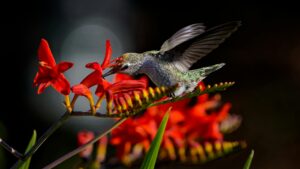
Bloom period and color. Deadheading: Crocosmia comes in red, orange, and yellow and all varieties bloom for about 6 weeks mid-June through August.
Deadheading. Cut the flower stalks when the blossoms have faded – this will encourage new stalks to form and extend the bloom period 1-2 weeks. Cut the stalks right at the point where they meet the leaves. Once bloom period is over, leave all the leaves intact until late fall or early the following spring. Once the leaves are all withered and have died back, they can be cut back to the ground. I always wait to cut mine back in early spring.
Deer, rabbits and other pests: Deer and rabbits can nip the leaves in early spring. If you have a lot of these critters, to be safe, spray with a repellent as soon as the leaves break ground.
Researching this plant, I read they are susceptible to spider mite. I have never had that problem in my garden. But be aware this could happen. Check your plants weekly for signs. The easiest way to check is to hold a piece of white paper under a stem or leaf blade of the plant and tap the plant. If what looks like pepper falls on the white paper, you have spider mites. Spraying the foliage with a strong pray of water once a week will discourage these mites. As a last resort, you can spray with one of the Safer brand products – follow the directions on the label. Just be aware that although the Safer brands are amongst the safest chemicals you can use, they are still chemicals and will kill other things besides mite – including some beneficial insects. Before making a decision to use a chemical remember, butterflies and moths – whether in egg, caterpillar or adult stage – do not tolerate chemicals.
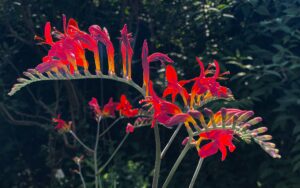
Planting, propagating and transplanting: Plant the corms in spring after all danger of frost is over and the soil has warmed up. A good time is when you are planting tomatoes and peppers in your vegetable garden. Look carefully at each corm and you will see there is a pointed end. Dig a hole about 3 inches deep and plant the corm with this pointed end facing up.
Crocosmia can be propagated in spring. Once the first shoots have broken ground, dig up the corm/clump and gently pull the clump apart and replant each piece. If it is only a single corm, replant. Crocosmia can be divided about every 3-5 years. I divide mine every 5 years.
What to plant with Crocosmia:
Yellow Coneflower (Ratibida pinnata) – I have Crocosmia planted in front of Yellow Coneflower (Ratibida pinnata) – a native plant in central Illinois which grows to 5 feet. This plant serves as a windbreak for my Crocosmia – my perennial garden is not protected in any way from wind. The yellow of these plants is a good contrast to the red Crocosmias and they bloom about the same time.
Shasta Daisies (Leucanthemum x superbum) – Crocosmia look good with taller varieties of Shasta Daisies – just be sure you have more of Crocosmia because the Shastas are a substantial presence. You do not want them to visually overpower the Crocosmia.
Black-eyed Susans (Rudbeckia hirta) – Crocosmia is a good back-drop for Black-eyed Susans and also annuals that are 2 foot tall and shorter.
Irises, Gladiolas and Alstroemeria – If you are looking for a mix of plants about the same height and similar leaves for a mass planting, plant Crocosmias with Irises, Gladiolas, and Alstroemeria (Peruvian Lily). Unless you live in the southern states, both the Gladiolas (Zone 8) and Alstroemeria (Zone 7) will have to be lifted from your garden in fall and wintered in an unheated garage or basement.
How to use this plant: My recommendation is to plant at least 3 – spaced about 8 inches apart. But this plant is great for a mass planting of 6-9 or even more. They can be a focal point of a perennial flower garden. The taller varieties can also be used as a backdrop for your garden – once deadheaded, the leaves remain green and upright until frost.
Miscellaneous: I only have the variety ‘Lucifer’ in my garden and I love it. It winters over for me and blooms beautifully – red, red, and more beautiful red for hummingbirds!