

Bee Balm (Monarda didyma) and Wild Bergamot (Monarda fistulosa)
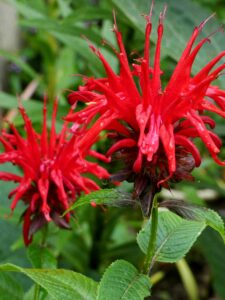
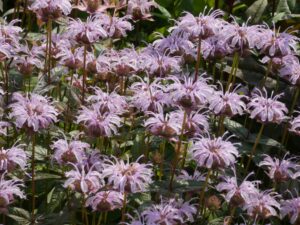
The botanical name is important because there are two Monardas generally available at garden centers and in online catalogues – both have been hybridized. Monarda didyma and Monarda fistulosa. Monarda didyma’s common name is Scarlet Bee Balm and this plant is the hummingbird magnet – it is always red. Monarda fistulosa is Wild Bergamot. It resembles Scarlet Bee Balm but its flowers are lavender – not red. Hummingbirds will come to this plant but only if they are already in your garden. It is not the magnet the Monarda didyma – Scarlet Bee Balm – is.
My favorite Monarda for my garden here in central Illinois is Monarda didyma ‘Jacob Cline’. It is resistant to powdery mildew which can affect my garden in July-September because of our high heat and humidity. ‘Jacob Cline’ grows well, the flowers are a good size, and it is a hummingbird magnet. The growing information for both Monarda didyma and Monarda fistulosa and all their varieties/cultivars is just about the same but be sure to read the plant tag to make sure – including the botanical name. I am talking about both plants in the following sections and will call them by their Genus name – Monarda.
Light: In my opinion, part sun to part shade. Tags generally say full to part sun, but I have never had success with Monarda in full sun – they need too much regular watering. And with full sun and lots of water, Monarda spreads more aggressively. I always plant in part shade, I do not water it once it is established, my plants always bloom well, and I can easily control how much the plant/plants spread. However, every garden is different, and every gardener has different experiences. Yours could be different from mine. Experiment with placing this plant. It is easy to transplant so if it does not do well in one spot, move it to another one with more or less light. And note that the more shade, the more susceptible the plant will be to powdery mildew. You really need to know your garden before finding the perfect spot for Monarda.
Soil and water: Average garden soil, but Monarda likes to be moist. I do mulch whether I am planting a single Monarda or several to many. But once established and the plant/plants start to spread, I discontinue mulching. Monarda spreads with underground runners and forms a nice mat which discourages weeds. After planting, water deeply twice a week for about a month until established and then keep an eye on it. If you do not get rain at least once a week, you may have to water it. And remember, the more sun, the more water Monarda will need.
Hardiness Zone: Zones 4-8.
Size and shape: The flower stalks will be 3-4 ft. tall. When deadheaded, the plant will be about 6 in. tall. In 3 years, without any cutting back, one plant can spread about 3-4 ft. Remember, the more sun (and water), the wider and quicker the spread. The flower stalks are upright – they do not need to be supported.
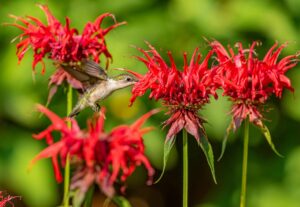
Bloom period and color. Deadheading: Blooms in shades of red or shades of lavender in July and August.
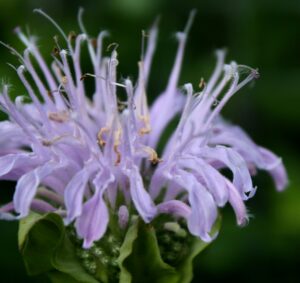
Deadheading. Once the flowers have faded, cut the stalks at ground level. You will be left with a lovely mat of green leaves. This mat will tolerate your standing or kneeling on it to deadhead, but do not make a habit of walking on it.
Deer, rabbits, and other pests: In my garden, these plants are not bothered by rabbits, deer or any other pests except powdery mildew. I have only ‘Jacob Cline’ as I have always had good luck with it being powdery mildew resistant.
Transplanting and propagating: These plants are easy to transplant. To propagate, just cut out part of the mat and replant either into a pot or right back into the ground. The best time to transplant or propagate is spring and fall. If you are planting several, in one area, space them about 12-16 inches apart.
What to plant with Bee Balm: First, a note about what NOT to plant with it: Phlox, roses, and zinnias – all three of these plants are susceptible to powdery mildew. ‘Jacob Cline’ has very good resistance, but I would still not plant it near these three. There are varieties of Phlox that are mildew resistant, but roses and zinnias must be sprayed, pulled out, or you just have to live with the appearance of mildewed leaves. My advice is to keep these plants as far apart as you possibly can. Powdery mildew easily spreads from plant to close-by plant.
If you plant only one Bee Balm and allow it to spread about 3 feet, there are other plants that will look good close by. If in full-part sun, Black-eyed Susans, white geraniums, and Shasta Daisies. If more in part shade, white Turtlehead, White Impatiens, and Rocket (Ligularia) – this is a big plant so you need to also give it space. But Rocket looks great behind Bee Balm.
How to use Bee Balm: With regular checking and cutting back, this plant can be used as a single perennial. If allowed to spread, one plant can also be used as a ground cover for a small area. If several to many plants are used, they can be an effective ground cover for an area of any size. Because Monarda can be used in both ways, I have included it under “Perennials Native to North America” and “Perennials that are generally not thought of when a groundcover is needed, but this is exactly what they are because they are aggressive. ……”
To use as a single plant: Decide where the boundary line for this plant will be and place any sort of edging to mark the boundary – I use bricks. Place your single plant somewhere within the boundary line – I generally place mine in the center of the area. Every month, I check the plant to make sure it has not spread past its boundary. If it has, I take a spade or shovel and cut through the parts of the plant that are where I do not want it to be – I generally cut it back about 6-8 inches from the boundary to give it room to respread. If you check this plant once a month during the growing season, it should never take more than a few minutes to cut back any of the plant that is where you do not want it to be. Just keep in mind that a single plant needs room to spread so the diameter or width of your planting spot should be about 2-4 feet.
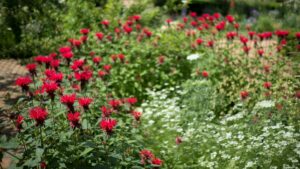
To use as a ground cover: Monarda is in the Mint Family and will spread. In my experience, it spreads well, but is not aggressive as other mints. One plant can be a good ground cover for smaller areas. If you have a larger area, space the plants about 12-16 inches apart – they will grow together to form a mat which discourages weeds. And this mat can be walked on if you need to get into the area to deadhead – just do not walk on it regularly. Decide just where its boundaries should be and place an edging at that boundary. I use bricks but any edging will work. Once the plant reaches the edging that is as far as you want it to grow. About once a month, look at the bed and either cut it back from the edging or pull the runners out. If you are careful removing the runners, they can be easily transplanted elsewhere or given to your gardening friends.
Miscellaneous: Since Monarda is in the Mint Family, you can brew a tea from the leaves. In my opinion, and I am trying to be kind, it is an acquired taste – one which I have yet to acquire.