
Getting ready for late fall and winter
Here in central Illinois, El Nino gave us quite unseasonable weather this early and mid-fall. Up until last week we were still having days where the afternoon temperatures were in the low 80’s. Normally this time of year, we are all in sweaters and jackets – enjoying outdoor high school football games. Not sitting in the stands in tee shirts and sweating up a storm! But in the past few days – finally! – the days have become more like fall. Today, it is partly sunny, blustery, and will be quite cool – temperatures in the high 40’s-low 50’s. That is more like it!
Now is the time to decide whether or not you are going to feed birds through the winter and what about a bird bath?
Let me begin with feeders:
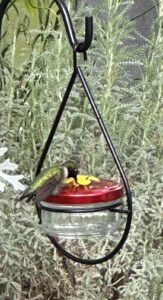
Hummingbirds: By now, almost all hummingbirds have migrated. Males always leave first and then it is a mix of females and this year’s youngsters. All hummingbirds migrate alone – by themselves – and that includes the young from this year. Parents do not guide them or even accompany them. All hummingbirds are on their own.
Many people take their feeders down in early September. However, when hummingbirds have a second or even on occasion a third nest, the young from those late nests begin migrating late and depending on where you live, can come through your neighborhood even as late as the first or second week in November. It may seem like a waste of time and money to change the sugar water in you feeder every 3-4 days when there does not seem to be any hummingbirds in your neighborhood but these are such small birds, they could be migrating through, stopping at your feeder, and you might never know. If you want to be on the safe side, leave your feeders up about one more week. Here is more information: Hummingbirds – Gardens and Feeders.
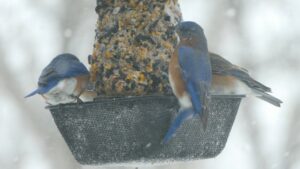
Seed and suet feeders: Here in central Illinois, there is a big supply of plants with seed heads, nuts like hickory and acorn, and fall berries. There are feasts for birds just about everywhere they look. However, as migration winds down and our winter residents arrive, these sources of food will start to shrink and so supplementing these sources with seeds and suet at feeders will benefit birds. Here is a study from Dr. David J. Horn, Associate Professor of Biology, Millikin University and Dr. Travis Wilcoxen, Assistant Professor of Biology, Millikin University: The Impact of Wild Bird Feeding on the Bird Community and Health of Individual Birds.
If you are going to have bird feeders, please understand it is a commitment. You must keep them clean and disinfected. Avian flu and House Finch Eye Disease – which affects all members of the Finch Family – runs rampant in many areas in fall, winter, and early spring and can be spread from bird to bird at your feeders. Keeping the feeders clean and the seed fresh will help prevent that. Avian flu is often fatal in wild birds and if spread to domestic birds such as chickens and turkeys can result in the entire flock(s) being killed at great financial loss to the farmer. Those of us who live by ponds, lakes, and rivers must be especially vigilant as avian flu is often spread by wild geese and ducks. However, avian flu can be spread by any bird. If you decide to feed birds, mark your calendars for once-a-week cleanings and make it a priority. Scroll through this article for information on how to keep feeders and bird baths clean: Bird Feeders and Bird Baths. For more information on avian flu: Avian Flu.
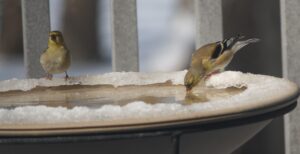
Bird baths: If you have pottery, cement, glass, or ceramic bird baths, it is time to drain them, clean and disinfect them, make sure they are dry, then store them for the winter. If you want to have water available for birds in the winter, then purchase a heated bird bath – or as I like to call it – the birdy hot tub. We have had a heated bird bath for 30 years and it has never affected our electric bill because the water is only heated enough to prevent it from freezing.
Heated bird baths work well in central states – I have lived in Pennsylvania, the mountains of West Virginia, and now in Illinois and these heated bird baths are great. If you live in places where the temperatures persist day after day for weeks on end into the single digits as daily highs like Minnesota, Montana, or northern Maine, try one and see how it goes. Just remember to replace the water about every 3-4 days and clean and disinfect it thoroughly once a week. Information on cleaning is in the previous paragraph’s link.
Cleon has now closed our large bird bath. It is cement and would be prone to cracking. That livestream camera will be off sometime this week as soon as my good friend Justin tells Claude of AI. We will open that bird bath sometime next April – depending on night-time temperatures which must be above 32°F.
Keep your feeders clean and well-stocked with seed so your birds will be healthier and as well-fed as birds can be all winter long. And if you do not have a heated bird bath, try one – it is great fun to watch birds use it during the coldest days. Birds need a good source of water all winter long so you will be helping them by making it easier for them to drink. Happy birding! Linda
P.S. I have added another plant to Landscaping and Gardening for Birds and Wildlife: Turtlehead. Another favorite native perennial – or groundcover – for wet to damp shade/part shade. Click here: Turtlehead (Chelone obliqua and Chelone glabra)