

Turtlehead (Pink Turtlehead – Chelone obliqua. White Turtlehead – Chelone glabra.)
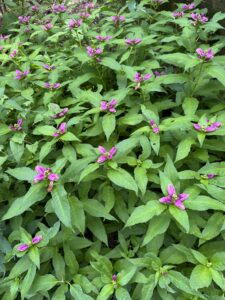
I love Turtlehead – such interesting flowers! I have always had the pink species (Chelone obliqua) in every garden I have had. Both species of Turtlehead like damp shade and as I am a lover of water and big trees, I have always had a good spot for it. I also like that it blooms in August and September so is gorgeous when much of the rest of my garden is looking a bit bedraggled. Both species are native in the eastern half of the country.
I planted three Pink Turtleheads about 15 years ago in my garden here in central Illinois and placed them together in a triangle – hoping they would form one larger clump. They did better than that – they filled in the entire bed. It took about four years, but I continue to have a mass planting of them covering an area about 4’x10′. And no weeds grow in that bed. I had no idea this perennial could also be a ground cover! And it spreads slowly so if you do not want to use it in that way but want more of a single or a small grouping of the plant, it is easy to control. Just cut or pull out any new shoots that grow where you do not want them.
With plants that slowly spread, I find it helps me to put a hard border around them so I know exactly how far I will allow them to creep and exactly where I don’t want them. My choice is bricks laid end to end and for no reason other than I like bricks. There are many edgings to choose from both at your local garden centers and online. I would recommend that after you place your Turtlehead, give them some room to grow and spread out a bit, but encircle them with that hard edge so there will be no guessing during future weeding and garden maintenance – you will know immediately if they have spread too far.
With the possible exception of southern Illinois in the Shawnee National Forest where Turtlehead can be found – this forest has many stream banks and lower places where the soil stays moist – both species of Turtlehead are rare throughout their native range.
Pink Turtlehead and White Turtlehead have the same growing requirements – White Turtlehead will be taller:
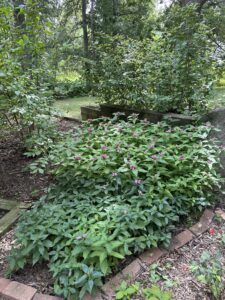
Light: Plant tags and most gardening sites online recommend full/part sun. In my experience, Turtlehead grows best in part sun to part shade – and I lean towards part shade. Mine are planted in filtered light on the north side of my house. I think if they are grown in full sun, they will need regular deep watering – at least twice a week. That is too labor intensive for me plus I live in central Illinois and we do have periods of dryness quite often. Planted in mostly shade, I have only had to water them if we are truly in a drought.
Soil and water: Will grow well in most average garden soils. The important thing is for the soil to stay damp – even wet from time to time. Medium-wet soil.
Hardiness Zone: Zones 5-9.
Size: The pink species (Chelone obliqua) is smaller: 2.5 and occasionally to 3 ft. tall, and about 1 ft. wide. The white species (Chelone glabra) is larger – often at about 5 ft. tall and about 1.5-2 ft. wide. Neither species needs support.
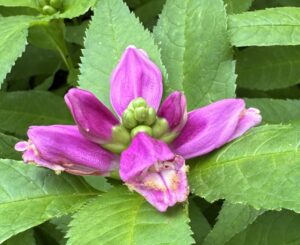
Bloom period and color. Deadheading: Blooms from late July into September. Blooms pink or white depending on which species you have – and yes, the flowers do look like turtles! They can be gently squeezed open just as you can with Snapdragons. Great for children – and I certainly squeeze at least one open every year. Always makes me grin. Because they bloom after July 1st, it is best to leave them alone until the following late March/early April when all stems should be cut to the ground.
Butterflies and birds: Native insects, bumblebees, and hummingbirds will come to these flowers.
Deer, rabbits, and other pests: I have always had Turtleheads in all my gardens and have also had deer and rabbits. Neither have ever bothered these plants. Nor have they been bothered by aphids or disease. As long as they have plenty of moisture, they are good, reliable growers.
What to plant with Turtleheads – either pink or white: Annuals such as Impatiens look great planted next to Turtleheads and will give you all season bloom. Upright Fuchsias would also be an interesting choice – they can be planted into the ground, dug up, and brought into your house for the winter after the Turtleheads finish their bloom. Ferns and Hostas provide leafy texture next to a bed or grouping of Turtleheads and the Hostas will bloom before the Turtleheads. Coralbells, Hostas and Turtleheads would provide interesting leaf texture and provide blooms in spring, summer, and early fall. Add some Impatiens and the bloom would be continuous from late spring til frost. All of these plants like moist part shade/shade in which Turtleheads will thrive.
How to use Turtleheads: You can plant them singly, in a group of 3 or more or use them in a mass planting to create a groundcover. Regardless of how you use them, if planting more than one, space them about a foot apart.