

Birds Close to Their Tipping Points
This week I am writing about several birds who are on alert status – close to their tipping points*. The steep declines in their populations can be traced to several things but the one cause they all share is destruction of habitats because of us. And the perilous state of these birds and dozens of others whose habitats are being destroyed by us without consideration for these birds will be exacerbated beginning this year and in the future. Why?
The following are an Executive Order from President Trump and a Fact Sheet put out by President Trump through the White House website that have taken the place of the two Executive Orders by previous Presidents that he rescinded. Both have to do with access to federal/public lands – he is greatly reducing or eliminating the regulations. The birds I included in this blog – all near their tipping points – are greatly affected by development, logging, and over-grazing. Some development, logging, and over-grazing is on private land over which we who do not own it have little or no control. But much is on land owned by our federal government – which means it is owned by all of us who are citizens.
Executive Order 14408 – Removing Unnecessary and Counterproductive Restrictions on Access to Federal Lands
Issued in May 2026 by President Donald Trump.
Fact Sheet: President Donald J. Trump Removes Unnecessary and Counterproductive Restrictions on Access to Federal Lands
From The White House website – May 2026.
Here are the two Executive Orders from former Presidents which have been rescinded by President Trump: (Both of these were considered nonpartisan orders and landmark policies for federal land management.)
Executive order 11644 – Use of off-road vehicles on pubic lands
Issued in 1972 under President Richard Nixon – Republican.
Executive Order 11989 – Public Land Jurisdiction
Issued in 1977 under President Jimmy Carter – Democrat.
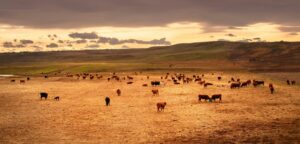
None of this is easy. Balance between our need and desire to live the lives we want to live and protecting habitats so everything else alive on this planet has that same opportunity is very difficult. Once again, I want to emphasize how much all of us depend on livestock, timber, oil and gas, and minerals that are mined.
I am typing this sitting in a house built with a lot of 2×4’s – wood. Although Cleon and I no longer eat beef and pork, many, many people still do – MacDonald’s and Wendy’s have thriving businesses in our small town and that is not from selling fish sandwiches. But over-grazing is serious business and destroys habitats for everything living there – ironically, including cattle if it goes on for too long. And over-grazing varies from season to season. Adequate rainfall means a grassland can support more cattle. A drought means it will support far fewer or even no cattle. Our warming climate does play into this a great deal.
I am not talking about the politically charged term of climate change, but the gradual warming of climate that all of us who are over 50 have experienced. Falls are not as crisp, winters are not as cold, and in many places, snow is not as frequent or deep – we all know this. And when Cleon built our deck here 20 years ago, the lumber yard advised him he did not have to dig down nearly as far for the footers as he would have 40 years ago because the ground was just not freezing as deeply. We all know our climate is changing – the argument is what is causing it. But it is changing, and we have to change how we live to accommodate these changes. That means that there are places where once cattle could graze and now either they should not or their numbers should be reduced.
And we are clearcutting woodlands and forests – sometimes at an alarming rate. Most especially in the northeast, east, southeast, and northwest. Look around at all the wood we use every single day – that all has to come from somewhere. Trees had to be cut down. But the Executive Orders from Presidents Nixon and Carter made some forests too difficult to harvest – no easy access. President Trump has changed all that by rescinding those orders. He has opened up these areas to logging by making it easier to install access logging roads.
And my guess is not one logging company will say something like, “Maybe we should not log this area even though there would be so much profit now that we can build an access road right through it. But, it is prime habitat for Evening Grosbeaks so let’s pass on this.” Sorry, but I simply cannot imagine this conversation taking place amongst the executives of a logging company. That is why these Executive Orders from Presidents Nixon and Carter were so important – they served to protect remote national forests and public lands that we citizens of the U.S. own and support with our tax dollars.
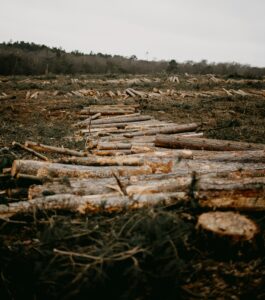
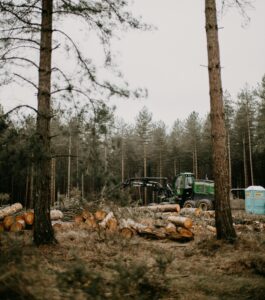
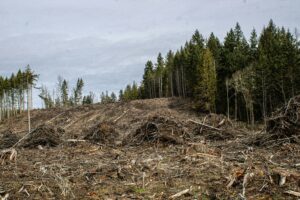
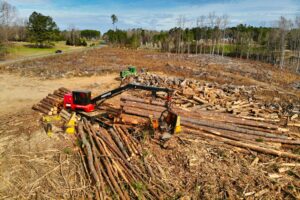
And how is this logging accomplished? How is all the heavy equipment needed to cut huge trees, move the huge trunks, and stack them, get into these remote areas? How are all these logs removed so they can be converted to lumber or whatever else we need? Access roads. Without access roads, there would be no logging. And we need logging for all the wood each of us uses to support the life we have. I am sitting in a wooden desk chair in front of my wooden desk in a room framed with wooden 2×4’s and that is just the tip of the wood iceberg that surrounds me every single day. But do we want unrestricted access to any logging company who comes along to clearcut our woodlands and forests? Or does there need to be regulations to make sure everything is being taken into consideration before an access road is put in and a forest destroyed for our lifetime? And birds – all wildlife – need to be on the list of things to consider. Balance.
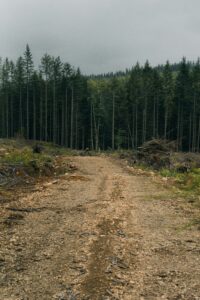
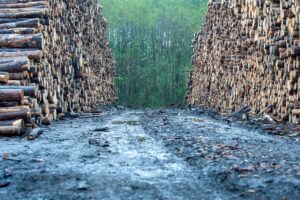
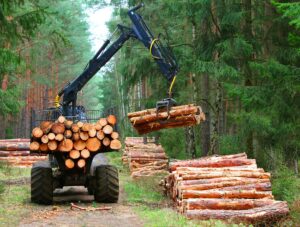
And now a few of the birds whose populations have been greatly affected by habitat destruction – some of this destruction was made easier by access roads into and through both grassland and woodland/forest. And I am only including one or two from each group – there are many many, more. The following information is from the 2025 State of the Birds – 2025 State of the Birds – and my research – most especially from the Cornell Laboratory of Ornithology***.
I will define the alert with each group of birds:
Yellow Alert Tipping Point – Birds who have lost 50% of their population over the past 50 years, but in the past 10 years, their population has stabilized.
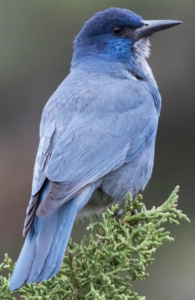
Pinyon Jay – Yellow Alert Tipping Point.
Pinyon Jays live in our western states – away from the Pacific coastline. They live in more arid areas that have large woodlands of pinyon pines and junipers. In the past 50 years – and more – large areas of pinyon/juniper forests and woodlands were clearcut to create grazing land for cattle. These jays were dependent on these unfragmented acres and acres of pinyon pines and junipers, and the plants that generally grow with them, for foraging and nesting sites. When these areas were clear-cut for cattle grazing, their habitats were completely destroyed and their population numbers plummeted.
Once this was understood and also the demand for beef stabilized or decreased in some years, the clearcutting stopped and the population of these jays began to stabilize. However, with the relaxing of access regulations for public lands by President Trump, this bird could be in trouble once again as the wood from pinyon pines is valuable timber used for fence posts, supports in mines, and general construction. But the main reason these trees are often cut is to increase grazing land. As we are all aware, there is much grazing of cattle on public lands.
Orange Alert Tipping Point – Birds who have lost 50% of their population over the past 50 years, but in the past 10 years, this decrease has accelerated.
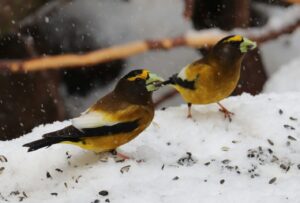
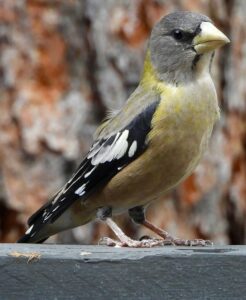
Evening Grosbeak. Orange Alert Tipping Point.
Evening Grosbeaks are a hard bird in which to track population numbers because they have irruption years**. But, there is no doubt their population numbers are declining and that in the last 10 years, that decline has increased. There are two main reasons for the decline. The first is clear-cut logging and developing forest lands in our eastern and northern states.
Evening Grosbeaks have historically been found in good numbers in forests of balsam firs, and this is a dominate fir in the northeast. The second main reason for the grosbeak decline is with the warming trends in our climate of the last 40 years, these balsam firs in the northeast are dying out, and the dependent grosbeaks are there in fewer and fewer numbers. Grosbeaks need these trees for nesting sites but most especially foraging. Loggers are still clearcutting large areas of balsam firs and with access to remote areas of public lands and national forests now relaxed or removed, it will be easier for loggers to work in areas that were once too remote and difficult.
These birds will use bird feeders. If you have feeders and grosbeaks, be sure to keep them as clean and the seed as fresh as possible. All birds are susceptible to disease from unclean feeders and spoiled seed, but finches and grosbeaks are more susceptible. This includes House Finch Eye Disease, Salmonella, and West Nile Virus. Here is a link on keeping your feeders clean: (Scroll down to Bird Feeding Guidelines) Bird Feeders and Bird Baths
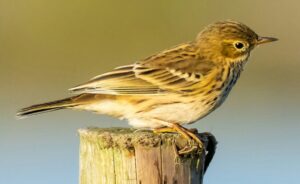
Sprague’s Pipit. Orange Alert Tipping Point.
You will find Sprague’s Pipits on The Great Plains and in the southern parts of New Mexico and Arizona. The habitat of this bird is short grass prairies, pastures, and grasslands which are a mix of grasses and plants that are generally in the 6–12 inch range – they will not nest in areas where the grass is over 12 inches tall. These birds thrived when buffalo freely roamed.
But once our native prairies and grasslands were converted to grazing areas for cattle, the habitats changed. Limited cattle grazing and regular rotation of herds is key to maintaining the health of short grass prairie that has been turned into grazing lands. Over grazing destroys the habitat – the grass and the accompanying plants are too short or in some areas die during long periods of hot sun and little or no rain. These pipits cannot survive in this habitat alteration/destruction.
Pipits’ main foods are insects and seeds which they catch and glean while walking briskly through the vegetation. This is possible in areas of short grass but not when the grass and the accompanying plants are more than a foot tall. And if the grass and accompanying plants are dying or dead, there will be no seeds or insects.
Red Tipping Point – Birds who have lost more than 50% of their population in the last 50 years and are now showing dangerously low total population numbers which are still decreasing at an alarming rate.
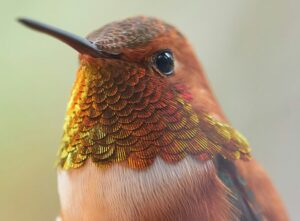
Allen’s Hummingbird. Red Tipping Point.
In the last 50 years, this bird has lost almost 80% of its population. This hummingbird lives along the Pacific coastline. Many hummingbird species live along all our coastlines and have been able to hold their own with development and more and more people.
Sadly, Allen’s Hummingbird seems not to be able to adapt to the loss of its natural habitat to urban and suburban development. Too many towns, shopping centers, strip malls and all their accompanying roads and parking lots have decimated the habitats this hummingbird must have.
At one time, the entire western edge of California was filled with narrow strips of coastal woodlands and forests, and large areas of scrub and chaparral. Allen’s Hummingbirds lived in these areas plus areas filled with eucalyptus, redwood and Douglas fir, but many of these coastal strips of woodlands have been clearcut for our development.
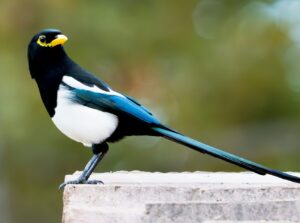
Yellow-billed Magpie. Red Tipping Point.
In the past 50 years, this bird has lost about 83% of its population. There are several factors that have caused this.
First – at the height of West Nile Virus in the early 2000’s, this bird lost about half of its population.
Second, – these magpies only live in the Central Valley of California which is heavy in agriculture. These birds have struggled with the chemicals so many of the farmers use – most especially those that kill rodents. Much of this magpie’s food is insects and rodents – both targets of these chemicals. When magpies eat either those killed by chemicals or that are laced with chemicals, it is often fatal to the magpies.
But the biggest impact to the population of these magpies each and every year is the continuing development of California’s Central Valley. These magpies live in open woodlands and also savannahs in which the primary trees are oak. According to the state of California, it is predicted that the Central Valley will have the fastest growing rate of human population in all of California through 2060 which means much more development. Much more destruction of this bird’s habitat so we can build.
What can you do about any of this?
Click on this link to a website that has suggestions to help birds in trouble: Road to Recovery – Saving Our Shared Birds
This photo of a grassland over-grazed by cattle is from the website The Northcoast Environmental Center – a group working hard to eliminate over-grazing on public lands. Here is their link: Northcoast Environmental Center

So much to consider as you are walking through your favorite habitats – or your neighborhood – on a beautiful fall day with your binoculars slung around your neck.
Happy birding! Linda
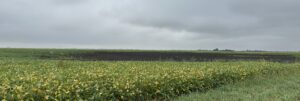
P.S. Cleon and I were driving on our favorite rural roads this past week and we drove through the farmland in the next county where there are still ephemeral ponds in spring – we did drive by the one that was in the videos in last week’s blog, but we could not see where it would have been. Between it and the road was 6-foot-tall corn ready to be harvested so it was completely hidden. But here is a photo of where an ephemeral pond was this spring in the adjacent field of soybeans.
The spring ephemeral pond was in the muddy area you see in the photo. There are no plants growing in it right now and our guess is the field has been treated periodically with chemicals – probably including pre-emergent herbicides. There was not a weed visible anywhere in this 200-acre field. We counted 7 areas of mud like the one in the photo in this field that would have been ephemeral ponds last spring – none had any plants in them. There were probably more that we could not see. We estimated this one in the photo – which was the largest we could see in this 200-acre field – was about .75 of an acre. As you can see, these ephemeral ponds can take away airable ground from the farmer every year. Once again – hard decisions. Difficult to find a balance.
We live in a small neighborhood built around a 16-acre lake. We are surrounded for as far as you can see with fields of corn and soybeans – hundreds and hundreds of acres. To our horizon in all directions, most of the hedgerows have been removed – this is an endless sea of corn and soybeans. And since we moved here 20 years ago, all these fields have been tiled which is an underground system of pipes that drain these fields of standing water in spring – particularly the lower areas. To our horizons in all directions, there are now no ephemeral ponds in spring. The farmers are able to work their entire fields without these obstacles. However, no migrating shorebirds or ducks have places to rest and forage anywhere close to us during their long migrations.
*Tipping Point – from biologyinsights.com: In ecology, a tipping point for a species is a critical threshold of environmental conditions or stressors beyond which the species’ population undergoes a sudden, often irreversible, shift in its state. This can mean a rapid decline in numbers, a change in distribution, or a collapse of the species’ ecological role, even if the underlying pressures are only gradually increasing. For a species, a tipping point occurs when the balance between its ability to recover from disturbances and the intensity of those disturbances is breached. Before this threshold, the species may persist through fluctuations, but once the threshold is crossed, positive feedback loops or cascading effects can accelerate the change, making recovery difficult or impossible.
**Irruption years – (from Stanford University) an irregular, often dramatic, movement of birds from their typical northern breeding or wintering ranges into more southern areas. Unlike regular migration, which follows predictable seasonal patterns, irruptions are unpredictable, irregular, and driven by environmental factors such as food scarcity or population density spikes. Examples of birds with irruptions are Snowy Owls, Red-breasted Nuthatches, Pine Siskins, and Evening Grosbeaks.
***Cornell Laboratory of Ornithology – for more information, click: Cornell Lab