

Even though we see them everywhere, never ignore robins – or mallards. They will always surprise you!
My husband Cleon and I set aside each Monday morning for an hour drive to Springfield – a city area of about 125,000 people and the capital of Illinois. Lots of big stores. And home to Lulu’s – our favorite diner. We always begin our morning of errands with a great breakfast, a whole lot of coffee, and great conversation with the staff.
It is summer and probably like most of you, there is always a project or two in progress. Last Monday, one of our first stops – after breakfast! – was Lowe’s. I needed bricks and Cleon needed a board. We loaded up my 30 bricks onto a flat-bed cart, and I stood with it near the cash registers in the garden center part of the store while Cleon went inside to get his board. He was gone quite a while and so I started listening to other peoples’ conversations. Two women employees were watering the plants and talking. One asked the other how the robins were doing and the answer was, “Just fine – now that I put the sign up.” I could not resist so I walked over to them and said, “Excuse me. Robins? You have robins?” And she lit up, “Of my yes! We have all sorts of birds out here – and inside. Lots of House Sparrows. But we have a robin who is nesting in a pot of flowers so I put a sign on it so that customers would not take the plant.” I asked her if I could see it and she showed me.
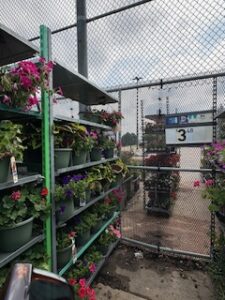
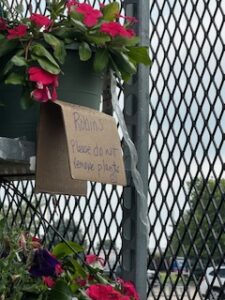
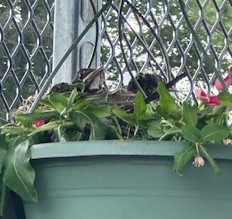
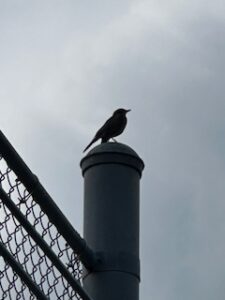
I suppose I have become more cynical, but I admit I was surprised this occurred at a big chain store. Not that a single sales associate or two wouldn’t take this sort of action to protect a nest of robins, but that management would allow it. We shop at Lowe’s for most of the things we need for all our projects because Cleon is retired military and after serving two years in Vietnam, I think he deserves every discount offered. I am so very proud of his service and the sacrifices he made in what was an unpopular and controversial war. But this? Lowe’s protecting a nest of robins? I just did not think that would ever happen. Thank you, Lowe’s!
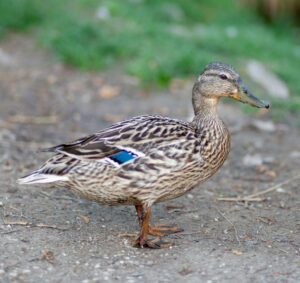
This sales associate went on to tell me another great story that happened this spring. A female Mallard had a nest somewhere in their garden center. She said they were all sure it was amongst the bags of mulch, soil, and pavers, but they could never find it. However, the Mallard was always somewhere in that area walking around. She did not allow customers to get too close to her, but she was not shy. And then one day, she walked around with three newly hatched babies.
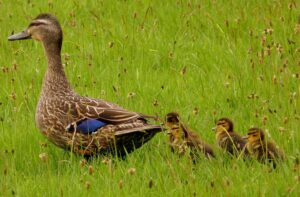
This went on for a few days and then she wanted to leave. She flew to the top of the fence calling to her ducklings but of course they could not fly. There is space between the bottom of the fence and the ground where the ducklings could scramble under and out, but there was no way she would fit and of course the ducklings did not understand this opening. So, this sales associate got two others to help, and they caught the ducklings. They took the ducklings outside the fence, set them down in the grass close to where she was perched, and they backed away. The female Mallard flew right down, gathered them up, and they all walked through the grass and away from the store. This store is partly surrounded by grass and some trees and there is a drainage area for water from parking lots. So, there is some suitable habitat for them until the youngsters can fly. What a story! And an interesting note – there was never a male in sight.
___________________________________________________________________________
Back to robins!
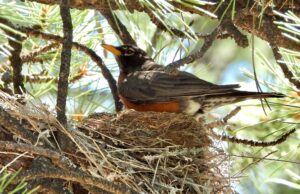
The American Robin can be found just about everywhere in North America – and in good numbers. Most of us have been familiar with this bird since we were children. But good questions are: Do robins reuse their nests? And if they do, is it just during one season or do they reuse them from year to year? Here are some official answers from experts on the internet – and I have included their websites so you can read more if you are interested:
1. From Copilot: This is the AI that appears first on my screen when I type in a question or inquiry. Your search engine may use a different AI. The bold type is from this AI.
American Robins generally build a new nest for each brood, but in some cases, they may reuse or build on top of old nests.
Typical Nesting Behavior
American Robins usually construct a new nest for each brood during breeding seasons, which can include two to four broods per year.
Nest Reuse and Exceptions
While robins prefer fresh nests, reuse can occur under certain circumstances. Some robins may build a nest on top of an old one, especially if they are strongly attached to a particular site. In other cases, robins may dismantle an old nest and repurpose materials for a new nest. Reuse is more likely if a previous nesting attempt was unsuccessful or if suitable nesting materials are scarce.
2. From Do Robins Reuse Their Nests?
No, robins do not typically reuse their nests. If a robin finds a spot they like, it may return the following year to the same place, but it will still build a new nest.
Robins who return to the same spots year after year frequently take apart their old, used nests and use the bits and pieces in their new nest. If a robin has found some satisfying materials, like unsoiled cotton, clothing, and paper, it will quickly move the soft and warm pieces into its new nest.
People consider robins as an icon of spring. And just like the season, these birds prefer to keep things new and fresh, so they’ll always go for a new nest over an old one for their next breeding season.
3. From biologyinsights.com
Do Robins Reuse Their Nests for Another Brood? (Note from Linda: This website post was dated January 8, 2026.)
American Robins generally do not reuse their nests, even within the same breeding season. This behavior is a survival strategy, ensuring the health and safety of their multiple annual broods. The female constructs a new nest for nearly every clutch of eggs laid during the spring and summer.
The Direct Answer: A New Nest for Every Brood
Robins almost invariably construct an entirely new nest for each attempt at raising a family, a process they repeat multiple times annually. The female, who does the majority of the building, begins construction shortly after the previous young have fledged. Building a new structure for a new brood is the standard behavior for the species.
While the general rule is to build anew, instances of a female modifying or building a new nest directly on top of an old one have been observed. This remodeling is infrequent and is considered a new effort rather than a true reuse. The impulse to move to a new location is strong, driven by factors that make the old nest unsuitable for a second occupancy.
And here is what happened at our house:
Never think anything said or written about birds is written in stone because birds simply do not listen to us, they do not look at or read websites, and they don’t read their entries in field guides.
We have a 2-car garage. On either side of the garage door, under the eaves, is a downspout, and each of these downspouts has an elbow. On each of these elbows, robins built nests last year. Looking at the garage door, the nest on the elbow on the right side of the garage was completed, but then it was abandoned. Robins – and House Sparrows and House Finches – looked at it all last summer and again this spring and summer, but there have been no takers. And no material was taken from it. I am not sure what is wrong with it? It is completely sheltered on 2 sides by the garage and house wall. It is under the eaves. And there is a trellis with a big vine growing on it in front of this area. Quite a cozy set up. Maybe too cozy? Not enough line of sight? I have no idea – just guessing – but this nest was completed in April of last year and that was it. No bird ever sat on it. Not one egg was ever placed in it. The nest on the other side of the garage is a totally different story.
This nest was also built in April of last year. The female sat on it for close to two weeks, so I am assuming there were at least 1-2 eggs – maybe more. And she abandoned it. House Sparrows looked at it but moved on. Later last summer – in early July – a robin again started nesting on the built nest – she did not add even one blade of grass. Just used it as it was. Her nesting was successful and she raised 3 babies.
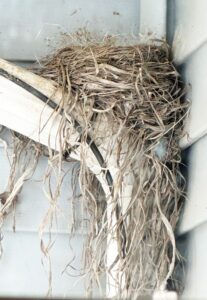
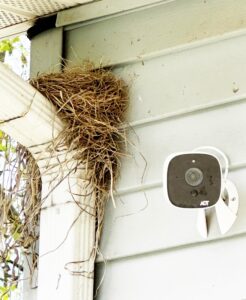
Cleon and I generally do not remove old nests. We are not sure how they are used over the winter. We generally have 2-3weeks in January where night-time temperatures are below zero and daylight temperatures remain in the low single digits. And during those weeks, we can have snow, sleet, hail, and high winds. We are not sure if these old nests are ever used by birds to huddle together with a bit of protection. And I can tell you honestly, neither Cleon nor I are going to venture out to look! So, we left both nests up. The one on the right of the garage door continues – to this day – to be unused. It has been examined, but no takers. The nest on the left side of the garage door has been used all spring and summer.
There was a robin family of 4 in spring, followed by a family of 2 that fledged about June 20th, and now it is mid-July and a female is nesting again. We have no idea if this is the same female in all three nests this year or if this is also the same female/females from last year. And where is the female who actually built the nest? Your guess would be as good as ours. We are wondering about this third nesting – once again, not one bit of material was taken from the nest or added to it. She just plopped herself down, spent a bit of time wiggling about a bit, then started sitting still. Right now, we think she is turning her eggs as she sits on the rim peering down with her beak within the nest fairly often. I have wondered if she decided the nest was good enough because when she claimed it, our heat index was hitting 105-107 every day – and this has continued. She does sits with her beak open and ‘panting’ for most of the day. And she takes a bath in the close by big birdbath that you can watch on livestream about once every hour or so.
So regardless of what the experts might write, and the excellent reasons given why it is better for robins not to reuse nests, this unaltered nest has now been the cradle for 4 robin families. This year:
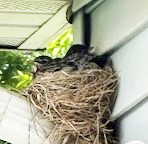
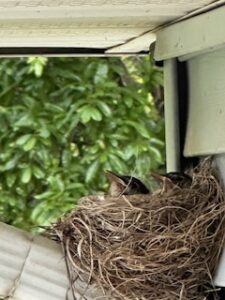
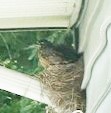
The moral of this story is we all should continue reading about birds – especially reading what people have observed about behavior. But only use what we read as guides as to what is likely to happen. Remember, nothing about the bird world is written in stone. Just about the time I tell someone – and always very authoritatively! – something a particular bird won’t do, I turn around and there is a member of that species doing exactly that! Get outside – look out your window. Observe for yourself. You will be entertained, amazed, and your heart will be warmed.
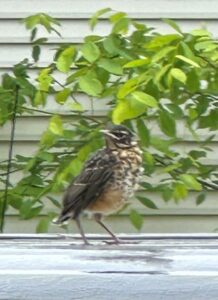
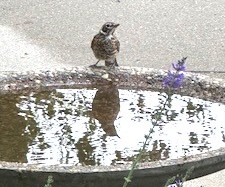
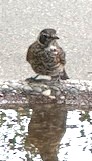
And here is one of the youngsters from the second family this year and this could have been one of its first trips to the big bird bath. I say that because it sat on the ground for a minute or two, just looking up at the bird bath, and then it took 3 tries before it landed safely on the rim. It sat there for about another 2 minutes, looking around and occasionally taking a drink, but it never got into the water. Maybe mom or dad needs to show it how to begin a bath?

Never ignore a robin! We can get closer to them than most birds, they are medium-sized songbirds, and often right out in the open where they can be easily seen. If you have not downloaded the free The American Robin guide, do so by clicking here: The American Robin. Happy birding!
P.S. I have added two videos. The first is from Mark who took a safari in Tanzania and sent me photos – blog from 6/29. And the second is from Lara – she and her family took a vacation in Scandinavia and sent the photo of the Common Gull – blog from 7/6. This is the video of that same gull. Here is the link to both videos: Videos of elephant and Common Gull
I have added another plant to the Landscape and Gardening section of his website. Green and Gold (Chrysogonum virginianum). This is one of my favorite groundcovers and I highly recommend it to anyone who needs one for part shade. Here is the link to this section of the website: Landscaping and Gardening for Birds and Wildlife
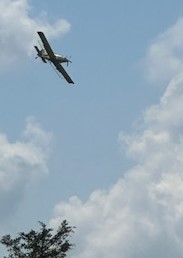 If you are watching either livestream with your volume turned on and you hear a small engine plane which sounds like something out of a WWII movie, do not worry – we are not being strafed. It is crop dusting time! In July of every year, the huge agricultural fields of corn and soybeans that surround our small lake and neighborhood are aerially sprayed with chemicals. Welcome to big chemical agriculture! I took this photo of one of the planes flying right over our house last summer.