

What is going on around here? And I have heard from some of you! Part 3
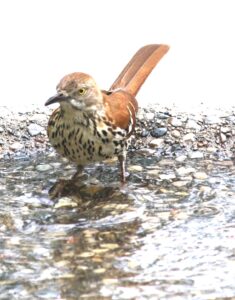
My large screen computer, which is the center for both live-stream cameras, is right across the room from my desk. I have the livestream on all day – I switch from camera to camera because I am always interested in who is using what, how everyone is behaving and interacting, and if anything has gone awry. Just as I sat down here at my desk a few minutes ago to write this blog there it was – our first Brown Thrasher of the season! Taking a bath in the big bird bath. Not the thorough bath we are all used to seeing them take in this bird bath – this was more of a good face-washing and a bit of water flicked over the back. Always glad to see our spring and summer residents return!
About 15 years ago, we started out with a pair of Brown Thrashers in a wild corner of our acre which is at the end of one of the lake’s inlets – they either nested in this area or close to it. Since about 5 years ago, we have had two pairs of nesting thrashers. This wild area is centered on 2 viburnum bushes which we planted and are now quite large. These 2 bushes are surrounded by black raspberries, a few hickory saplings, some tall grass, and vetch. And there is always some poison ivy which I do spray from time to time with an herbicide. Our helper Miles who has been with us since he was 15, has an extreme reaction to poison ivy which can require doctor visits and shots, and my reaction is no fun either. Only Cleon is fairly immune. So, my choice for eradication is an herbicide sprayed directly on the emerging plants – and it generally takes 3 sprayings about a week apart and then close watching for the rest of the growing season.
Poison ivy is of benefit to wildlife – most particularly the berries. But to us humans? It can be a real problem. I try never to use herbicides but sometimes, it is necessary. But I am careful to only spray right on the offending plant and never on a windy – or even breezy – day. In that way, the spray goes exactly where I want it and nowhere else.*
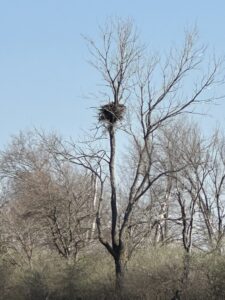
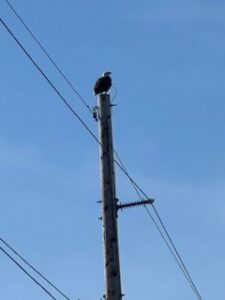
We have 2 Bald Eagle nests within 10 miles of our house – both have been active five years or more. Both are getting awfully big. The one here in the photo is at an active quarry right off a 2-lane state road that is south of us. The quarry is a fairly large operation – lots of digging and loading of tractor trailer trucks at all times. And of course, the usual signs warning of periodic blasting. The Bald Eagles are at the edge of a woodland that borders a large agricultural field that borders the quarry.
Driving out past this woodland on a rural country road, is a little-used, gravel road off to the left that twists and turns a bit all across the back of the quarry. From this road, you see none of the quarry. Only a beautiful savanna and wet grassy areas that are all teeming with birds in spring and early summer. Sparrows, orioles, blackbirds, cardinals, and swallows abound. We have even seen Purple Martins! After viewing the eagle nest with our scope – we never get closer than scope range – we take this long meandering drive with a cell phone stuck out the window and running the sound ID on Merlin**. If Merlin picks up something interesting, we pull over and verify for ourselves.
Our groundhog is back. Those of you who have been following my blog saw him last year. Our house sits closer to the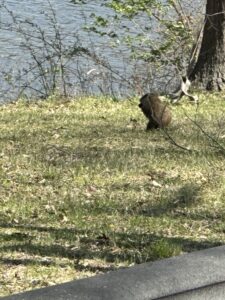 street so most of our yard is behind the house. The groundhog lives and roams in our backyard close to the shore of the lake so some distance from our house and my gardens – not vegetables, but flowers, herbs, and shrubs. So far, we are living peacefully – side-by-side – and I hope that continues. His roaming territory comes close to the Canada Geese nesting spot. There is a straggly start of a nest, so they are not yet serious about anything. We will see how this sorts itself out. There are generally three size categories for the subspecies of Canada Geese and the geese here on our lake are in the large category so can take care of themselves. And the male and female of a mated pair work very well together to make short work of a predator or intruder. Here is a short video Cleon shot from our deck. As the video begins, you will see the bird feeders – which you can watch on the livestream – are on the far left. The groundhog will be at the center of the video. Cleon will zoom in on it and when he does, you will see the pair of Canada Geese who have seem to have won the right to nest on our point, but who are certainly dawdling about getting started. Click here for the video: Groundhog
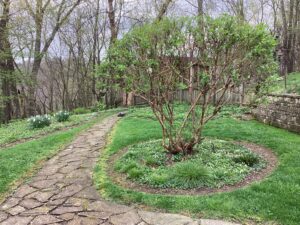
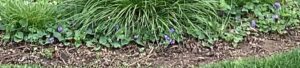
Carol from Pennsylvania sent this photo to me after reading Shelly Lyon’s poem on this website under Natural Thoughts – your Poems & Essays. Her poem is called “Wood Violets”. This is a view in Carol’s backyard, and I think it is truly lovely. I want to walk down that path! Explore!
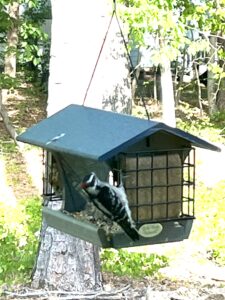
Shelly also let me know that she has bought her first house and moved in late this past winter. She put her bird feeder up and look who joined her! She told me that she is close to a large woodland, and her neighbors told her they have a terrible time with squirrels in their feeders. She tried the bird seed treated with things like cayenne pepper that should ward off squirrels. Her experience is the birds did not like it. She switched to regular seed and that is when the woodpeckers started coming. Everyone can have different experiences with repellents so yours might be different from Shelly’s. I know from our experience here, birds do not like every commercially prepared block of suet – some are completely ignored. We also know our Baltimore Orioles only like Welch’s grape jelly. We human beings are not the only picky eaters in the animal world!
P.S. Cleon just shouted up to me! He is downstairs sitting at our kitchen table which looks out on the large bird bath, oriole feeder, and hummingbird feeder. A male Baltimore Oriole was there for a few moments and ate. Our first one this year! We have 2-3 pairs each year nesting in ours and our neighbor-across-the-inlet’s trees. Females generally arrive a week later. So, keep an eye on this feeder. Within 3-4 weeks, you should see both the males and females at the feeder off and on all day plus they will use the bird bath almost every day.
And keep an eye open for Gray Catbirds. We did hear one in our trees two weeks ago, but it moved on. Migration still has about 5 weeks left so we should have some who will stay and nest. They use the feeder even more than the orioles. And of course, the House Finches have been using it.
Our hummingbirds have not arrived. if you see something odd buzzing around the feeder, it is carpenter bees and wasps. We have a large wooden pergola at our front door which both love for nesting. And they now also seem to like buzzing this feeder. We will keep an eye on this to see if it becomes a problem for the hummingbirds. This activity with the bees and wasps is generally over by mid-May.
Nature is just endlessly interesting – don’t you agree? And how do we fit in? Without dominating? How do we live side by side with wasps without swinging a fly swatter or getting out that can of Raid? If any of you have thoughts about this, go back to the home page for my blog and click on ‘Share Your Thoughts’ and do just that – share your thoughts with me. I would love to hear from you!
*If you are watching the livestream on the big birdbath, you might see me spraying an herbicide about once a week. We have bindweed in this garden, and it has been the bane of my gardening existence since we moved in and I started this bed. I do plan to write an article for the Landscape section on the horrors of bindweed and my suggestions for eradication. I am dealing with what I hope is the last of it – and my fingers are crossed as I type this. I have already sprayed it once last week – this is the second spraying, and I think it will need a third. This is close to the oriole feeder, the hummingbird feeder, and that birdbath. And I am extremely careful to keep the nozzle right on the bindweed and only spray when it is not windy. I dislike using herbicides but sometimes there is just not an alternative. I spray poison ivy and bindweed.
**For more information on Merlin, click here: Merlin and It Sound ID