
The American Chestnut Tree
Most of us know that the American Chestnut was once a common tree throughout the Appalachian Mountains, but because of a blight, the tree is now almost extinct. What I did not know was how much work is being carried out to restore this tree and that there are two sides to this. One side is work being done by our federal government under the U.S. Department of Agriculture – the Forestry Service, in conjunction with the University of Tennessee and the American Chestnut Foundation. This is a joint effort to develop a hybrid – about 92% of the genetic structure is the American Chestnut and about 8% of the genetic structure is from the blight resistant Chinese Chestnut. Saplings have been grown in a nursery setting, then planted in federal forests, and are now being monitored. This is one side of the coin.
The other side is that there is a place in the Appalachians where it appears the American Chestnut tree is returning – and showing no signs of blight. And that genetically engineering trees is the wrong solution because no one knows how these trees will grow and interact with everything else in woodlands. That the risk is too great. The group that is advocating a halt to genetically engineered trees being introduced into our woodlands and forests is The Global Ecology Project.
There are 3 excellent videos that I recommend you watch in their entirety, and I have added their links blow. Sit in a comfortable chair at your computer or laptop and get yourself a nice drink so you can sit back and enjoy – for me it is some of Cleon’s wonderful coffee. He cannot cook – has absolutely no interest in cooking – but he sure can make coffee!
The first video is at the bottom of the page from a USDA – Forestry Service website. I also recommend you read the page before watching – lots of good information which will serve as an introduction to the video. Upon completing the first video (Part 1), a screen should come up from which you can click on Part 2. Watch that one also. Both are simply excellent in both information given and presentation. Here is the link: The American Chestnut Tree (Parts 1 and 2) – working with genetics .
The third video is from The Global Ecology Project and takes the stand that we should not be introducing genetically engineered trees into our woodlands when we have no idea how the full-grown trees will interact with our woodlands in terms of neighboring trees, understory, soil, and all the animals and insects who live there. Here is the link: The Wild American Chestnut: A Giant Returns .
This is something for all of us to think about – genetic engineering. The pros and cons. As experts become more adept at manipulating genes in every living thing, there are uncertainties and ethical questions to consider – one is certainly the speed in which all of this is happening. And the idea that we should do it – just because we can. So, as you are walking or sitting and observing birds – and everything around you – consider both sides. Do we risk the genetically engineered American Chestnut trees, or do we place all our hopes in this one stand of Wild American Chestnut Trees that, so far, appear to be thriving? And there is a third choice – that we simply allow this tree to go extinct. What do you think?
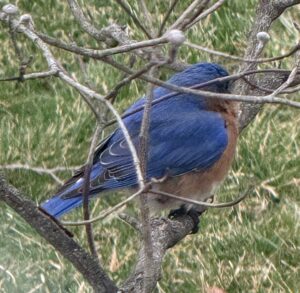
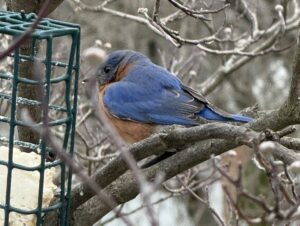
P.S. And Susan from Pennsylvania sent these to wish all of us a happy spring! Few creatures say this better than the 2 male Eastern Bluebirds in her front yard in their dazzling breeding plumage!