

Manipulation. Control. Playing god?
Everything you do in your yard affects all the creatures that live there: birds, insects, mammals, amphibians, reptiles, plus every organism that lives underground. And that includes making the decision to feed birds, provide a bird bath, add nesting boxes, create new gardens, or even adding a patio. Should you not do those things because they will change the habitat that is your backyard? Of course not. Just think about the changes before you make them. How will they affect every other creature that shares the space with you. The following two examples are from Cleon’s and my experience in our own backyard – the changes we made, why we did what we did, and the results.
When we moved here about 20 years ago, Cleon and I made the choice to have bird feeders and bird baths, and we keep them going all year round. As a result, we have a nice population of birds in our yard plus an abundance of squirrels. At night, if you watch the livestream from the feeders, from time to time, you will see raccoons on the ground under the feeders eating the seeds. Here is one in late February: A very healthy, chubby raccoon! Those 3 weeks we had of single digit and below 0 temperatures, plus all that bitter wind, did not seem to adversely affect this raccoon at all.
We have raccoons all year round. We have excellent habitat for them, but not all our neighbors welcome them. Raccoons can cause some damage – they will dig in gardens, get into trash cans, chew on roofing material, and they will nest in attics. For Cleon and me – so far – the only problem is they use our deck as a raccoon latrine which is not actually destructive, but it is annoying. Right now, in our backyard at night, we have 2, and sometimes 3. We think one of the reasons they persist in our backyard is the easy dinner they have from the seed Cleon throws on the ground under the feeder.
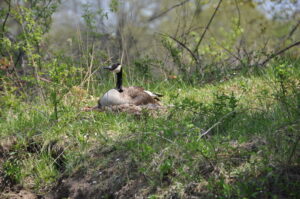
We have a prime Canada Goose nesting spot on our point. Last year was the first year we had no nest at all – in fact, we had no nests anywhere on our lake. No youngsters. No families. But every other year we have had a nest and this year, if you have been watching the live stream, you will see geese in our backyard – they also eat the seed on the ground under the feeders. And right now, they are starting to fight over which pair will have sole claim to our backyard and nest spot. If the dominant pair does have a nest with eggs, raccoons are a big predator of these eggs – also just hatched goslings.
Geese tend to leave their nests unattended for about an hour close to dusk. Both male and female fly off together. Before she leaves, the female covers the eggs and if you did not know where the nest was, you would not see it – she is very good at camouflaging. But I am guessing her scent is obvious. Raccoons are active from dusk to dawn and if the geese do not get back in time, or the raccoons start foraging early, those eggs are there for the taking. If the raccoon approaches the nest at night when the female is sitting on it, the male Canada goose can pack a wallop with wings and beak, but if the male is young, the raccoon could be threatening enough that the male backs off and leaves the female to defend the nest. She will – and ferociously, but if she is also inexperienced, the raccoon will win and the nest will be ruined and the eggs gone. This really is a test of wills and aggression between mammal and bird. These geese and their nests are most vulnerable from dusk till dawn.
By us having bird feeders, we have increased the presence of raccoons in our backyard where traditionally there has been a Canada Goose nest. We built this house. It was a vacant acre before we built – and we were one of the first houses in our small neighborhood. Now there are more homes, and we are not the only one with bird feeders. Before the houses and feeders, my guess is there were not many raccoons, and the geese were more successful. In the twenty years we have lived here, we have seen the raccoon population slowly increase. In that time, the geese have successfully hatched their eggs about half the time and half the time, the raccoons had a meal. Our choosing to have bird feeders and seed on the ground has affected the success of these nests.
Am I going to remove the feeders? Stop throwing seed on the ground? No. Geese are smart and capable. And excellent defenders of their territories. The risk to their nest is now greater, but I think it is an acceptable risk. I also think the Canada Geese are well aware of the raccoons. In spring they honk all night long, so they are wide awake when raccoons are out and about. And Canada Geese have a strong, thriving population in most places – in fact, in some places there are too many. So, am I playing god here in my backyard? Probably so. I am certainly trying to manipulate and control it.
If you have downloaded and read the free guide on the American Robin I am offering (here is a link: The American Robin), you will have read of our experience with adding a nesting jar to our front garden. Here is more.

I bought a lovely pottery bird jar when we were in Colonial Williamsburg, VA, and if you have ever walked around the colonial village, you will see these bird jars attached to many of the historic houses. I liked the idea of having one in our yard, so I bought one. Cleon attached the jar to the post of the pergola we have at our front door so that when we were sitting at our kitchen table, which is in front of those windows, we would both have a good view of it. And we waited to see what would happen.
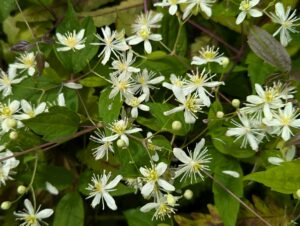
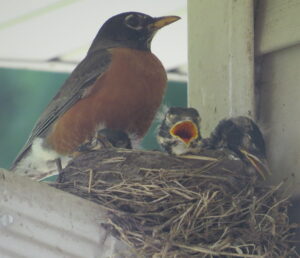
Before Cleon put the jar up, a pair of robins built their nest on top of the lattice support system he built for me that holds my Clematis vine (Clematis virginiana – native to the eastern U.S.). By the time Cleon attached the pottery nesting jar to the pergola post, the robins had a completed nest.
A pair of House Wrens moved right into the nesting jar and we had great fun watching the female maneuver sticks into the jar. We were amazed at the amount she crammed in there. And then it happened.
At first, we saw a robin’s egg smashed in our driveway. That is not that unusual. Any of you who have trees and robin’s nests will occasionally find a smashed egg on the ground. A few days later, we found a just-hatched baby robin on the driveway – dead. And then we started watching the robin nest and actually observed one of the wrens stealthily approach that nest, secreting itself by moving behind and through the foundation shrubs. The bird hopped up the latticework trellis – using that clematis vine as cover – and got right up on the rim of the robin’s nest. That is when we moved and scared the wren off.
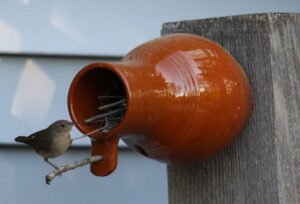
We never gave adding that bird jar – a nesting box – a second thought. We liked that it was from Colonial Williamsburg and that we could place it where we could watch a pair of birds go about the routine of building a nest and raising young. We thought it would be fun. And for us, it was. And the House Wrens had a fairly safe and secure nesting spot to raise their family. But there was a cost – a very high cost. And the robin family paid it. Cleon and I had not done our homework. We knew House Wrens were aggressive around their nests, but we did not realize just how far from the nest the aggression could occur. The female robin laid 4 eggs. One was smashed on the driveway and 2 just born baby robins were taken from the nest and dropped on the driveway in the hot sun where they died. This was the work of that pair of House Wrens – they perceived the robins as a threat to them and defended their nest. The robins were not a threat to them, but that is not how the wrens saw it. Adding that bird jar is what led to the end of 1 egg and the deaths of 2 babies. And that was all our fault.
We kept the bird jar on that post until the wrens were finished and then took it down. We now do not put it anywhere until we do a thorough check to see if any other birds are nesting within view. We cannot help it if a pair of birds nest too close to House Wrens after the House Wrens are nesting. But we can watch where we put the jar, so we do not put it anywhere near birds who are already nesting.
Give this some thought. Does this mean you should you not alter your yard in any way? Not add bird feeders or bird baths or nest boxes? Of course not. Just think before you place. Do your homework. Have a plan that takes into consideration everything else living in your yard – the seen and unseen. And always remember, every action you take has a consequence. Sometimes what happens is good such as providing a safe haven for an endangered or threatened species or a helping hand to migrating birds which would include leaving your hummingbird feeders up and filled in fall for about 4 weeks after the recommended date in your area. But sometimes what you do to help one species will harm another. And that is what happened in our yard. By providing a nesting jar for the House Wrens, we decimated the robin family.
Cleon and I learned a hard lesson that spring. We are now much more careful about what we do in our yard and where we do it – and we try to consider the possible outcomes. We have also tried to apply this sort of thinking to other aspects of our lives – most particularly in all issues facing us today. Right now, solar and wind farms plus carbon sequestering are big issues here in central Illinois and there are pros and cons for all three. After observing first-hand how a decision we made in our own yard had such an adverse effect, we now understand even better that every decision we human beings make affects every living thing on this planet. I encourage you all to consider every side of a change. In our society, power and money have become very important, but that has to be balanced with habitats, our environment, our entire planet. For us and for future generations – and not just of human beings, but of every other living creature. Every living thing is dependent on many, many other living things. Extinction of one species affects every species. Every decision has pluses and minuses – consider both before you make a decision in your own yard, your neighborhood, the park in which you volunteer, or the next time you cast your vote.
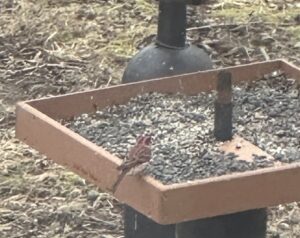
P.S. Referring back to my previous blog of March 5th, I FINALLY got a photo of the male Purple Finch this morning! The females were so much more obliging! The males just would not sit still long enough! If you have trouble – as I sometimes still do – deciding whether what you are seeing is a House Finch or a Purple Finch, here is a link to help you: Purple Finch and House Finch – how to tell them apart.