

A Wren and an Owl and something to think about …….
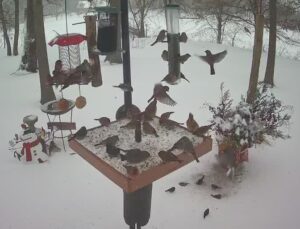
If you have been watching the livestream, for the last few weeks, you know that here in central Illinois, we are still in a deep freeze. As I am typing this, I am looking across the room at the computer that runs livestream camera and I see by the weather report it is 9°F. And just typing that makes me shiver!
Ever since the terrible storm we had two summers ago when 9 of our big oak and hickory trees in our back yard came crashing down, those of you who regularly watch our livestream know that the number of birds we have had at the feeder has been less. That is until now. Cleon and I have lived here 20 years, and this is by far, the longest period of extreme cold we have experienced. Since January 1st, almost every night, the temperatures are in single digits or below 0. And the winds are often well over 10 mph. Absolutely bitter.
And since early January, we have had birds everywhere! It is now more rare to watch the livestream and see no birds at the feeders. It is much more likely you will see birds covering the platform, on every perch, and all over the ground under the feeders. And in the past several days, more and more are using the birdbath. Blue Jays and House Finches are drinking and European Starlings are bathing – sometimes 4 at a time! And talk about making me shiver! When I am sitting here at my desk – wearing sweatpants, thick socks, and a warm turtleneck – and I look out and see starlings actually in the birdbath splashing all around and looking like they are enjoying themselves….. well, I cannot even imagine!
Since Cleon is still recovering, I have been doing more of the bird feeder filling. The feeders and birdbath are in our back yard, and we store the seed in metal garbage cans in our garage. I walk out the back garage door and down through the yard to get to the feeders – generally with my hands full of containers of seed, suet, and a full watering can. And I have not been closing the door behind me. Imagine my surprise when I walked back into the garage yesterday and heard fluttering.
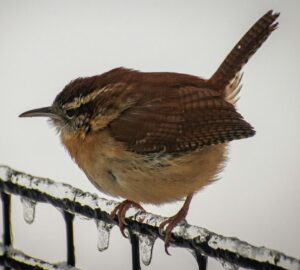
I walked over to my small greenhouse which I can enter from the garage. I had the windows closed, but the door to the garage was open to keep the interior of the greenhouse at about 50-55°F. And there it was – a Carolina Wren. The sneaky little bugger had flown right in through the door I left open when I was carrying everything down to the feeders. And was busy as could be nosing into everything in the greenhouse – examining each and every plant. I swear, there are no creatures on earth nosier than chickadees and wrens!
So how to get it out? The outside temperature was in the low teens and there was a 17mph cold wind blowing so I hated to open the greenhouse windows, but after explaining everything to all my plants – and apologizing! – I opened the 2 large windows, kept the door to the greenhouse open to the garage, kept the back garage door open, and opened the 2 big garage doors. And then I went inside for 10 minutes. When I returned, I checked the garage and greenhouse thoroughly and the wren was gone.
Wrens are clever and very, very sneaky. They will readily use any open door or slit at a window – if they can get inside a shed or garage, they will. If it had been a month later, this bird could even have been looking for a nest site, and it would not be the first time a Carolina Wren has built a nest in this garage. So, my advice to you is if you are feeding birds this winter and you go from your garage to your feeder area, close the door behind you. Wrens do not miss a trick and are very opportunistic. Luckily, they are also very quick to find the escape out of a garage or shed. 10 minutes by themselves with all doors and windows open usually does the trick. And my plants in the greenhouse? Luckily, it was a partly sunny day and so once I closed the 2 big windows which stopped the cold wind from blowing through, the greenhouse quickly warmed to the 50-55° range and my plants were just fine. Who knows? Maybe they enjoyed a breath of fresh, cold air!
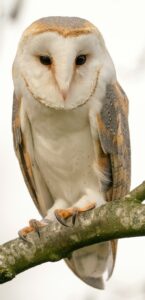
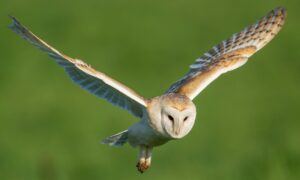
And now for the owl. Cleon is still in the period of time in which there are doctor and therapists’ appointments. He is doing very well and one by one, the medical people are signing off his care. A full recovery is expected. We were driving the 30 miles to one of the larger cities in Illinois for one of his appointments when we both saw the same thing at the same time. Off to our right, a big bird took off from the top of one of the light poles along one of the exits. We both looked at each other in total excitement! This was no Red-tailed Hawk which is common along this route. Nor was it the Bald Eagle we had seen coming home on this road two days before. This was a large white/pale bird with a big wing-span and tawny streaks and mottles. We saw a Barn Owl!!!!! Barn Owls are very rare sightings for us here or anywhere and we were thrilled!!!!!!!.
P.S. An interesting note – just something to think about …….. Our Illinois Governor – J.B. Pritzker – has been on the cutting edge of state governors promoting alternative sources of power. During his years in office, our state has greatly expanded the number of wind and solar farms. This is not without controversy from farmers – it is on farmland where these are placed. But what I want to spend a moment or two writing about this cold morning are solar farms.
I live outside a town of about 11,000 people – the county seat. Big agricultural fields of corn and soybeans surround the town and make up most of the county – and this is the case of most counties here in central and southern Illinois. Larger towns as county seats, smaller towns of generally less than 1000 people – and often less than 500 people – and then thousands and thousands of acres of agricultural land in predominantly corn soybeans, wheat, and cattle. And our soil here in Illinois is some of the best in the world.
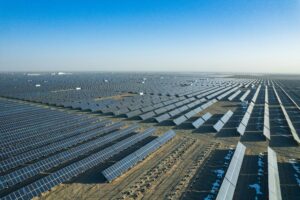
Close to where we live, a 120-acre solar farm was completed last year and is now in operation. 120 acres of some of the best farmland anywhere has been taken out of food production to produce energy from solar panels which rely on the power of the sun. And yet here, we do not have many sunny days January through March. If you have been watching the livestream since I began 3 years ago, you know this is true. The majority of our days in January, February, and most of March are heavily overcast. Dull, dreary, gray. So why build solar farms in areas of our country that do not have sun for most days over an entire season – 1/4th of the year? And take some of the best farmland you will ever find in order to do it? Why not build solar farms where there is sun almost 365 days a year? We have vast areas of desert in our western and especially our southwestern states. Why not build them there where they can be in operation all year long? Build the necessary transporting towers and cables to then transport the power where it is needed? Using land that is not farmland? I am not against solar power – in fact, I think it is an intriguing idea that will only get technologically more sophisticated in the future. But I am against taking irreplaceable farmland on which to place these panels. Again, this is something that needs more thought and planning. Our farmland in the Midwest and on the Great Plains was created by thousands of years of prairie plants with their immense root systems – living, dying, and decaying into rich soil. That process will never ever occur again. This rich soil is irreplaceable. These are decisions with real consequences, and everything has to be considered – much thought given before action is taken. It cannot be just about making money or proving a point. So, something to ponder as you go through your day…… and turning lights on, using hot water, and turning up your thermostat.