

Mandevilla
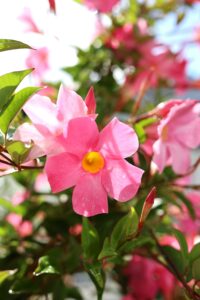
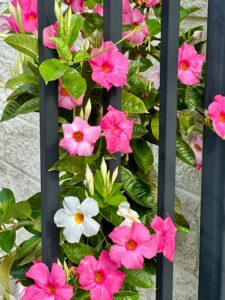
Attracts hummingbirds! This is a vine which must have vertical support and unless you are in the southern parts of our southern states, either grow it as an annual vine or as a container vine that can be brought in for the fall, winter and early spring. Mandevilla will not tolerate one moment of frost. If you live in a colder growing zone than Zone 9, decide to plant it into the ground, and want to keep it till the following spring, you will have to dig it up in fall before frost to bring it indoors. This could be difficult because it is quite a big plant.
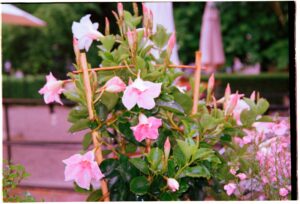
Light: Full to part sun.
Soil and water: Regular potting soil. In spring and early summer, check the pot every 2-3 days and water it when it is dry. In July, August, and September, check it every day and water as necessary.
If you are planting it into the ground, then a good garden soil that is fertile and well-drained is necessary.
Hardiness Zone: Zones 9-11.
Overwintering: In late summer or fall, when outdoor and indoor temperatures match, bring your Mandevilla inside. It likes bright indirect light – no direct sun. Stop fertilizing and do not over water. Check your plant twice a week by sticking your finger into the soil about 2 inches deep. If the soil feels dry, water, if it feels moist, don’t.
Before the plant starts putting out new growth – late February/early March is a good time to check – cut the plant back by about 1/3 of its size. Remove any dead branches and any branches that are growing in a direction you do not want them to grow. When that is completed, pinch back the ends of all unpruned branches to encourage new growth – Mandevillas bloom on new growth. Repot with fresh potting soil. Since you have removed about 1/3 of the plant, you can also cut back the roots by about 1/4 to better fit your container. You can cut the roots anywhere – these vines are not fussy. They will easily repair and regrow roots – just do not cut back more roots than you have cut branches.
If you are going to plant this vine into the ground, bring it in its container to an outside shady spot between May 1st and May 31st. Watch the night-time temperatures – they must be consistently above 50°F before you make this move. Once the night-time temperatures are warmer, you can take the plant outside and place into the shade. Over a period of about a week, gradually move it into more morning sun (afternoon shade) each day, and then start including afternoon sun, until it is in full sun (including afternoon) to part shade – its permanent spot until fall.
Size: This greatly varies. If you are treating your Mandevilla as an annual and not overwintering it, then you can expect it to add no more than about 10-12 inches of height to the height it was when you bought it. And this depends on if you fertilize it regularly or not. If you over-winter it, and keep it for several years, you can control its height with annual pruning (the maximum height of an unpruned vine is about 20 feet with a width of about 15 feet). But this vine is easily controlled by pruning and you can keep it just to about whatever height and width works best for you.
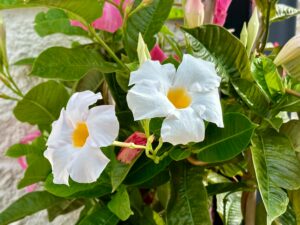
Bloom period and color. Fertilizing. Deadheading. Mandevilla comes in pink and red, yellow, purple, and white. Botanists and hybridizers have been busy with this vine. Lots of varieties/cultivars. If you are using it to attract hummingbirds, choose red or pink.
Mandevillas do not need deadheading – the plants do this themselves. Unless it is absolutely necessary, do not prune your Mandevilla during spring and summer as you will decrease its flower production. Prune only in late winter.
Fertilizing: For the best growth and bloom, fertilize your plant once every two weeks with a 10-20-10 or 10-30-10 fertilizer.
Deer, rabbits, and other pests: Deer and rabbits avoid this plant.
Generally, Mandevillas are pest-free, but check your Mandevilla once each week for aphids, spider mites, and scale. Spider mites can be hard to see. Hold a white piece of paper under a branch and gently shake the branch by tapping it. If what looks like pepper falls onto the white paper, you have spider mites. If you must spray for spider mites and scale, I recommend a spray from the Safer brand or a similar brand. These are the safest sprays for you and also your plants, birds, and butterflies. Follow the directions on the label and check your plant regularly for the rest of the growing season – these pests can return. I always keep a bottle in my cabinet but only use it when I absolutely have to. In my opinion, aphids are best taken care of by donning waterproof gloves and dipping your gloved fingers into a bowl of water. Run your fingers and thumb along all the infected leaves and stems of the affected areas – squishing as you go. Do this once a week for three weeks and your infestation should be either gone or greatly diminished. If you have these mites, aphids, or scale,
you must treat your plant because all will spread. If your Mandevilla is in a container, move it away from all other plants until it has been treated and the infestation is either under control or gone.
Propagating: The plant can be propagated in spring and early summer with soft cuttings of non-flowering shoots. Wear gloves as a small amount of milky sap could exude from the cuts – this sap can irritate the skin. Place the cuttings in small containers with drainage holes – regular potting soil is fine. Indirect light and temperatures between 65-75°. Keep them moist.
How to use Mandevilla: This is a showy vine and when placed in a large, decorative pot, can be used as an accent or focal point for any outdoor space that meets its light requirements. They look great on decks and patios. If you keep it watered, fertilized, and checked regularly, the bloom can be spectacular for most of the growing season. These pots can also be placed anywhere in your garden – just make sure they have good protection from wind and that you check them for water every 2-3 days in spring and early summer, and every day in July, August, and September. Also make sure the containers are well braced so they do not blow over if there is an errant wind from which they are not protected.