

Obedient Plant or False Dragonhead (Physostegia virginiana)
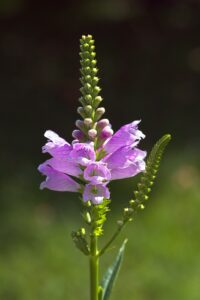
Light: Full to part sun.
Soil and water: Average garden soil. Likes the soil to be moist to wet but it will tolerate drought conditions. The drier the soil, the less it will spread.
Hardiness Zone: 3-9.
Size and shape: 3-4 ft. Upright. Does not need to be supported.
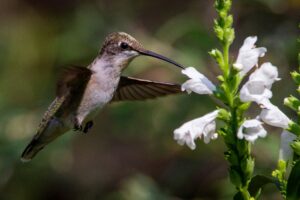
Bloom period and color. Deadheading: Pink or white – will bloom profusely in full sun and wet soil. Blooms August and September. To deadhead, cut the fading flowers off just below each flower spike and above an intersection of a leaf stem with the flower stalk. Leave all stalks in place through fall and winter. Cut all stalks to the ground in late March-early April.
Deer, rabbits, and other pests: Deer and rabbits avoid this plant. Generally pest/disease free.
Transplanting and propagating: Easy to transplant. Use a sharp spade or shovel and cut through the plant and its roots and remove whatever size clump you would like to transplant. Dig a hole the same depth and firm soil around the roots. Water twice a week for about 4-6 weeks until it is established.
Seeds can be collected. 40 day striation period. Plant in pots, seed trays, or right into the garden. They will take about a week to germinate.
What to plant with the Obedient Plant: In my opinion, these plants are best planted alone, or with a wide border (2 feet or more) between them and the next grouping of plants. This is a plant that needs a lot of room. But other plants that like the same growing conditions would be:
Turtlehead (Chelone obliqua)
Canna Lilies (Canna or Canna indica)
Swamp Milkweed (Asclepias incarnata)
Siberian iris (Iris sibirica)
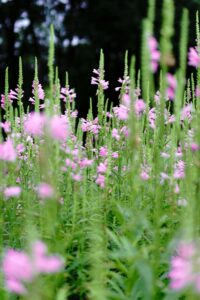
How to use the Obedient Plant: Depending where you place it, this plant can be invasive!!! Which is why I have it listed as a groundcover – it is a good one!!! I do have it in my garden growing in poorer soil (I never fertilize it), in part sun, and only in spring is the soil wet – often sopping wet. In July and August, this can be a drier area. I have placed a border of bricks around it. And I have given it lots of room. I planted 1 plant in the center of this bed which is about 8 ft. by 8ft. with a 2 ft. border outside the bricks before there are any other plants. The bricks will not contain its growth, but serve as a reminder to me as to just how far I want this plant to spread. I check it every month in order to cut back any growth that is close to the bricks – or beyond. So far, in 5 years, it has not gotten out of its bounds. There is still room within its bed for more spreading. I think the dry soil in mid-late summer is what keeps it in check. But understand if you plant it in its optimal conditions – full sun and a wet soil, it is aggressive and can be considered invasive – two traits that make it awful to try to keep it confined to a single plant or a to tiny area, but great when it has room or you are using it as a groundcover.
This plant makes a good groundcover for a sunny, wet area. The base of the plants forms a mat and so will discourage weeds. It spreads by its roots and so will fill in an area. The only downside is that as the years go on, it could die out in the center. To prevent that, about every 5 years, refresh the plot by digging up much of the bed, dividing the healthy parts into nice-sized clumps, and then replanting the clumps about 16-18 inches apart. As long as the soil stays damp to wet and it is in full sun, the bed should fill out by the end of the summer or the following late spring.