

What is – and has been – happening here at our house ……..
Geese! And they were everywhere!!!!
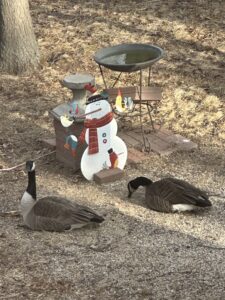
Not everyone likes geese and depending where you live, I can understand the reasons for wishing them elsewhere. But I love them! Particularly the Canada Geese who live year-round on our small lake here in central Illinois. If you have been reading my blog, you know that last spring we had no successful nests. In fact, we went almost the entire summer without any geese whatsoever. We have lived here about 20 years, and this was the first year that happened. We normally have a resident flock of about 15-50.
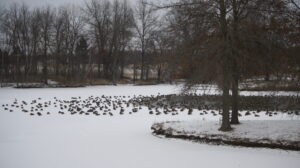
The Canada Geese did return to our lake last fall and took up residence once again. They have been with us every day except for about the three weeks the lake was frozen solid. The Canada Geese and their cousins, the Greater White-fronted Geese who were here in migration, kept a small part of the lake open with their constant swimming. But the temperatures were below 0°F every night for almost three weeks and no amount of swimming geese could keep water free of ice in those temperatures. But once the ice thawed, the geese returned and the Canada Geese have been with us every day since. The Greater White-fronted Geese have moved on to their nesting areas on the tundra above the Arctic Circle.
Right now, you will see a pair of Canada Geese off and on under the feeders. This is a mated pair – a male and a female. Although they look exactly alike, their behavior will tell you which is which. The male will generally be standing or resting – straight and tall. His neck stiff. His only movement might be his head as he keeps a vigilant watch over the female – always looking for predators and here where we live, that would be red foxes, raccoons, minks, and sometimes possums. These mammals generally do not take on adult geese – who defend themselves very well – but they commonly raid unguarded nests and will kill goslings.
These male geese are also on the lookout for other Canada Geese. From about July through January, Canada Geese are almost always in flocks. They generally get along very well together in these flocks. They will do everything together: forage, rest, preen, sleep. But in February, these flocks start to break apart and geese pair up and start looking for nesting territories. And this is what this pair under the feeders is doing – or has done. We live on a peninsula which juts out into our small lake, and we have a prime nesting spot on our point which sits about 3 feet above the water when the lake is at its normal level. A small ‘clearing’ has been kept free of the wild black raspberries that grow along our shoreline – all that work has been done by geese. So, when the female builds her nest and is sitting, not only is she partially obscured by the brambles, but access from land is also difficult because of the tangled, sharply thorned vines. The only easy access is from the lake. That does help with defense against predators of the nest.
So, this pair has claimed our backyard as their nesting territory – which includes under our feeders. And we will see what happens. Generally, there will be 3-4 pairs who fight over our backyard, and you may see some of this play out behind the feeders. You will see them chase each other and if you have the volume turned up, their honking can be deafening. Necks are outstretched, wings are flapping hard, and they hiss at each other. They also lunge at each other and are not above grabbing hold of tail feathers and giving vicious tugs. This fighting will continue out into the water where they will try to drown each other. As far as we know, none of these geese have ever been hurt, but this is serious fighting. Generally, it is male against male and female against female, but if it is just one bird – generally a male – and the male of the mated pair is having trouble, the female will pitch right in and help. Mated pairs work together very well to defend their nest and surrounding area. NO OTHER GEESE ARE ALLOWED! PERIOD! NO EXCEPTIONS!!!!!!
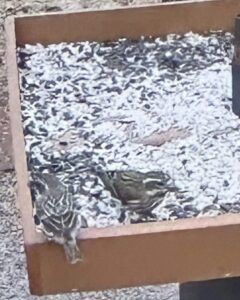
We have at least 2 pairs of Purple Finches at the feeders – they have been here about 2 weeks and may stay for at least another week or so. The mated pairs stay close to each other and often all 4 are at the feeders at the same time. In my opinion, Purple Finches greatly resemble House Finches, and they are sometimes hard to tell apart – especially if you are more of a beginning birder or you only get a glimpse. Click on this link for help telling these 2 species of finch apart: Purple Finches and House Finches.
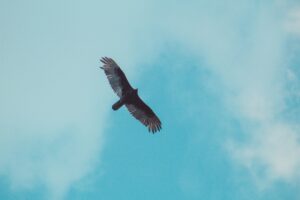
We have heard several Killdeer flying over our house. And we have 1 Turkey Vulture soaring over our lake. We have had 1 Turkey Vulture almost every day each spring and summer for the last about 8 years – wonder if this is the same one returning? If so – welcome back!!!

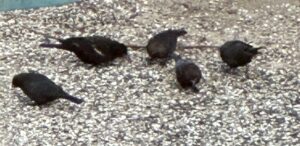
Male Red-winged Blackbirds arrived about a week ago. It is rare for us to have female Red-winged Blackbirds at the feeders. Generally, the females arrive in our neighboring fields a week or two later than the males. We have yet to see the females, but my cousins who farm about 10 miles south of us have told me they have seen a few. The males will soon begin to stake out their nesting territories. Brown-headed Cowbirds winter in central Illinois, but never at our feeders. The males have just returned to our feeders.
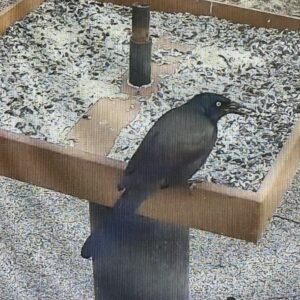
And I shot this video just yesterday – the first Common Grackle we have had since last fall: Common Grackle. It was not a brightly sunny day, but you can still see the iridescence on the feathers of this male. Truly a beautiful black bird. And just like the Red-winged Blackbirds and Brown-headed Cowbirds, the female Common Grackles will be here in 1-2 weeks and courtship will begin!
Late winter and spring are such interesting times at feeders. If you would like some help identifying birds at your feeders, please consider purchasing my field guide which will immediately arrive in your Inbox as a PDF: Common Songbirds and Raptors in Your Yard, Neighborhood, and Favorite Park. There are sample pages to view and read, and a list of the birds included. Here is a link: Birding Books by Linda Hendricks Spence.
In our lake, we still have a few pairs of Hooded Mergansers – also a small flock of about 7 male and females – no pairing off as of yet. And the Ring-necked Ducks just arrived. Yesterday, there were 2 and today, besides these 2, there is a small flock of about 12 males and females – no obvious pairing. In fact, this flock stays tight – they are right next to each other as they move down the lake. Interesting behavior for these diving ducks. We are used to them in flocks, but they are loose flocks. We often have 8 to about 15 this time of year every year. And when they are on the lake, although they are within sight of each other, they are not close together. This flock of 12 moves as one with little to no space between each duck. Birds are endlessly interesting!