

Sabine National Wildlife Refuge near Hackberry Louisiana
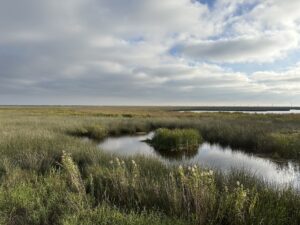
 Cleon and I spent an exhilarating morning at Sabine National Wildlife Refuge. It was a beautiful, brisk day. When we were there, the temperature ranged from 41°-50°F, the morning went from cloudy to partly cloudy, and the wind ranged from 5-10mph. We took a wonderful cement sidewalk/boardwalk through the marsh which included an elevated viewing platform. The sidewalk ran next to one of the small canals and through areas of marsh grass and this is where we saw many of the birds we listed. The walk is listed as 1.75 miles – my pedometer measured 2.25 miles. Being a marsh, this walk is flat. We did not take our scope, but we both had binoculars and they were enough. Many of the birds were close to the walk. We also had Merlin on – if you are unfamiliar with Merlin, click on this link: Merlin and Its Sound ID
Even though many of the birds we listed were close to this walk, they were not used to people – they were skittish. So, if you do visit this refuge and take this walk, we would recommend you wear darker clothes of greens and browns – nothing flashy. And keep your talking to low tones and whispers. These marsh birds can disappear into the tall grasses and reeds in a nanosecond – never to be seen again. We both agree – this was one of the best birding walks we have had in a long time. And December was the perfect time – at least in my opinion. Very few insects. It was cold, so most reptiles were not visible – I am much more relaxed when snakes are living good lives, but elsewhere! And because it was December, we were the only ones there. All adds up to make a perfect day for me!
Sabine National Wildlife Refuge was established in 1937 and at that time was 124,511 acres of marshland ranging from freshwater marsh to salt marsh that is close to near seawater strength in salinity. Marshes are second only to rain forests in terms of the vastness and variety of life they shelter and nurture. This refuge also contains pockets of different habitats besides marsh: freshwater impoundments, levees, canals, wooded ridges, ponds, lakes, and bayous.
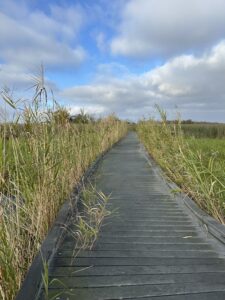
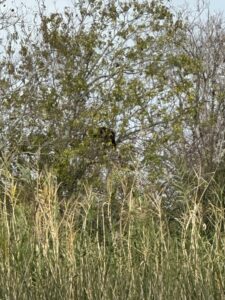
Unfortunately, since the formation of this refuge, it has lost about 40,000 acres because of people digging channels through the area, people building levees, and hurricanes. In recent years. a major effort is being made to restore some of these acres and to prevent further habitat loss. The primary management objective is to preserve a large area of coastal wetlands for migrating and wintering ducks, geese, wading birds, and all birds who thrive in a habitat that includes water and wet, marshy areas. The birds who migrate here for the winter arrive in this refuge from the Central and Mississippi Flyways*.
Here is the official recorded number of animal species:
300 birds
26 mammals
41 species of reptiles and amphibians – this refuge is home to hundreds of alligators
132 species of fish
68 species of marine invertebrates**
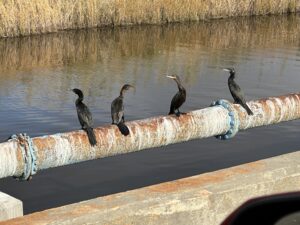
Here is our bird list:
Snowy Egret
Great Egret
Great Blue Heron
Black Vulture
Red-tailed Hawk
Mississippi Kite
Osprey
Marsh Wren
Sedge Sparrow
Savannah Sparrow
Northern Mockingbird
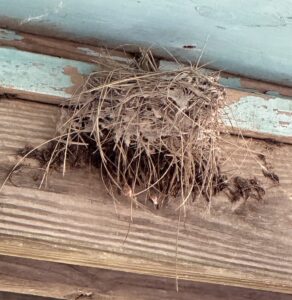
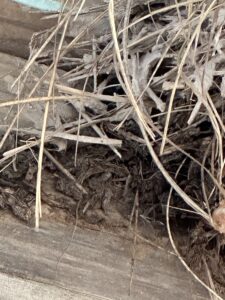
Nest of Eastern Phoebe
Gray Catbird
Boat-tailed Grackle
Red-winged Blackbird
European Starling
Sora
Common Gallinule
Neotropic Cormorant
Common Goldeneye
White-faced Ibis
White Ibis
Glossy Ibis
Roseate Spoonbill
Belted Kingfisher
Herring Gull
From Merlin:
Common Yellowthroat
Snow Geese
Ruby-crowned Kinglet
American Pipit
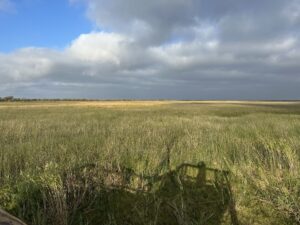
We did not hear or see these birds. We agree with Merlin that the habitat was good for Common Yellowthroats, Snow Geese, and American Pipits. But we question the Ruby-crowned Kinglet. There were only a few, widely scattered medium-sized trees, and these kinglets are primarily woodland/forest birds. However, they sometimes can be found in more isolated trees or small groves of taller, mature trees. But there were no tall trees anywhere in sight of where we were – only widely scattered short hedge lines of scrubby small trees and underbrush. It is possible kinglets could have been in one of these hedgerows, but they would have had to fly over miles of unbroken marsh to get there. We did look at these hedgerows and neither saw nor heard kinglets. And in December, they rarely/never sing and so Merlin would be identifying them by their soft call notes. We think Merlin could be wrong about the kinglets.
A word about the less common birds on our list:
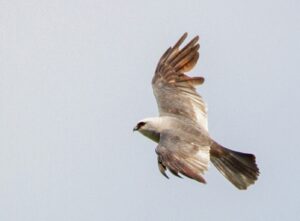
Mississippi Kite – These kites will perch on overhead utility wires and that is where we saw this one. To us, it always looks like a large Northern Mockingbird or a large Shrike. The same gray coloring. Except as in many hawks (kites are hawks), this bird looks muscular – in comparison to a mockingbird which is slender. This marsh is good habitat for them – they like trees of all sizes in which to perch, and large open spaces. Although in my opinion, seeing this kite was unusual as this refuge is not part of its winter range – it is its summer range – there was no doubt that it was a Mississippi Kite. We got lucky!
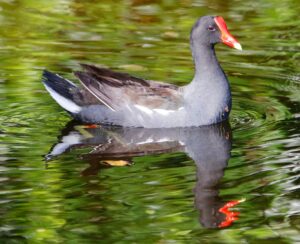
Common Gallinule – these birds were skittish. We heard them scrambling for cover in the tall grass long before we actually got a glimpse. Good-sized birds that disappeared faster than you can blink an eye. Even though these birds behave more like ducks, they are not in the same family as ducks – they are more closely related to rails and cranes and have been placed in that family. Like its close relative, the much more common American Coot, they have feet that are not webbed like ducks, but look like the feet of chickens – or the feet of rails and cranes. Gallinules are excellent water birds. They swim mostly on the surface of the water like Mallards, but they can dive and swim underwater.
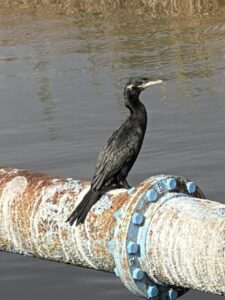
Neotropic Cormorant – This bird is closely related to the much more common Double-crested Cormorant. It looks very similar to the Double-crested except it is only about half as big. That it is much smaller is apparent even if a Double-crested is not nearby for comparison. The Neotropic seems to be fairly common at this refuge and none that we saw were skittish in the least. They did not mind us getting close – they seemed more curious than uneasy.
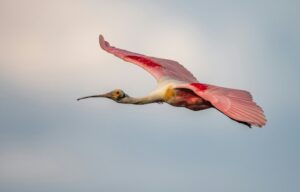
Roseate Spoonbill – I did not realize this bird was also here in Louisiana. The ones I have seen have been on Sanibel Island off the west coast of Florida in the J.N. “Ding” Darling National Wildlife Refuge. The one I saw here was in flight and my first thought was Flamingo???? Definite pink cast and is this not the bird we all think of when we think ‘big pink bird’? But even in flight, I could see the bill was all wrong. Definitely a Roseate Spoonbill.
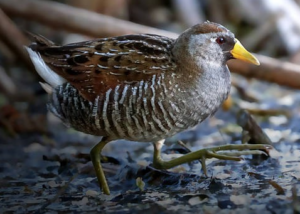
Sora – This was our first sighting! The bird exploded out of the tall grass, flew the short distance across water – wings beating furiously – landed, and disappeared immediately. Talk about right place, right time! Had we not been looking right at that area, we would have missed seeing this bird entirely. According to the North American Breeding Bird Survey and Partners in Flight, Soras are the most abundant of the rails in the U.S. (Click here for more information on both organizations: North American Breeding Bird Survey and Partners in Flight . However, in my experience, they are secretive. I have been in a lot of marshes but this is the first time I have ever actually seen one.
*Central Flyway in the U.S. – from Montana south through New Mexico and Texas.
Mississippi Flyway – Minnesota and Wisconsin south and following the Mississippi River, including the states on either side.
**marine invertebrates – animals without a backbone such as sponges, shrimp, crabs, jellyfish, coral, octopus, sea urchins, squid, and clams.