

It’s Time! Feeders for Hummingbirds, orioles, and bluebirds …..
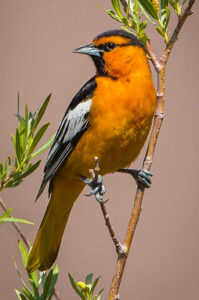
April is a great time to put up feeders for hummingbirds, orioles and bluebirds. These birds are primarily insect eaters in spring and summer, but all love fruit any time of the year – or as in the case of hummingbirds, sugary water. First, the orioles.
If you live surrounded by big trees, many of you will have at least one of these orioles in your neighborhood: Baltimore, Bullock’s, or Orchard. If you live in the Rockies and west, the oriole you will most likely see is Bullock’s Oriole. For me, living in central Illinois, we have both the Baltimore Oriole and the Orchard Oriole in our trees. Those of you who live east of the Rockies could also have both of these birds. There are other orioles in the continental U.S., but they are more rare and have quite limited ranges. But one thing all these orioles have in common is they will come to backyard feeders designed and maintained for them.
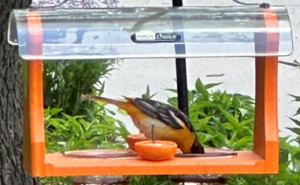
The male Baltimore Oriole in the photo to the above-right is at the feeder in our front yard here in central Illinois. As you can see, we have 2 lovely fresh orange halves placed for him, but he, his mate, and the other 5 orioles who regularly use this feeder completely ignore the oranges and stuff themselves with grape jelly. And it cannot be just any grape jelly either. They actually will ignore anything but Welch’s. I researched this and found it is not just our neighborhood orioles who are picky. Most orioles seem to prefer Welch’s – the theory is it has just the right amount of sugar. My husband – who is our grocery shopper – has to buy the jumbo jars because he fills the cups at least twice a day.
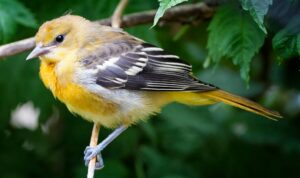
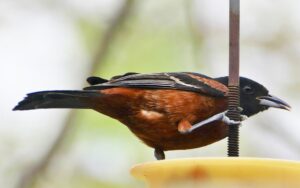
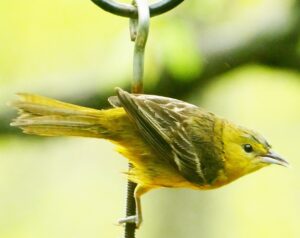
Here are photos of the male and female Orchard Oriole – generally listed as “Uncommon”, but their range extends from the Rocky Mountain States down through Texas to the east coast.
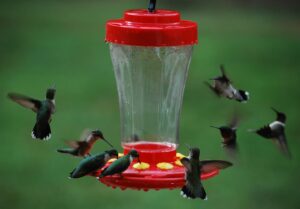
Hummingbirds. Hummingbirds are quite entertaining at feeders, and they are just so beautiful. But they also have foul tempers – all hummingbirds fight. In fact, if hummingbirds were the size of Bald Eagles, we would all be dead! Pound for pound – or in the case of hummingbirds, fraction of an ounce for fraction of an ounce, hummingbirds are amongst the most aggressive creatures in nature. Do they win all their fights? Absolutely not – they are just so small.
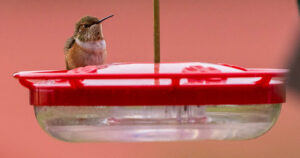
They do not like each other or anything else – with one exception. They are drawn to anything red – feeders, flowers, and also the red on outdoor furniture, garden gnomes, and the baseball cap you are wearing. So, consider putting up at least 1 hummingbird feeder – with red on it, of course – and prepare to be entertained.
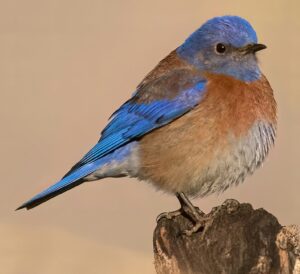
Bluebirds. Regardless of whether you have Western Bluebirds, Mountain Bluebirds, or Eastern Bluebirds, all will come to a feeder designed and stocked specifically for them. Check the range maps in your field guide to see which bluebird you might have.
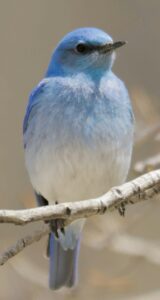
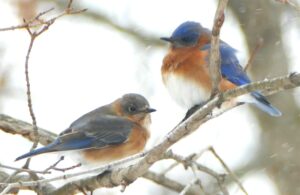
What to feed orioles, hummingbirds, and bluebirds, and how to clean their feeders.
Orioles: Grape jelly and oranges seem to be their favorites. But orioles love fruit so if your feeder has room – you can see in the photo above, ours has 2 cups – try a few darker berries like cherries or black raspberries and also darker grapes.
Hummingbirds: Here is a link for the recipe for the sugar water – it is easy to make and much better for the birds than the ones you can buy (scroll down to Hummingbird Feeders): https://birdingbeyondthefieldguide.com/hummingbirds-gardens-and-feeders/
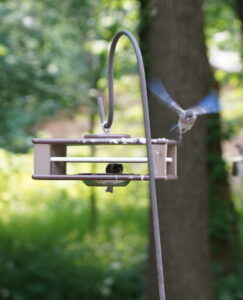
Bluebirds: Bluebirds love mealworms and here is a link to just about everything you need to know about mealworms from the North American Bluebird Society: https://www.nabluebirdsociety.org/PDF/FAQ/NABS%20factsheet%20-%20Mealworms%20-%2024May12%20DRAFT.pdf Bluebirds also like fruit and seem to be particularly fond of red raspberries.
Something to consider before you purchase a special bluebird feeder and keep a supply of mealworms on hand – do you actually have bluebirds in your neighborhood? Bird feeders can attract birds to your yard that would not always be there. But in my experience, bluebird feeders do not attract bluebirds who are not already right there. If they are in your yard, they should use your feeder. If they are not already in your yard, the feeder will most likely not draw them in. I am not sure why that is. Birds like chickadees, jays, blackbirds, and finches seem to fly around, looking down for feeders, and then passing the word as soon as they spot some. Bluebirds seem to fly around oblivious to feeders, but will use them if they stumble upon them. So, look for bluebirds around your yard before investing time and money in a feeder.
Cleaning all these feeders: The feeders for orioles, hummingbirds, and bluebirds must be kept clean. The hotter the weather, the more bacteria there will be, and these bacteria are not good for any of the birds. The sugar water in hummingbird feeders can ferment which is often fatal. If you plan to add these feeders to your yard, mark your calendar to clean the feeders at least every 3 days. And honestly? Our Baltimore Orioles are a mess. They keep themselves scrupulously clean – our feeder is very close to a large birdbath they use every day and love. I don’t know what it is they do at that feeder, but at the end of each day, there are bits of jelly everywhere – including the roof. Like there has been a giant food fight! So, once they start using it, we clean it every day.
The oriole and hummingbird feeders are cleaned in the same way. Hot water and vinegar in a ratio of 4:1. Use a cloth or brush. Thoroughly clean all the surfaces and let the feeder air dry. Refill. Never use soap, any detergent, or bleach.
Bluebird feeders can be cleaned with hot water and soap and/or vinegar. Use a cloth or brush to get into all the corners and crevices and rinse thoroughly. Air dry.
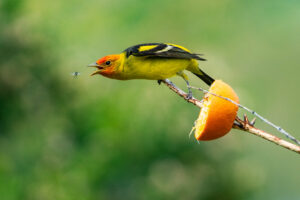
And you may be surprised! Orioles, hummingbirds, and bluebirds are not the only birds who will use these feeders. At our oriole feeder, we often have House Finches and Gray Catbirds – who are quite feisty and maybe they are responsible for the food fights? Woodpeckers can get quite adept at using hummingbird feeders – especially Downy Woodpeckers who are smaller birds. Woodpecker tongues are long! Wrens, American Robins, and European Starlings love mealworms and might dig right into those offered at your bluebird feeder – the style of feeder can help prevent this. Keep that in mind when purchasing your feeder – especially if you have starlings.
I hope all of you consider these feeders. Feeders and all the birds who use them will make your garden complete. Your own wildlife refuge!
P.S. Our second livestream camera on our large birdbath is now up and running. Cleon and I always have a bet as to which birds will be the first to discover it and use it – generally that can take a day or two. Not this year. Within moments of Cleon removing the cover and filling it, House Finches were there – drinking and taking a bath. Followed by robins. So this year, Cleon wins! My guess was robins – who were a bit lazy from my point of view!
We will also be putting up our oriole feeder and hummingbird feeder – we are hoping to do that tomorrow. We have had days of stormy weather so decided to wait for a break in the weather – but the good news is our drought is over. We have not seen or heard Baltimore Orioles, but we have heard Gray Catbirds. And our House Finches are with us all year round. Both those birds will use the oriole feeder quite a bit. We will also be adding a second hummingbird feeder to the wooden post in the bird feeder area. That will probably happen some time next week as the ground is sopping wet right now. We will wait for drier conditions before venturing out. April 15th is a good target date for us to set out the hummingbird feeders but there are always early arrivals – and they arrive tired and hungry. Not a lot for them to eat right now so feeders help.