
Finch Irruption – Fall and Winter 2026-27
I received an email from the Finch Research Network and they are predicting an irruption* of finches this fall and in the upcoming winter. Here are the species to look for – especially at your feeders.
If you live or are birding in our western and plains states**, look for:
Evening Grosbeaks – a quite large irrumption is forecast for these grosbeaks.
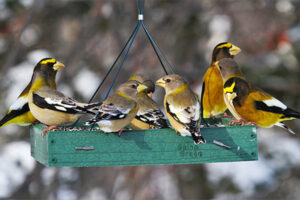
If you check the range map in your field guide, you will see that Evening Grosbeaks have winter ranges all across our northern states and year-round ranges in the Rockies and Sierra Nevadas. With this irruption, there will be more of them in within their range, but they will also extend their range out onto the Great Plains. If you live in Nebraska, Kansas, Oklahoma, northern Texas, or in higher elevations of Arizona, New Mexico, and southern California, look for them at your feeders. In winter, these birds are generally in a small flock (most often, less than 30 birds). They can be nomadic so do not be surprised if they come to your feeders for a few days or even several weeks, then move on.
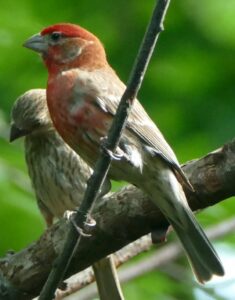
Red-Crossbills – not as large an irruption is forecast for these crossbills, but it still could be significant. And notice, if you are just glancing out the window at your feeders, you may think you are just seeing the much more common House Finch. Take time to look carefully at each bird!
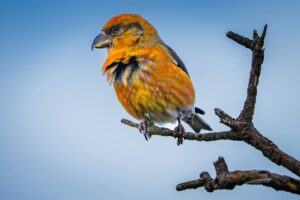
The Red Crossbill’s normal range is similar to the Evening Grosbeak’s range – both year-round and winter. Once again, if you live within their range, you should see them at your feeders this late fall and winter – or more of them if they have always been regular visitors. And if you live in southern Nebraska, Kansas, Oklahoma, northern Texas, look for them at your feeders.
Cassin’s Finches – not as large an irruption is forecast for these finches as is for the grosbeaks, but it could still be significant. This finch can also be mistaken either for the House Finch or a Red Crossbill. Appearance and behaviors are all similar. Try to get a good look at each reddish, finchy-looking bird to see which species you are actually seeing. Cassin’s Finch has a smaller winter and year-round range than either the Evening Grosbeak or Red Crossbill, so it is possible more of you who live in the western and plains states will see this bird for the first time at your feeders this late fall and winter. Normally, those of you in North and South Dakota, Nebraska, Kansas, Oklahoma and northern Texas would never see this bird. Look for it at your feeders this year. I do not have photos of Cassin’s Finch so click on this link for several: Photos of Cassin’s Finch.
If you live or are birding in our eastern states***, look for:
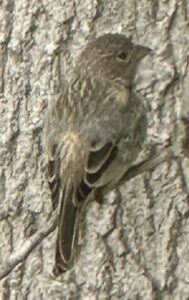
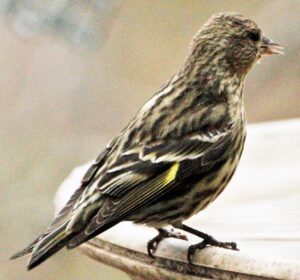
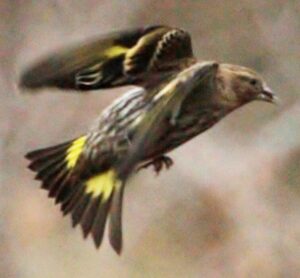
Pine Siskins: The year-round range for this bird is the northern parts of our northern states. Their winter range is all our states except the most southern parts of our southern states and the entire state of Florida. This is another bird who is usually in a small flock which can be quite nomadic. You might see them at your feeders for a few days or a few weeks and then they move on. Or they could be at your feeders all winter. If you have never seen them at your feeders, keep an eye out for them this year and if you normally have them, you could have more. The forecast is for a big irruption in the northeast**** and the rest of us to have an irruption, but not as large. Our friend Jim took these photos and he lives about 30 miles north of us. He almost always has Pine Siskins at his feeders every winter. We never do – hope that changes this year. I will have my binoculars ready to look for yellow!
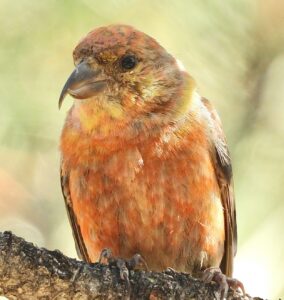
Red Crossbills – see above. In the eastern states, a small irruption is forecast. The much larger irruption will be in the western and plains states.
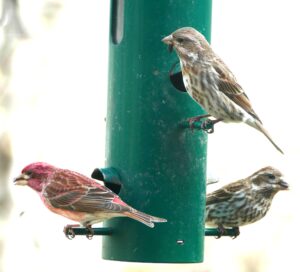
Purple Finches – a small irruption is forecast for the eastern states. Most of us – except those who live in the southern parts of our southern states and Florida are within the winter or year-round range for this bird but once again, the flocks are nomadic. For example, we generally get 4-6 Purple Finches at our feeders in late February and they will stay until late Match. But we do not see them earlier in the winter. It is a small flock of both males and females and they do stick together. I am hoping to see more and for a longer time this winter. Fingers crossed!
And once again, the males and females look similar to and behave like male and female House Finches – and this year I will include also Red-Crossbills and Pine Siskins. Binoculars!!!!!
And a bird that is not a finch but is forecast to have a small irruption in our western states:
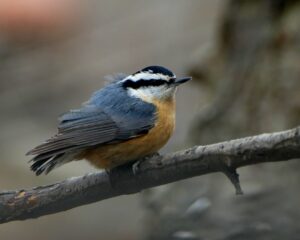
Red-breasted Nuthatch – Besides at your feeders, look for this bird on the trunks and branches of your trees – sometimes upside-down. They also call to each other during the winter months – listen for them. Click here to learn their calls: Calls of Red-breasted Nuthatch. Their calls are similar to their cousins the White-breasted Nuthatch. Click hear for their calls: Calls of White-breasted Nuthatch. Listen to both to learn to tell them apart.
Why will this be such a good irruption year for these finches? The Finch Research Network***** has listed two main reasons. The first is there was a large increase in Spruce Budworm – a favorite food of these finches for feeding their nestlings. This led to a record number of nests and birds fledged from these nests. The second reason is that pines, spruces, and firs did not produce a lot of cones this year and the seeds of these cones are a major fall and winter food source for these birds. Since the cones will be more scarce, these birds will go further south in search of winter food. And they will all come to feeders.
So a great fall and winter to do some birding sitting all warm and cozy in your house or apartment and looking out your windows at feeders or trees. You might get a chance to see some birds you have never – or only rarely – seen before. I know I will spend time parked in a comfortable chair watching our feeders! Happy birding! Linda
P.S. I have added another plant to Landscaping and Gardening for birds and Wildlife – Lady’s Mantle. Click here: Lady’s Mantle (Alchemilla mollis).
*Irruption – (from Merriam-Webster) – a sudden sharp increase in the relative numbers of a natural population usually associated with favorable alteration of the environment.
**Western and plains states:
Western states:
Arizona
California
Colorado
Idaho
Montana
Nevada
New Mexico
Oregon
Utah
Washington
Wyoming
Plains states:
Kansas
Nebraska
North Dakota
South Dakota
***Eastern states: These are all the states east of the Mississippi River.
Alabama
Connecticut
Delaware
Florida
Georgia
Illinois
Indiana
Kentucky
New Hampshire
Maine
Maryland
Massachusetts
Michigan
Mississippi
New Jersey
New York
North Carolina
Ohio
Pennsylvania
Rhode Island
South Carolina
Tennessee
Vermont
Virginia
West Virginia
includes Washington, DC
****Northeast states:
Connecticut
Maine
Massachusetts
New Hampshire
New Jersey
New York
Pennsylvania
Rhode Island
Vermont
*****Finch Research Network. Here is the link: The Finch Research Network.