

Alliums or Ornamental Onions (Allium spp.*) – these are most often simply called alliums*
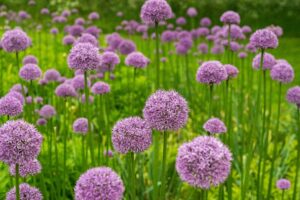
Alliums or Ornamental Onions are planted for their lovely, stiff, globe-shaped heads of flowers. Many gardeners, catalogues, and garden centers do not call them ornamental onions, but call them alliums – this is what I have aways called them.
The genus Allium also includes leeks, garlic, shallots, and onions – all of which are harvested for their bulbs and the bulbs are eaten by us. These beautiful, perennial, alliums/ornamental onions that I am discussing here are related to the onions, etc., that we eat – even their flowers are similar – but the allium/ornamental onion flowers are larger and more dense than the flowers of onions and garlic.
All alliums we grow for their flowers will be hybrids or varieties.
Light: Most alliums prefer full sun. I have three of the shorter, late-summer-blooming variety (see Bloom period and color. Deadheading.) and all are growing in part sun. All are doing well – the short, 8-inch flower stems are straight and upright. But with the taller varieties, remember that the more sun, the more the plants will stand straight and tall. The less sun, the more apt the taller plants are to lean towards the sun. All alliums look best when their flower stems are straight and upright – not slanting or leaning. Give them as much sun as possible. If you are planting the taller varieties in part sun, consider giving them support (more about this under Size).
Soil and water: Alliums are quite tolerant of all kinds of soil. The only thing that seems to be required is that the soil be well-drained. Alliums will rot in soil that stays wet.
Alliums can be purchased as plants in containers or as bulbs. If buying bulbs, the best time to plant is in fall – a few weeks before your frost date. Plants growing in containers can be planted in September or any time in spring or early summer
Hardiness Zone: Zones 3-8. The growing zone for individual hybrids can vary within this range of 3-8 so check the plant tag or the information online before purchasing to make sure the particular hybrid you have chosen fits the growing zone in which you are going to plant it.
Size: This varies from hybrid to hybrid and from variety to variety – check the plant tags or the information online to make sure the plant you are buying will work in the space you are providing. The size range is 10 to 36 inches tall and 10 to 18 inches wide. The tallest varieties of allium – 30-36 inches – should be staked or supported. If you live in a windy area, consider supporting any that are over 24 inches tall.
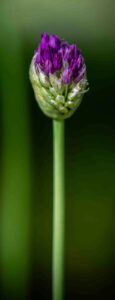
Bloom period and color. Deadheading: Color and bloom period depends on the variety. The traditional colors of alliums vary from pink to lavender to rose to purple to white. There are also blue and yellow alliums – plant hybridizers have been busy! The period in which the plant blooms will depend on which allium you are planting. Alliums are divided into three blooming periods (I am using botanical names so you have the exact allium. There may be different variety names added which does not change when they bloom):
Early – Spring to early summer:
Early blooming varieties, such as Allium karataviense and Allium neapolitanum, typically flower in mid to late spring – between April and May. These compact species feature soft pastel tones and lush foliage that goes very well with spring-blooming bulbs – like tulips and daffodils – and early perennials. In cooler climates, spring-blooming alliums last longer, while in warmer areas, the bloom period may end sooner due to increased heat.
Spring alliums generally bridge the gap between early bulbs and summer perennials. When planted alongside tulips or irises, they create smooth transitions from early spring to late spring. Once flowers fade, the seed heads can be left in place to add structure and texture to your garden or they can be collected for drying and then reseeding.
Mid-season – Summer:
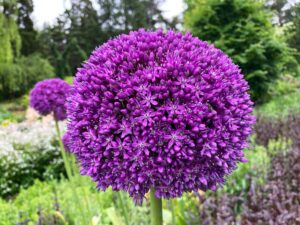
Allium giganteum, Allium christophii, and Allium hollandicum have noticeably taller stems than the earlier bloomers. These stems are topped with large, globe-shaped clusters that can reach up to ten inches wide. These alliums bloom from late May through July and create bold, spherical shapes of rich purples and lilacs. Their towering presence adds dimension and texture to flower beds, making them ideal companions for roses, salvias, and ornamental grasses. Hot summer days often intensifies their color. My advice is to stake or support the flower stems.
Late season – Late summer through fall:
Allium sphaerocephalon (the drumstick allium) and Allium senescens bloom between July and September. These later alliums tend to be shorter, smaller plants with smaller flower heads that are round to oval. They bloom in deep burgundy, magenta, or pink hues and add wonderful fresh color to gardens that tend to fade and look bedraggled and straggly during these months.
Deadheading and cutting back the plants: Fading flowers can be cut off at ground level, or flowers can be allowed to set seed or not – your choice. Some self-seed and some do not – it depends on the hybrid or variety. If they self-seed, they can be prolific, but not invasive. The seeds are heavy and so most often fall straight to the ground. You will find new plants around the parent plant – not all over your garden.
The varieties that bloom in spring may have foliage that begins to decline in July. Do not cut back this foliage until the foliage has completely died back and is brown. Remember, these plants grow from bulbs, and the leaves – even as they decline – are working to store much energy in the bulbs which the plants will use the following year. This is the same as with crocuses, tulips, daffodils and hyacinths. If you are planting the varieties which bloom in spring, plant them with annuals, perennials that bloom in mid-late summer, or plant them in the back of your garden to hide the declining foliage.
Divide your plants every 3-4 years by digging up a clump and carefully pulling it apart. Do this in early spring or after they finish flowering. If you are dividing spring bloomers in early summer, when you replant the clumps, make sure to keep them watered for several weeks. Replant the clumps at the same depth. Doing this will keep your plants fresh and will encourage them to produce lots of flowers.
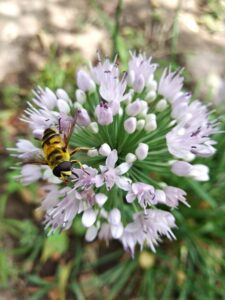
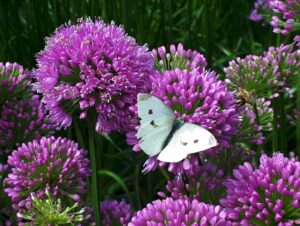
Butterflies and birds: Beneficial insects – especially native bees and small parasitic wasps – love these flowers.
Deer, rabbits, and other pests: Alliums have the same scents in their leaves as the onions we eat and so in most cases, rabbits and especially deer will avoid them. I have both rabbits and deer and neither have ever bothered my three plants. Alliums are generally not bothered by insects or diseases – their oniony smell is a deterrent. They even repel aphids!
What to plant with alliums: Keep in mind when your plants will bloom. If they bloom in spring and early summer their foliage will start to decline in July and August – this declining foliage often does not look neat and tidy. A plant going dormant can look like it is dying – not a pretty sight. So, plan for this foliage to be hidden by plants next to it that are now growing larger. In my experience, perennial geraniums – also called cranesbill – will hide the declining foliage fairly well. Salvia is another. Most annuals will help hide the declining leaves. In my research for this plant, catmint is recommended. An interesting choice would be lavender. Any bushy plant that is at least several inches shorter when the alliums are in full bloom should work – as the foliage of the allium declines, the bushy plant can grow as big and tall as you would like it to be.
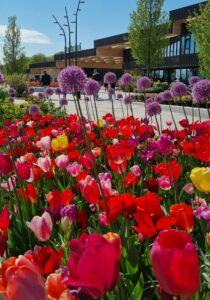
If you plant varieties of allium that bloom from July on, declining foliage will not be a problem – the foliage will decline when everything else in your garden is declining in preparation for winter.
How to use alliums: They can be used as single plants scattered throughout your flower garden, they can be planted in groups of 3 or more, or you can plant just one. Just make sure you know how tall your allium is expected to get so you know if it should be in the front the middle, or the back of your garden.
*spp. – This abbreviation is used after the botanical name of a genus and indicates that there are several to many species in the genus. This gets a bit confusing with alliums because ‘allium’ is not only the botanical/Latin name of the genus, but also – more often than not – the common name of all the plants in the genus. One way to determine how ‘allium’ is being used is that when the word has a capital letter and is italicized – Allium – it is being used as the genus. When it is not italicized and has no capital letter – allium – it is being used as the common name. However, one exception is this website. This website was built with Word Press and although Word Press allows me to do a lot of things, I cannot italicize a word in the title of anything on this part of the website. In a paragraph, yes. In a title, no. So, this title should have Allium ssp. written in italics – Allium ssp. I simply cannot do that. It’s always something, right?