

What we didn’t see in Charleston, SC ……
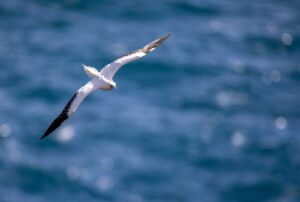
One of my favorite ocean birds is the Northern Gannet. Its winter range is in the ocean along the shorelines – from Maine
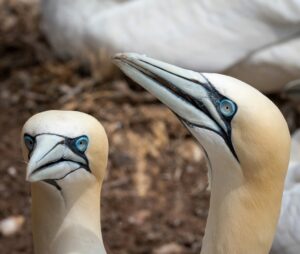
to the southern tip of Texas. In other words, all along the Atlantic and Gulf coasts. These are large birds – about 40 inches long, weigh about 6.5 pounds, and have a 6 ft. wingspan. All white with black wingtips and golden tints on their heads and necks. These are hard birds to miss.
Northern Gannets are generally in small flocks of a dozen or so to hundreds. And they make spectacular dives straight into the water where they are excellent underwater swimmers. Their favorite food is fish. In my blog of 11/5, you saw a photo I took of a fishing boat offshore and the dozens of birds surrounding it. This is always a good spot to look for gannets, but there were none – only Laughing Gulls and Brown Pelicans. We saw fishing boats offshore every day, so the fish were there. Just no gannets. Most field guides list them as ‘Common’ throughout their winter range. Partners in Flight* estimates the breeding population of Northern Gannets to be about 720,000 and stable. The reason we did not see any could be as simple as that even though 720,000 is a lot of birds – and these are big birds – their winter territory along both coasts is huge. The Charleston area is quite built up. Even though there are fishing boats, it may be there are simply better places for them to spend the winter. Places where they feel more comfortable – safe. But regardless of reason, we saw no gannets offshore anywhere in the Charleston, SC area the first week of this past November.
Click on this link to view a wonderful wildlife film by Robert Fuller. It is about 8 minutes long and filmed along the Yorkshire coast in England – one of the places Northern Gannets nest. You will also see Atlantic Puffins, Northern Fulmars, Razorbills, and Guillemots. There are several ads within the film which you can skip or watch – your choice. This filmmaker captured the beauty and grace of these magnificent birds: Northern Gannets
Black Scoters are harder to spot than Northern Gannets. They are much smaller and almost all black. They are about 20 inches long, 2 pounds, and with a wingspan of about 28 inches. However, they are most often in flocks, and the males do have a yellowish-orangish blob/knob on the top of their beaks. In my observation – and I have not seen many flocks – I have only seen these scoters on rockier shorelines. The shoreline of Charleston, SC is not rocky. That could be one reason why we did not see any of these birds. Another could be that the Cornell Laboratory of Ornithology** and the 2025 State of the Birds*** both state this bird is near its tipping point. That is based on the fact it has lost 50% of its population in the last 50 years. However, this species is showing signs of stabilizing. Right now, it is estimated there are about 900,000 of these scoters. They are considered by many wildlife groups to be ‘Near Threatened’. This bird’s winter range is all up and down both the Pacific and Atlantic coasts. Their main food in winter is mollusks and shellfish.
Here is a link to a video of a flock of Black Scoters at the Indian River Inlet in Delaware – shot by Matthew Herron. The video is about 5 minutes long and shows both males and females bobbing about like corks. Beautiful footage of this flock! Black Scoters
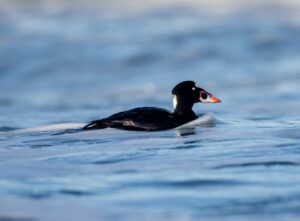
We also looked for Surf Scoters – relatives of Black Scoters. But again, even though these birds are listed as ‘Common’ on both the Atlantic and Pacific coasts, we did not see any. This scoter is also hard to spot. Another small black sea duck – slightly larger than the Black Scoter. The bill of this scoter is white with an area of orange/yellow on its top center and a round black spot on either side. It is distinctive, but you will only see it through binoculars or scope. What will be more obvious is the white forehead and the white wedge on the back of the neck. With either scoter, look for bobbing dark objects beyond the breaker line. One of their main foods in winter is mussels.
Here is a link to an 8-minute video by Liron Gertsom – shot in the waters of Vancouver, British Columbia. Besides Surf Scoters, you will also see Buffleheads, Barrow’s Goldeneyes and a Harlequin Duck. Surf Scoters
These three birds, plus many more, can be seen on all our coasts: Atlantic, Gulf, and Pacific. While they can sometimes be spotted with just your eyes, binoculars will make it easier, and a scope is even better. Most of these sea ducks and water birds are in flocks. Their foraging is always interesting and can be spectacular. You can also see these birds – again, generally in small flocks – flying over the water. This will often be fairly close to the water’s surface and can be anywhere from the waves coming into shore to the horizon line.
Remember, our coastlines can be wonderful birding spots – especially in winter. My favorites along the Atlantic Coast are Brigantine National Wildlife Refuge, Assateague National Seashore, and the Outer Banks – although the Outer Banks are getting more and more crowded with expensive homes right on or near the beaches and there are more and more restricted areas. If you have favorite places for watching ocean birds or waders of any species along the Gulf of Mexico or the Pacific coast, let me know and I will post them in a future blog. Just click on the Share Your Thoughts at the top of this blog.
Cleon and I are traveling again – leaving this Sunday, the 7th, for Louisiana. Besides spending some time in New Orleans, we will be birding at several national wildlife refuges west of that city. On the way home, we will be stopping at Wheeler National Wildlife Refuge in Alabama – one of our favorite spots. I am very much looking forward to this trip as I have never been to Louisiana and am looking forward to wonderful food, good music, and great birding! I will be posting!!!!
*Click here for more information on Partners in Flight. Partners in Flight
*Click here for more on the Cornell Laboratory of Ornithology. Cornell Laboratory of Ornithology
**Click here for more information on the State of the Birds. State of the Birds